

Most teams don’t need more traffic. They need more revenue from the traffic they already paid for. That is what conversion rate optimization services (CRO services) are built for: finding the biggest revenue leaks, fixing them fast, and proving the win with data.
This guide breaks down what real CRO services include, how to choose a conversion optimization agency or consultant, and what a modern conversion rate optimization program looks like when it is not just a “pretty PDF” audit. You will also see exactly how Plerdy runs a 30-day Conversion Accelerator Sprint with a “No-Fluff” money-back guarantee, and what you get at the end.
If you want a short version: CRO is not “opinions about buttons.” It is UX audit + CRO plus execution plus A/B testing services that validate what actually lifts conversion rate and revenue.
What Conversion Rate Optimization Services Include
Conversion rate optimization services are a structured process for improving how many visitors complete a business goal: purchase, demo request, signup, lead form, or upgrade. Good CRO services focus on outcomes and use behavior data to decide what to change.
Most CRO services include a mix of research, UX analysis, hypothesis writing, test execution, and measurement. The difference between average and excellent service is simple: do they ship and validate changes, or do they only report them?
Typical Components Of CRO Services
- Behavior research: heatmaps, scroll maps, click maps, session recordings, and funnel drop-off analysis to see where users hesitate or leave.
- UX audit + CRO review: clarity of the value proposition, friction points, content hierarchy, navigation, trust signals, forms, and mobile usability.
- Prioritized hypotheses: a ranked list of “what to test next” based on expected impact and effort.
- A/B testing services: building variations, setting goals, running tests long enough to be confident, and deciding winners with data.
- Implementation support: launching changes safely, validating tracking, and making winners permanent.
- Continuous monitoring: ensuring wins hold over time, especially after releases, redesigns, or traffic source changes.
How Plerdy Is Different From A Typical CRO Agency
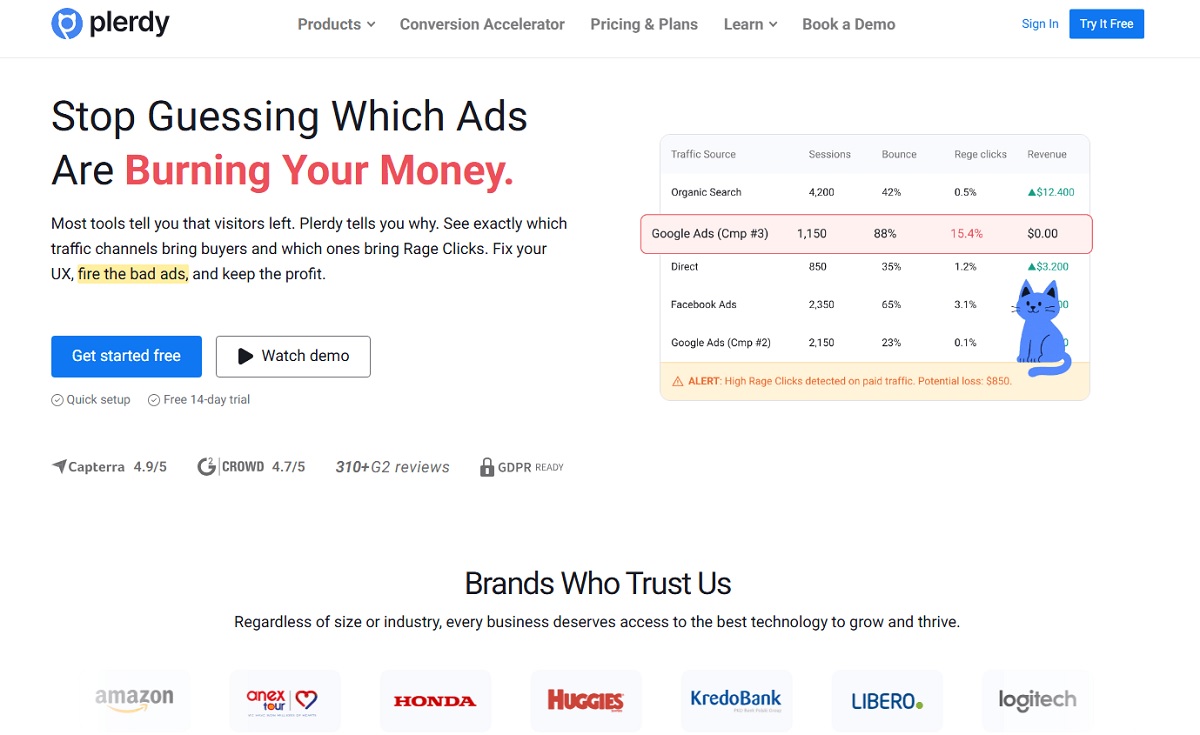
Many agencies sell “a CRO audit” that ends with slides. Plerdy is built around one idea: one stack from insight to outcome in a 30-day sprint. That stack is: behavior data → shipped fixes → validated wins.
- Not a “pretty PDF” agency audit: you do not pay for opinions. You pay for prioritized leaks, executed tests, and validated decisions.
- Less dev dependency: in many cases, changes can be implemented directly with Plerdy’s A/B tool using HTML, CSS, text, and layout edits.
- Proof-first mindset: winners stay, losers die. Decisions by data, not taste.
Plerdy is also recognized for its analytics and behavior tools. If you want proof beyond marketing claims, check the product feedback and ratings on G2. Many teams search for “top heatmap tools” because they want confidence in the data layer. Reviews help reduce risk.
Signs You Need CRO Services (Revenue Leaks Checklist)
If your traffic is growing but revenue is not, you are not “unlucky.” You likely have friction in the journey. Visitors do not wake up thinking they want to buy from your website today. They land, scan, scroll, and if something feels off, they leave.
Here is a practical checklist of common conversion killers. You do not need all of them to justify CRO services. One or two big leaks can be enough to justify a sprint.
Common Conversion Killers You Can Spot Fast
- Too many clicks before checkout: every extra step is a drop-off chance. Friction kills throughput.
- Unclear value proposition: users ask “What do I get here?” and your page does not answer in the first screen.
- Critical mobile usability gaps: small spacing, hidden CTAs, broken sticky elements, or slow interactions on mobile.
- Confusing or long forms: more fields, unclear error handling, and weak microcopy cost you leads and checkouts.
- Slow load: even small delays can hurt sales, especially on mobile and paid traffic landing pages.
Additional High-Impact Issues CRO Teams Often Find
- Weak trust signals: missing reviews, unclear returns, unclear security cues, or vague guarantees.
- CTA mismatch: the page headline promises one thing, but the button asks for something else.
- Hidden pricing or unclear packaging: users cannot compare options quickly, so they postpone the decision.
- Navigation confusion: users click around because they cannot find “the next step” on the page.
- Message dilution: too many competing banners, popups, or offers that split attention.
If you recognize these problems, you do not need a longer meeting. You need a structured plan, fast execution, and validation through A/B testing services. That is what real CRO services should deliver.
CRO Services vs CRO Audit: What Most Agencies Miss
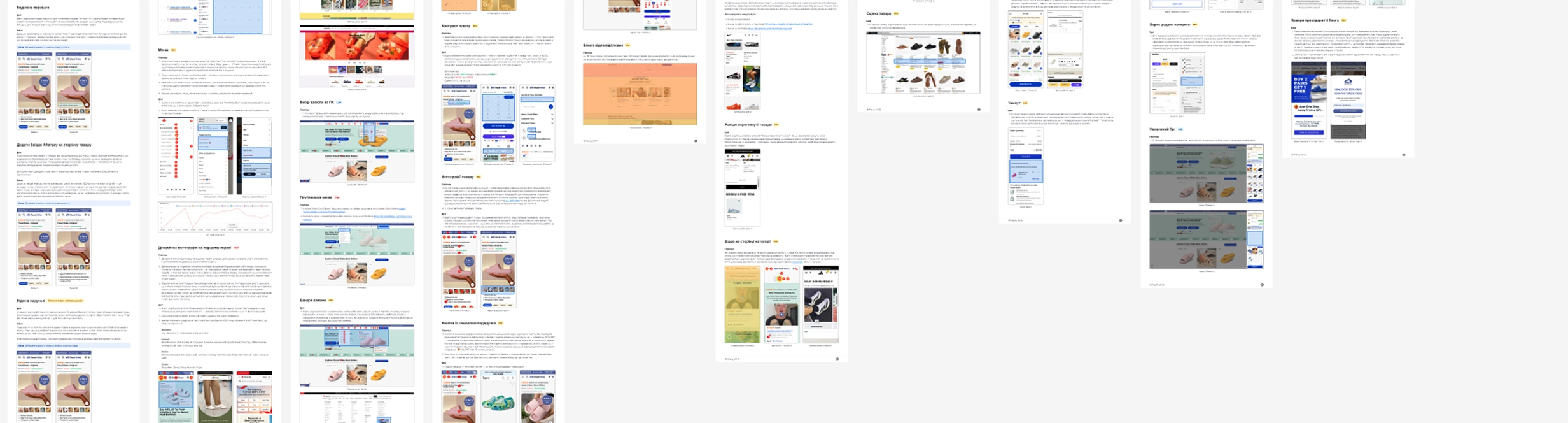
A CRO audit can be useful, but only if it is the start of execution, not the end. Many conversion optimization agencies deliver a slide deck, then leave your team with a backlog and no test plan. That is not a conversion rate optimization program. That is a report.
What A Slides-Only CRO Agency Audit Usually Looks Like
- One or two discovery calls
- Heuristic review with screenshots
- A long list of “recommendations” with no ROI prioritization
- No implemented variations
- No validated A/B test wins
- No hand-off that your team can actually ship quickly
What A Done-With-You Sprint Should Deliver Instead
Plerdy’s approach is built to avoid common pitfalls:
- Pitfall: too many “ideas” and no focus. Fix: prioritize by ROI and test feasibility.
- Pitfall: opinions about design. Fix: behavior data from heatmaps, funnels, and real sessions.
- Pitfall: no execution. Fix: build and launch test variations inside the sprint.
- Pitfall: no validation. Fix: run A/B tests and keep only winners.
- Pitfall: unclear ownership after the audit. Fix: hand-off playbooks, dev tasks, and QA verification.
If you are choosing a CRO consultant or a conversion optimization agency, ask one question: What happens after the audit? If the answer is “your team implements it later,” you are buying hope.
The Plerdy 30-Day Conversion Accelerator Sprint (Step-By-Step)
The Plerdy sprint is designed for teams that want validated wins quickly. It is a done-with-you conversion rate optimization program that combines UX audit + CRO analysis, prioritized hypotheses, implementation, and A/B testing services in one focused 30-day window.
Plerdy has limited capacity and accepts only a small number of sprint clients each month. That is not a marketing gimmick. The sprint includes hands-on execution, so bandwidth is real.
Step 1: Discover (Week 1)
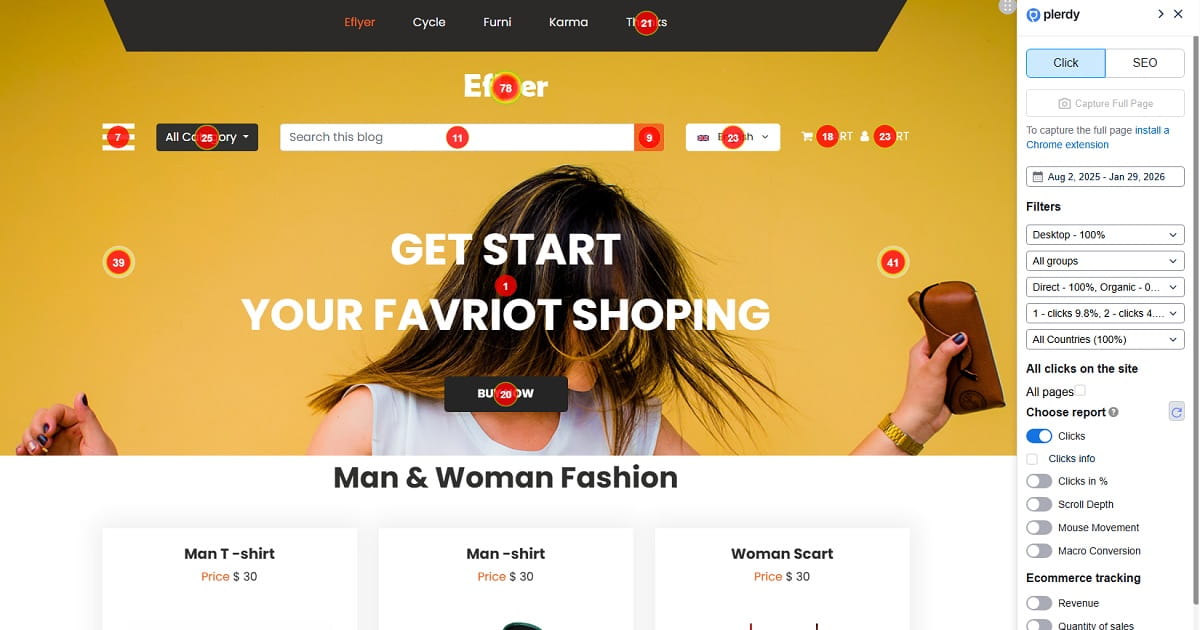
In Week 1, we find 5–15 revenue leaks using:
- Heatmaps and click behavior (what users try to click, and what they ignore)
- Session recordings (how real users get stuck)
- Funnels (where they drop off and where the loss compounds)
- Page-level UX review (clarity, hierarchy, trust, friction, mobile)
Then we prioritize leaks by ROI potential, not by personal preference. You get a clear shortlist of what to fix first.
Step 2: Implement And Build (Weeks 2–3)
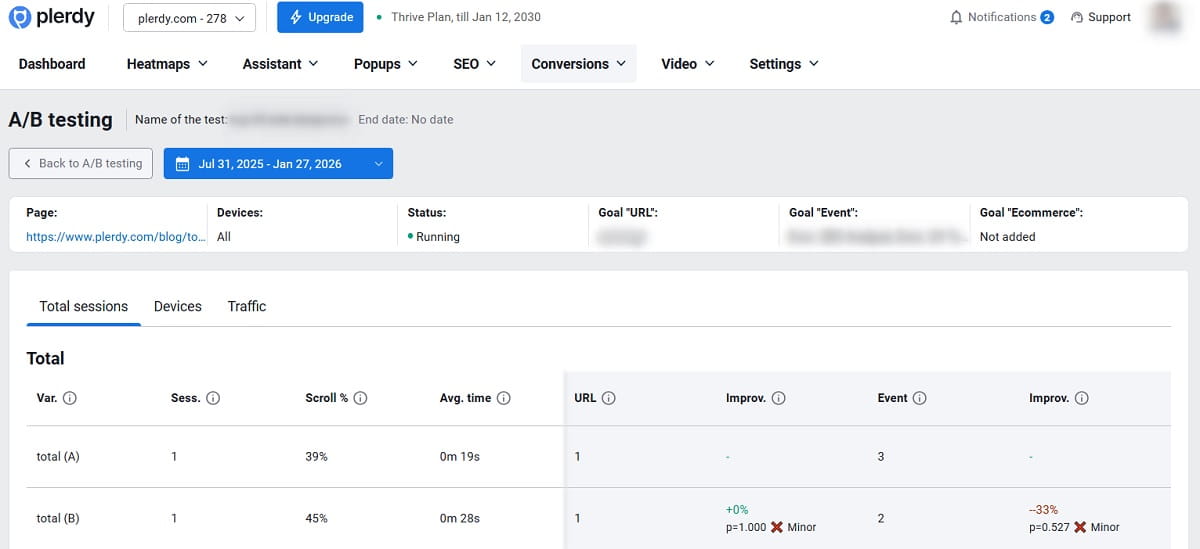
Weeks 2–3 are about shipping. We build test variations and launch them with Plerdy’s A/B tool. Most common CRO fixes can be implemented without heavy developer time, because the tool supports changes like:
- HTML edits (restructuring blocks, adding clarity sections, moving trust elements)
- CSS updates (spacing, visibility, hierarchy, mobile fixes)
- Text and offer changes (value proposition, CTAs, microcopy)
- Layout changes (CTA placement, form simplification, pricing comparisons)
For larger changes that require engineering (like a full redirect test on a new URL), we coordinate the work, create clear tasks, and keep scope tight so the sprint stays on track.
Step 3: Validate (Weeks 3–4)
Weeks 3–4 focus on validation. We run A/B tests inside Plerdy. Winners stay. Losers die. We do not “ship a guess.” We ship decisions by data.
We align metrics to your business model. For ecommerce, it might be conversion rate and revenue per visitor. For SaaS, it might be signup-to-activation or demo-to-close proxy metrics that you can measure within the sprint window.
Step 4: Hand-Off
At the end, you keep the wins, the playbooks, and the license. When a winning variation needs to be hard-coded permanently, Plerdy writes clear tasks for your developers and QA verifies the shipped version matches the tested winner.
The “No-Fluff” Money-Back Guarantee (How It Works)
Most CRO services come with soft promises and vague language. Plerdy uses a hard guarantee, because the sprint is built around execution and proof.
What The Guarantee Covers
- Objective condition: If we do not find and validate a measurable conversion lift in 30 days, you can request a 100% refund.
- Subjective condition: Even if we do find a win, but you honestly feel the work was just “fluff” you already knew, you can request a 100% refund.
- License included: In both cases, you keep a 12-month Plerdy Enterprise license for free.
What “Validate” Means In Plain English
Validation means at least one test result that is strong enough to make a real decision. We do not call a win based on vibes. We call a win based on measured uplift in your primary metric, supported by the test results.
The sprint is built to move fast, but still keep measurement honest. If a test does not reach a reliable conclusion in the sprint window, we do not pretend it did.
See If You Qualify For The Guarantee
What You Get: Deliverables, Tools, And Hand-Off
A conversion optimization agency should leave you with tangible assets you can use. Not just a document. Not just screenshots. Here is what the Plerdy sprint produces.
Deliverables You Can Actually Use
- Revenue leak map: the 5–15 highest-impact friction points found in Week 1, backed by behavior data.
- Prioritized hypothesis backlog: ranked by expected ROI and effort, with clear success metrics.
- Test plan: what we are testing, why, what changes, which pages, and what metric decides a winner.
- Built variations: multiple variants for key pages (HTML/CSS/text/layout) implemented through Plerdy’s A/B tool.
- Tracking notes: measurement setup notes, primary metric definitions, and guardrails to avoid false wins.
- Dev tickets: clear tasks to hard-code winning variants when needed.
- QA checks: verification that the live implementation matches the tested winner and does not break UX.
- Playbooks: reusable learnings so your team can repeat wins on other pages (PDPs, pricing, checkout, onboarding).
- 12-month Plerdy Enterprise license: included so you can keep monitoring and keep optimizing after the sprint.
Tools Used During The Sprint
- Heatmaps and behavior analytics: to see what users do, not what they say.
- Session recordings: to observe friction patterns, confusion, and hesitation points.
- Funnels: to quantify where drop-offs compound into revenue loss.
- Plerdy A/B testing tool: to build and validate variants quickly, often without developer help.
If you want to see what a CRO audit deliverable looks like in a visual, practical format, review the audit demo here.
Pricing, Value, And ROI Math (With A Simple Example)
CRO pricing gets confusing because some agencies sell time, some sell deliverables, and some sell “programs” that do not ship anything. The simplest way to evaluate pricing is to compare the cost of the sprint against the potential upside of even a small lift.
A Simple Revenue Math Example
Imagine your ecommerce store makes $50,000 per month with a 2% conversion rate. If you raise it to 3%, you do not just grow by 1%. You jump to $75,000 per month. That is +$300,000 per year.
That is why CRO services are not “nice to have” when you already have meaningful traffic. One extra percent can be big money.
Value Stack And One-Time Investment
Here is the pricing and value framing for the Plerdy 30-day sprint. These numbers are fixed as shown below.
- Audit: $1,250
- A/B Setup & Management: $850
- Implementation: $2,500
- 1-Year Plerdy Enterprise: $3,036
Total Value: $7,636
One-Time Investment: $3,036
If you want to reduce risk further, read what real users say about Plerdy on G2.
Mini Case Study: What A 30-Day Sprint Can Change
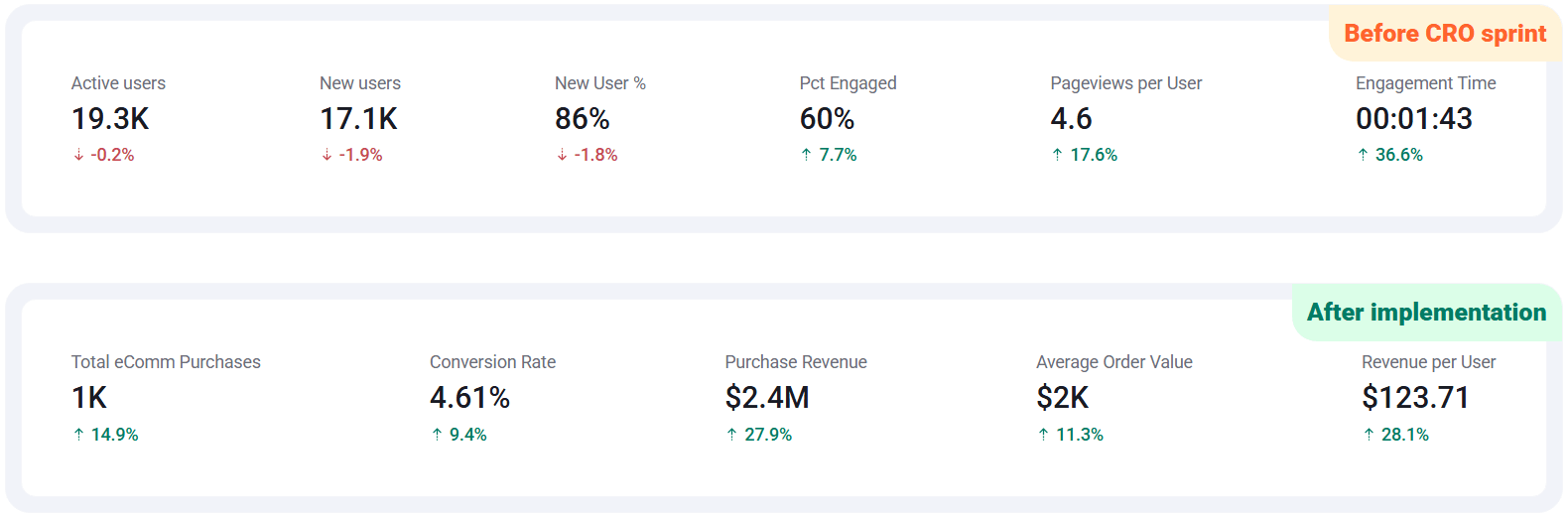
A sprint works best when you have enough traffic and conversions to measure change. When the testing power is there, small UX fixes can create outsized results.
What Changed In Plain English
- The team identified high-impact leaks and implemented focused fixes within the sprint window.
- The improvements were validated through testing and measurement, not just “best practices.”
- The case study shows a conversion rate that improved to 4.61% and a revenue lift shown in the results.
The key takeaway is not a single tactic. The takeaway is the process: discover with behavior data, ship changes quickly, validate with A/B testing, then keep the winners.
Who This Is For (And Who It’s Not For)
CRO services are not magic. They require enough traffic, enough conversions, and willingness to test. The fastest way to waste budget is to hire a conversion optimization agency, then block tracking, refuse experimentation, or delay approvals.
Who This Is For
- Ecommerce, SaaS, marketplaces, and service businesses with meaningful traffic and a clear conversion goal
- At least 20,000 sessions per month and at least 50 conversions per week
- Teams that want validated wins, not a “slides-only” CRO audit
- Teams that can approve test variations quickly so execution fits inside 30 days
- Organizations that are comfortable with experimentation and measurement (A/B tests ideally reaching 80% confidence/power or better when possible)
Who This Is Not For
- Sites below 20,000 sessions per month or below 50 conversions per week (testing may not be conclusive fast enough)
- Teams that refuse tracking, experimentation, or basic instrumentation
- Organizations that cannot give timely approvals and block shipping changes
- Teams looking only for a “UX audit PDF” without execution
If you are below the thresholds, you can still do CRO work, but a sprint with validation may not be the right format yet. In that case, focus first on fixing obvious friction and building reliable tracking.
FAQ: Answers Before You Even Ask
What are the requirements to qualify for the 30-day sprint and guarantee?
To qualify, you should have at least 20,000 sessions per month and at least 50 conversions per week, plus proper tracking access and the ability to approve test variations quickly. The sprint works best when you have enough volume to validate results with confidence, not just “best practice” opinions.
How long does the Conversion Accelerator Sprint take, and what happens each week?
It is a 30-day sprint. Week 1 is discovery: we identify 5–15 revenue leaks using heatmaps, session recordings, and funnels, then prioritize them by ROI. Weeks 2–3 are implementation and build: we create test variations using Plerdy’s A/B tool (often without developers). Weeks 3–4 are validation: we run A/B tests, keep winners, and drop losers. Then we hand off the playbooks, tasks, and the 12-month Enterprise license.
Do we need developers for CRO services and A/B testing services?
In many cases, no. Plerdy’s A/B tool can implement common changes directly with HTML, CSS, text, and layout edits. You may need a developer for complex scenarios like redirect tests to a new URL, deeper template work, or platform-specific constraints. When dev work is needed, Plerdy provides clear tickets and QA verification so the winning variant can be hard-coded safely.
We already use Google Analytics. Why do we need Plerdy for UX audit and CRO?
Google Analytics is strong for “what happened” (drop-offs, paths, conversion counts). Plerdy helps with the “why” by showing behavior: heatmaps, session recordings, and friction patterns. CRO improves faster when you can see what users tried to click, where they hesitate, and which elements distract from the next step.
What counts as fulfilling the “No-Fluff” money-back guarantee?
The objective part is simple: if we fail to find and validate a measurable conversion lift within 30 days, you can request a 100% refund. The subjective part is also clear: even if we find a win, but you honestly feel the work was “fluff” you already knew, you can request a 100% refund. In either case, you keep the 12-month Plerdy Enterprise license for free.
What does “validate” mean in A/B testing services during the sprint?
Validate means we do not call a win based on opinion. We run A/B tests and use the results to decide which version performs better on a primary metric like conversion rate or revenue per visitor. When the data supports a decision with practical confidence, we keep the winner and roll it forward. If a test cannot reach a reliable conclusion in the sprint window, we do not pretend it did.
What are the most common conversion killers you fix in conversion rate optimization services?
Common killers include too many clicks before checkout, unclear value proposition, mobile usability gaps, confusing or long forms, and slow load where even small delays can hurt sales. We also often see weak trust signals, CTA mismatch, hidden pricing clarity, navigation confusion, and pages with too many competing offers that split attention.
How is Plerdy different from a typical CRO agency audit?
A typical CRO audit often ends with a slide deck and a backlog your team may never ship. Plerdy’s done-with-you sprint is built around one stack: insight → shipped fixes → validated wins in 30 days. You get prioritized leaks, implemented variations, A/B testing, and a hand-off with playbooks, dev tasks, QA checks, plus a 12-month Plerdy Enterprise license.
Is Plerdy safe for privacy and compliance when using heatmaps and session recordings?
It can be safe when configured correctly. Sensitive inputs can be masked, and tracking can be aligned with consent practices and retention requirements. The goal is to analyze behavior patterns and friction, not to collect sensitive personal details. You control what is tracked and how it is handled in your environment.
What happens after we get a win in the sprint?
After a winner is validated, it should become permanent. If the winning variant needs hard-coding, Plerdy writes clear development tasks and QA verifies the final implementation matches the tested winner. You also keep the sprint learnings and playbooks so your team can repeat similar wins across key pages like pricing, product pages, checkout, or onboarding.
What tools are included, and where can I see proof or examples?
The sprint uses Plerdy heatmaps, session recordings, funnels, and the Plerdy A/B tool to build and validate variations. You can preview an example of the audit-style deliverable via the demo: https://www.figma.com/design/Wkyh7R6JaXrTV4psvxYs1N/CRO-DEMO-ENG?node-id=1-206&t=0cUWImUkVat9Z4CP-4. For third-party feedback, you can read G2 reviews here: https://www.g2.com/products/plerdy/reviews.
Conclusion: How To Get Started
If you are already spending on traffic, CRO services are often the highest-leverage way to increase revenue without increasing ad spend. But only if the work includes execution and validation, not just opinions.
The Plerdy 30-day Conversion Accelerator Sprint is built for teams that want a clear process: find 5–15 revenue leaks, prioritize by ROI, ship variations quickly, and validate wins with A/B testing. If we do not find and validate a measurable lift in 30 days, or if you honestly feel the work was fluff, you can request a full refund and still keep a 12-month Plerdy Enterprise license.
To preview what the deliverables look like, review the audit demo.