Most people browse property listings without contacting you because of hidden UX friction on your listing pages, overly long inquiry forms, slow mobile galleries, and missing trust signals—not because they are uninterested in buying or selling. According to Ruler Analytics, the average real estate website conversion rate sits at just 2.8%, which means roughly 97 out of every 100 visitors leave without booking a viewing, requesting a valuation, or calling your office.
If you own a brokerage, agency, or development firm, pouring more budget into paid ads rarely fixes a leaky website. Before buying another click, install Plerdy – an all-in-one conversion rate optimization platform combining website heatmaps, form analytics, behavioral popups, session replay, and Plerdy MCP for ChatGPT and Claude. Within a single day of traffic, you can see exactly where high-intent property buyers hesitate, which form field makes them quit, and which fixes will generate more qualified leads from the visitors you already pay to attract.
In this guide:
- Why Do People Browse My Property Listings But Never Contact Me?
- What Is a Good Real Estate Website Conversion Rate in 2026?
- How to Get More Leads From a Real Estate Website: 7 High-Impact UX & CRO Fixes
- Best Conversion Optimization Tools for Real Estate Websites (2026)
- Ask Your Real Estate Website Data via Plerdy MCP
- Frequently Asked Questions About Real Estate Website Conversion
Why Do People Browse My Property Listings But Never Contact Me?
Visitors leave property listings without reaching out for five concrete reasons: high-friction inquiry forms, vague or buried calls to action, clunky mobile search filters, missing social proof on individual property pages, and inflated traffic numbers distorted by non-human bots. Until you observe how real buyers interact with your listing pages, you are guessing where your marketing budget is leaking.
For a business owner, the math behind real estate website conversion is far more forgiving than the math behind paid acquisition. Real estate pay-per-click clicks are expensive, and scaling ad spend on an unoptimized site simply multiplies your cost per lead. Doubling your conversion rate on existing traffic, by contrast, lowers your acquisition cost immediately and adds high-margin commission revenue without increasing your ad budget.
The table below illustrates how improving your website conversion rate from 1.5% to 3.5% impacts a brokerage receiving 5,000 monthly visits. Commission and lead-to-close percentages vary by market—plug your own average commission and closing rate into this model to estimate your brokerage’s upside:
| Business Metric | Unoptimized Site (1.5% CR) | CRO-Optimized Site (3.5% CR) | Net Monthly Difference |
|---|---|---|---|
| Monthly Website Visits | 5,000 | 5,000 | $0 extra ad spend |
| Qualified Website Leads (Visitor → Lead) | 75 leads | 175 leads | +100 leads / month |
| Closed Deals (Illustrative 2.5% Lead → Close) | 1.88 deals | 4.38 deals | +2.50 deals / month |
| Gross Commission (Illustrative $9,000 / Deal) | $16,875 | $39,375 | +$22,500 / month |
Even if your brokerage closes just one extra transaction per quarter from fixing listing-page drop-offs, a conversion platform pays for itself dozens of times over. The bottleneck is rarely a lack of demand—according to the National Association of REALTORS® 2026 Profile of Home Buyers and Sellers (reported by Florida Realtors), 90% of buyers and a record 92% of sellers still work with an agent or broker. Consumers research online first, then choose the brokerage that makes taking the next step effortless and trustworthy.
How to diagnose the exact leak without guessing: Standard analytics platforms tell you that 400 people viewed a $750,000 listing and only 3 submitted a form—they never tell you why the other 397 walked away. Opening that same page in Plerdy Website Heatmap Tool reveals the behavioral story immediately: click maps expose non-clickable floor plans or photos getting dead clicks, scroll-reach layers show whether visitors ever see your inquiry form, and automated behavior signals flag rage clicks, U-turns, and mobile pinch-zooming per 100 sessions.
What Is a Good Real Estate Website Conversion Rate in 2026?
A solid overall real estate website conversion rate in 2026 is 2.8% or higher across all traffic channels, with paid search averaging 3.7% and organic search averaging 2.4%. However, owners should never judge every page by a single sitewide number—an instant home valuation page should convert significantly higher than an educational neighborhood blog post.
To benchmark your brokerage against real tracked data rather than agency guesses, review the 2026 real estate channel averages published by Ruler Analytics (based on over 110 million sessions and 5 million tracked form submissions and phone calls across 13 industries, also summarized in their industry conversion benchmark study):
| Traffic Channel | Real Estate Average Conversion Rate (2026) | What This Means for Brokerage Owners |
|---|---|---|
| Paid Search (PPC) | 3.7% | Highest-intent channel, but expensive if landing pages leak leads |
| Email Marketing | 2.6% | Strongest channel for nurturing long 3–12 month buying cycles |
| Referral Traffic | 2.5% | Visitors arriving from property portals, directories, and reviews |
| AI Referral Traffic (ChatGPT, Perplexity) | 2.5% | Growing high-intent channel that already outperforms organic search |
| Organic Search (SEO) | 2.4% | Compounding traffic; depends heavily on local neighborhood intent |
| Direct Traffic | 1.9% | Returning visitors and brand searches checking active listings |
| Paid Social | 1.3% | Discovery traffic; requires soft lead magnets or quizzes, not hard forms |
| Organic Social | 0.9% | Top-of-funnel awareness; rarely converts on the first visit |
| All Channels Average | 2.8% | Baseline target; optimized brokerages push beyond 4%–5% |
Two nuances matter when you review these numbers with your marketing team:
- Separate visitor-to-lead from lead-to-client conversion: Your website is responsible for turning visitors into inquiries, viewing bookings, and phone calls (visitor-to-lead). Your sales team and CRM speed-to-lead are responsible for turning those inquiries into signed agreements (lead-to-client). Classic research from Harvard Business Review (“The Short Life of Online Sales Leads”) demonstrated that firms contacting an online lead within one hour are nearly seven times more likely to qualify it than firms waiting just one hour longer.
- Segment by page type and traffic quality: IDX property search pages, home valuation calculators, and neighborhood market reports naturally convert at much higher rates than top-of-funnel blog articles. Meanwhile, bot crawlers and AI scrapers can inflate session counts and make your conversion rate look artificially low. In Plerdy, you can inspect Traffic Value and channel-level goals—including AI referral traffic—to see which specific pages and campaigns generate real inquiries and which ones burn budget. If you are still building your acquisition foundation, pair this guide with our real estate SEO guide and digital marketing for real estate guide.
How to Get More Leads From a Real Estate Website: 7 High-Impact UX & CRO Fixes
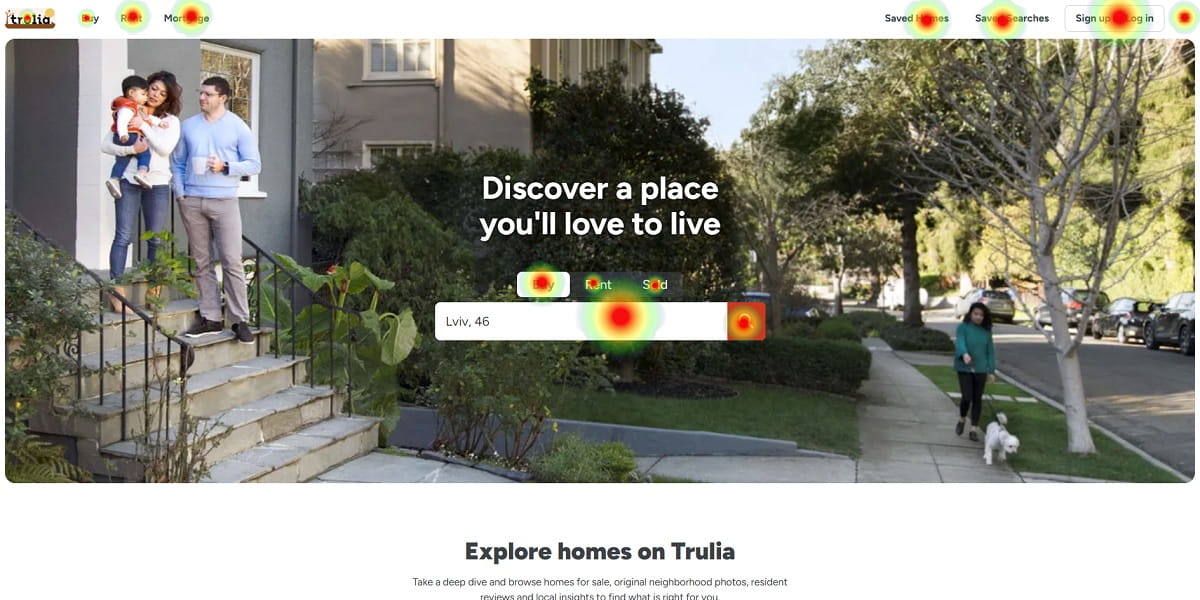
To get more leads from a real estate website, fix the seven highest-friction conversion leaks in order of revenue impact: listing-page dead zones, form-field abandonment, leaving browsers with no soft capture, slow mobile search filters, generic CTA copy, missing listing-level trust signals, and untracked funnel drop-offs. You rarely need an expensive redesign—targeted behavioral fixes deliver faster ROI.
1. Fix Dead Zones on Property Listing Pages Using Heatmaps
Your individual property listing page is where buying intent peaks, yet most brokerages design it like a static brochure. Common revenue leaks include unclickable photo thumbnails that trigger frustrated taps, buried floor plans, oversized hero images that push the viewing request form below the fold, and distracting third-party widgets that pull buyers off your site.
How to check it in Plerdy: Open your top 10 most-visited property pages in Plerdy Website Heatmap Tool. Check the Attention layer to see what percentage of visitors actually scroll down to your inquiry form and neighborhood details. Next, review Behavior Signals for dead clicks on photos or price badges and inspect mobile Swipe Maps to see whether shoppers interact with your image carousel or abandon it after the second slide.
What to fix: Make every photo and floor plan expandable on tap, place a sticky or above-the-fold viewing CTA next to the price summary, and include full upfront property facts (total price, HOA/maintenance fees, square footage, parking, school district). If you invest in 3D walkthroughs, prioritize them on flagship listings—Matterport research indicates that properties featuring 3D virtual tours receive 49% more qualified leads than listings with standard photos alone. There is no universal public benchmark for moving a CTA block higher on a specific brokerage theme, so measure your baseline scroll reach in Plerdy and validate the layout change with Plerdy’s built-in free A/B testing.
2. Eliminate Form Abandonment With Field-Level Form Analytics
Most real estate websites ask for too much too soon. Asking a first-time browser for their first name, last name, email, phone number, budget range, pre-approval status, preferred move-in date, and a free-text message before they have even seen a floor plan guarantees high form abandonment. Worse, many broken validation rules—such as strict phone number formatting on mobile—silently block motivated buyers from submitting.
How to check it in Plerdy: Enable Plerdy Form Analytics. Plerdy automatically detects every contact, viewing-request, and valuation form on your site as soon as visitors interact with a field—no manual developer setup per form required. Within days, you will see exact field-by-field metrics: how many visitors opened the form, started typing, hit a validation error, hesitated on a slow field, or quit altogether. Click any high-abandonment field to launch filtered Session Replay videos of the exact visitors who gave up there.
What to fix: Strip initial inquiry forms down to three or four essential fields (Name, Email or Phone, and Preferred Viewing Time or Intent). Make phone numbers optional on early-stage downloads, replace clunky dropdowns with one-tap buttons, and place a compact inquiry form directly on every property listing page so buyers never have to hunt for a separate “Contact Us” page. Plerdy’s free plan tracks 2 forms for 30 days, while paid plans starting at $21/month (billed yearly) scale up to 5–30+ forms with extended history.
3. Capture Leaving Browsers With Behavioral & Quiz Popups
Because real estate is a high-stakes financial decision, the vast majority of your visitors are in research mode during their first session. If your only conversion option is “Schedule a Showing Today,” you lose 95%+ of future buyers and homeowners who are three to six months away from transacting—and most of them will return to a national portal instead of your brokerage.
How to check it in Plerdy: Review your exit pages and scroll-depth reports in Plerdy to identify high-traffic neighborhood pages, mortgage calculators, and listing search results where visitors spend over 45 seconds before closing the tab without converting.
What to fix: Deploy targeted, behavior-triggered offers using Plerdy Pop-Up Software instead of paying for a separate popup subscription. Plerdy includes 20+ display rules (exit-intent, scroll percentage, time on page, specific URL patterns, and traffic source) plus built-in Quiz Popups. High-converting real estate angles include:
- Seller exit-intent popup: Triggered on market report pages—“Thinking of selling in [City]? Get a free local home valuation in 60 seconds.”
- Buyer property-finder quiz: A 3-step interactive quiz (Budget → Bedrooms → Neighborhood) that emails matching off-market and MLS listings.
- Price-drop alert trigger: Shown after a visitor views 3+ listings in the same area—“Want instant alerts when homes in this neighborhood drop in price?”
4. Optimize Mobile Property Search, Filters, and Load Speed
Buyers routinely browse properties on their phones during evenings and weekends, yet real estate websites are notoriously heavy due to uncompressed listing photos, embedded Google Maps, and third-party IDX scripts. Every fraction of a second costs you real inquiries: in the Milliseconds Make Millions study by Google and Deloitte (full report at Deloitte), even a 0.1-second improvement in mobile site speed was associated with an 8.3% reduction in bounce rate on lead-generation informational pages, alongside measurable conversion lifts across retail (+8.4%) and travel (+10.1%).
How to check it in Plerdy: Filter Plerdy Session Replay specifically for Mobile sessions that lasted under 30 seconds or triggered rage clicks. Simultaneously check Plerdy’s Error Tracking Tool to catch JavaScript, 404, or 5xx errors that silently break mobile IDX filter drawers or “Book Viewing” buttons—ranked by the number of affected visits.
What to fix: Convert property galleries to next-gen WebP format with lazy loading for below-the-fold images, keep mobile filter controls accessible with one thumb (Location, Price Range, Bedrooms, Property Type in a single clean drawer), and ensure tap targets and form inputs never require pinching or horizontal scrolling. Pair your mobile UX fixes with fast server caching and a CDN.
5. Replace Generic “Contact Us” Buttons With Intent-Driven CTAs
Vague buttons like “Submit,” “Contact Us,” or “Learn More” force visitors to guess what happens next—will an aggressive salesperson spam their phone in two minutes, or will they receive a floor plan PDF? Specific, low-friction CTA copy removes that uncertainty and aligns with the visitor’s exact stage of intent.
| Weak, Generic CTA | Stronger, Intent-Driven Real Estate CTA | Best Page Placement |
|---|---|---|
| Contact Us | Book a Private Viewing | Above the fold on individual property listings |
| Submit | Get My Free Home Valuation | Seller landing pages and local market reports |
| Learn More | See Floor Plan & HOA Breakdown | Mid-content inside property descriptions |
| Sign Up | Send Me New Listings Under $600K | IDX search results and neighborhood pages |
| Call Us | Chat With a Local Agent on WhatsApp | Sticky mobile footer bar |
How to check and prove it in Plerdy: Never debate button wording in meetings. Use Plerdy’s A/B Testing Tool (unlimited experiments included even on the free plan) to test a specific CTA against your current control on live traffic. Plerdy calculates statistical significance (p-value) automatically so you only roll out winners backed by real lead volume.
6. Place Social Proof and Agent Profiles Directly on Listing Pages
Many visitors land directly on an individual property page from Google Search, paid ads, or a shared link—they never see your homepage or your “About Us” page. If that listing page looks anonymous, hesitant buyers will close your tab and look up the same address on a major portal.
How to check it in Plerdy: Use Plerdy’s Click Map and Visitor Paths report to see how many users leave a property page to check your “About Us” or “Reviews” page—and how many never return to book a viewing.
What to fix: Embed trust directly next to every listing’s inquiry form. Include a real photo of the assigned agent, their local transaction specialty, a short one-sentence bio, direct phone/WhatsApp options, and 2–3 verified client testimonials (pulled from Google Reviews or Trustpilot) from buyers or sellers in that exact neighborhood. Humanizing the listing page aligns directly with the NAR 2026 finding that 90%+ of buyers and sellers want trusted human representation.
7. Track the Full Funnel From Listing View to Booked Viewing
Without a visual conversion funnel, you cannot tell whether your biggest drop-off happens between the homepage and property search, between search results and listing pages, or between opening a listing and submitting the inquiry form.
How to check it in Plerdy: Build a 4-step funnel in Plerdy Website Funnel Analysis: Homepage / Neighborhood Page → Property Listing Page → Inquiry Form Start → Thank-You / Calendar Confirmation. Add no-code Event Tracking on click-to-call phone numbers, WhatsApp buttons, and mortgage calculators so every micro-conversion is counted accurately—not just form fills. Once your on-site funnel is airtight, you can confidently scale top-of-funnel acquisition using our real estate lead generation ideas.
Best Conversion Optimization Tools for Real Estate Websites (2026)
The best conversion optimization tool for a real estate business owner in 2026 is an all-in-one platform that combines behavioral diagnostics (heatmaps, session replay, form analytics) with on-site lead capture (popups, A/B testing) so you do not have to manage and pay for four disconnected subscriptions. Below is a verified 2026 comparison of active standalone platforms—all pricing and statuses checked directly against official vendor pages in November 2026.
| Tool | Starting Price (2026) | Best For | Behavior & Form Analytics | Popups, A/B Tests & MCP |
|---|---|---|---|---|
| Plerdy | Free plan; paid from $21/mo (billed yearly) | Real estate owners wanting CRO, lead capture, SEO & AI analytics in one login | Heatmaps (click, scroll, attention, swipe), Session Replay, Field-Level Form Analytics, Funnels, Error Tracking | Built-in Popups & Quizzes, Unlimited A/B Tests, SEO Checker, Plerdy MCP (Claude & ChatGPT) |
| Microsoft Clarity | Free (no traffic cap) | Zero-budget starter heatmaps & session recordings | Click/scroll heatmaps, Session Replay, rage/dead clicks (no field-level form analytics) | Clarity MCP; no popups, no A/B testing, no SEO checks |
| Mouseflow | Free (500 sessions/mo); Essential from $25/mo (billed yearly) | Teams focused on funnels & form friction | Heatmaps, Session Replay, Funnels, Form Analytics | No built-in popups, no A/B testing, no SEO checks, no MCP |
| Crazy Egg | 30-day free trial; paid from ~$29/mo (billed yearly) | Small teams wanting simple page snapshots & basic tests | Heatmaps, snapshots, recordings, basic error tracking | Basic A/B testing; no full popup quiz suite, no SEO audit, no MCP |
1. Plerdy
Plerdy is the strongest all-in-one conversion optimization platform for real estate agencies, brokerages, and property developers that want measurable lead growth without juggling separate tools for heatmaps, popups, form tracking, A/B tests, and technical SEO. With one lightweight script (or the official WordPress plugin), Plerdy installs in about five minutes and begins collecting behavioral data the same day.
- Why real estate owners choose it: You get Website Heatmaps (clicks, scroll reach, hover time, mobile swipe maps, and frustration signals), automatic Form Analytics with one-click session recordings per abandoned field, Pop-Up & Quiz Software with 20+ behavioral triggers, unlimited A/B testing (even on the free tier), Conversion Funnels, JavaScript Error Tracking, an automatic SEO Checker synced with Google Search Console, and Plerdy MCP for asking AI assistants directly about your site’s performance.
- 2026 pricing: Forever-free plan with no credit card required (100 heatmap page views/day on up to 3 pages, 2 forms in Form Analytics for 30 days, 500 session recordings, 100 popup views/day, and unlimited A/B tests). Paid plans start at $21/month billed yearly, scaling cleanly from Startup to Scale, Thrive, and Enterprise as your listing traffic grows.
- Honest trade-off: Plerdy is a website CRO, UX, and SEO platform—it does not replace your real estate CRM (such as Follow Up Boss or Street CRM) or your MLS/IDX feed provider. Instead, it sits on top of your existing website to double the number of leads entering your CRM.
2. Microsoft Clarity
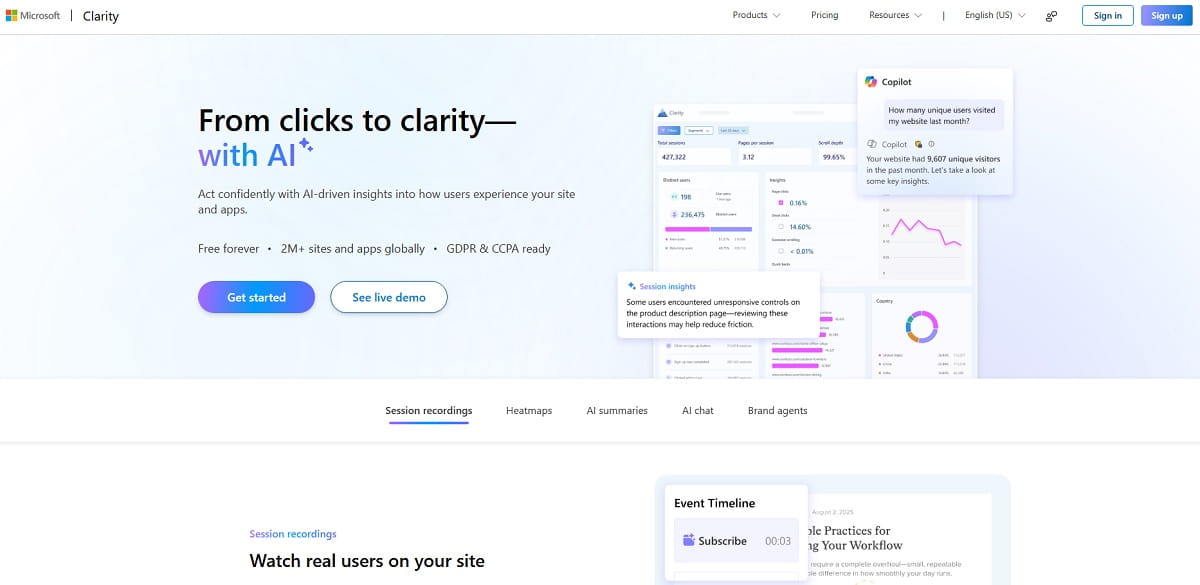
Microsoft Clarity is a solid zero-cost entry point if you only need basic click maps, scroll heatmaps, and unlimited session recordings. It also offers an official Clarity MCP integration and AI session summaries.
- Best for: Solo agents or early-stage sites with zero software budget who want quick visual diagnostics.
- Key trade-off: Clarity stops at observation. It does not offer field-level form abandonment analytics, exit-intent or quiz popups, built-in A/B testing, or on-page SEO monitoring—meaning you will still need two or three extra paid tools to capture and test more leads.
3. Mouseflow
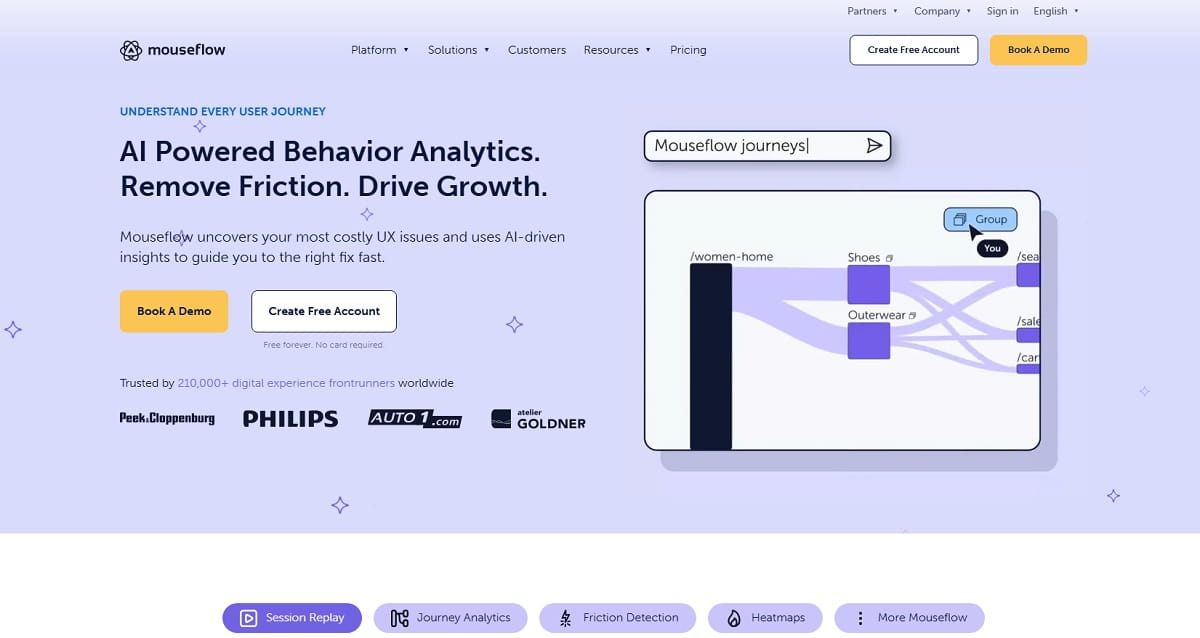
Mouseflow is a mature behavioral analytics platform offering heatmaps, session replay, conversion funnels, and field-level form analytics. Its forever-free plan covers 500 sessions per month on one website, with paid Essential plans starting at $25/month (billed yearly) for 5,000 sessions.
- Best for: Marketing teams that already own separate popup and A/B testing software and want dedicated form and funnel friction reports.
- Key trade-off: No built-in lead-capture popups, no native A/B testing, and no SEO audit layer—creating higher total stack costs for brokerage owners compared to Plerdy.
4. Crazy Egg
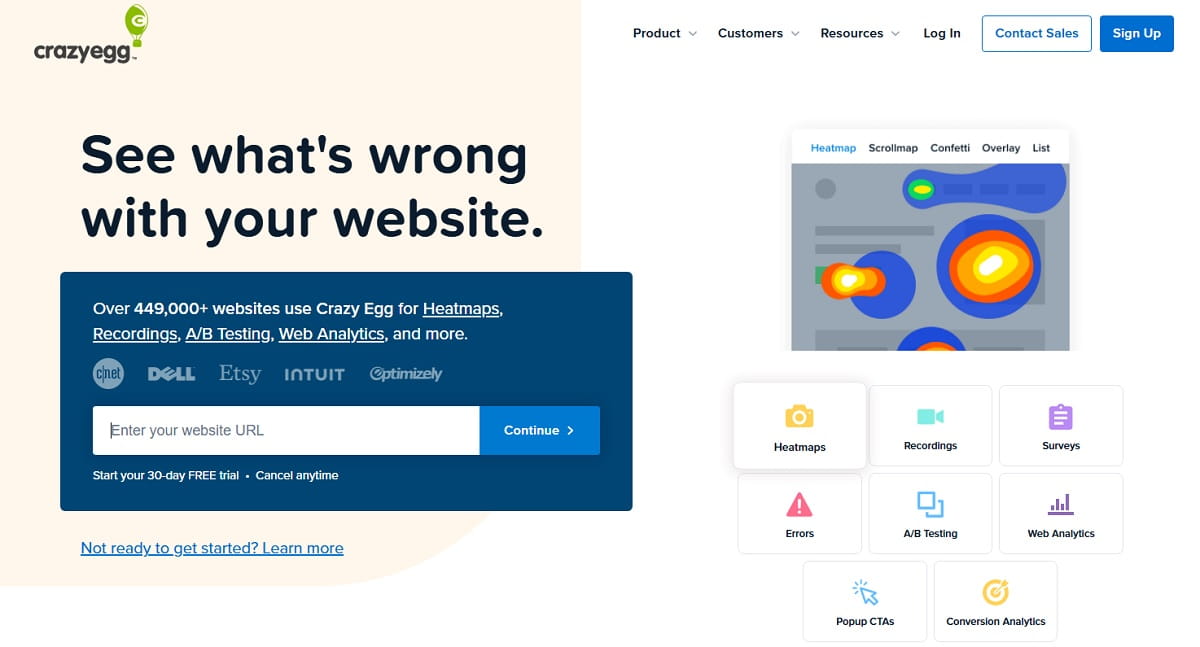
Crazy Egg focuses on straightforward visual snapshots, scrollmaps, recordings, and basic A/B tests. It offers a 30-day free trial with paid plans starting around $29/month billed yearly.
- Best for: Small brokerage teams that want simple snapshot comparisons of landing page layouts.
- Key trade-off: No permanent free plan, no MCP connector for AI-assisted reporting, and no integrated technical SEO checker.
Important 2026 Market Update (Merged & Sunsetting CRO Tools): Before committing your agency to a tool recommended in older blog posts, check vendor status. The CRO market consolidated heavily across 2025–2026: Hotjar was folded into Contentsquare and no longer operates as an independent signup; Smartlook is on Cisco’s End-of-Life path with server shutdown scheduled for August 31, 2027; and VWO and AB Tasty merged on September 16, 2026 under the Wingify brand. Choosing an active, independent all-in-one platform like Plerdy protects your workflow from forced migrations and surprise enterprise repricing.
Ask Your Real Estate Website Data via Plerdy MCP

Most real estate business owners do not have two hours every Monday to click through analytics dashboards—and with Plerdy MCP Server, you do not have to. You can connect your Plerdy account directly to ChatGPT or Claude in minutes (follow our step-by-step MCP setup guide) and ask plain-English questions about your listings, forms, traffic sources, and SEO issues.
Plerdy MCP exposes 12 read-only reporting tools covering heatmaps, page elements, session timelines, form drop-offs, funnels, errors, traffic channels, and Google Search Console data. Because the connection is strictly read-only and no visitor personal data leaves Plerdy, your AI assistant can pinpoint revenue leaks and link you straight to the exact session recordings or heatmap reports without ever risking unauthorized site changes.
3 ready-to-use Plerdy MCP prompts for real estate business owners:
- Find leaking high-traffic listings: “Which property listing pages had the highest traffic over the last 30 days but the lowest inquiry form completion rate, and what UX signals (rage clicks, dead clicks, low scroll reach) show up on those pages?”
- Pinpoint mobile form abandonment: “Where do mobile visitors quit our ‘Book a Viewing’ and ‘Free Home Valuation’ forms? Show me the exact field with the highest drop-off rate and give me links to the session recordings.”
- Cut wasted ad spend immediately: “Which paid ad channels or landing pages brought sessions in the last 30 days with zero lead conversions, and are there JavaScript or mobile UX errors blocking submissions there?”
Instead of waiting for a monthly agency PDF that only reports clicks and impressions, you get a two-minute executive briefing every week—complete with exact pages and fixes your team can ship the same afternoon.
Frequently Asked Questions About Real Estate Website Conversion
Why do people browse my property listings but never contact me?
Most property visitors leave without inquiring because of hidden UX friction: long contact forms, slow mobile photo galleries, vague “Contact Us” buttons, missing agent trust signals on listing pages, or broken search filters. Using Plerdy Heatmaps and Form Analytics reveals the exact page element or form field where prospects drop off.
What is a good conversion rate for a real estate website in 2026?
According to Ruler Analytics, the average real estate website conversion rate is 2.8% overall—ranging from 3.7% on paid search and 2.4% on organic search to 2.5% on AI referral traffic. High-intent pages such as instant home valuation calculators typically convert higher than top-of-funnel neighborhood blog posts.
How can I find out which form field makes real estate leads quit?
Standard traffic analytics only show page views and completed submissions. Field-level tools like Plerdy Form Analytics automatically detect your viewing and valuation forms, track abandonment and validation errors per field, and link directly to session recordings of visitors who stopped halfway.
Do popups work on real estate websites without annoying buyers?
Yes, when triggered by user behavior instead of firing immediately on arrival. Exit-intent valuation offers, saved-search price-drop alerts, and short 3-step property-finder quizzes built with Plerdy Pop-Up Software capture undecided browsers who would otherwise leave your listings and never return.
How fast can a real estate business see results from conversion optimization?
Installing Plerdy takes about 5 minutes, and heatmaps plus form drop-off reports appear the same day as visitors browse your listings. Fixing high-friction leaks—such as broken mobile search filters or overly long viewing forms—typically produces measurable lead lifts within 2 to 4 weeks, which you can verify using Plerdy’s built-in A/B testing.
Stop Losing Qualified Property Leads to Fixable UX Friction
You already did the hardest and most expensive part of real estate marketing: getting motivated local buyers and sellers onto your website. Every broken mobile filter, invisible viewing button, and 9-field inquiry form silently hands those commissions to competing brokerages and national portals.
Create a free Plerdy account today (no credit card required, 5-minute setup) to launch heatmaps, form analytics, session replay, and behavioral popups on your top property pages—or unlock full multi-form tracking and Plerdy MCP starting at $21/month billed yearly so your team turns existing traffic into booked viewings.