

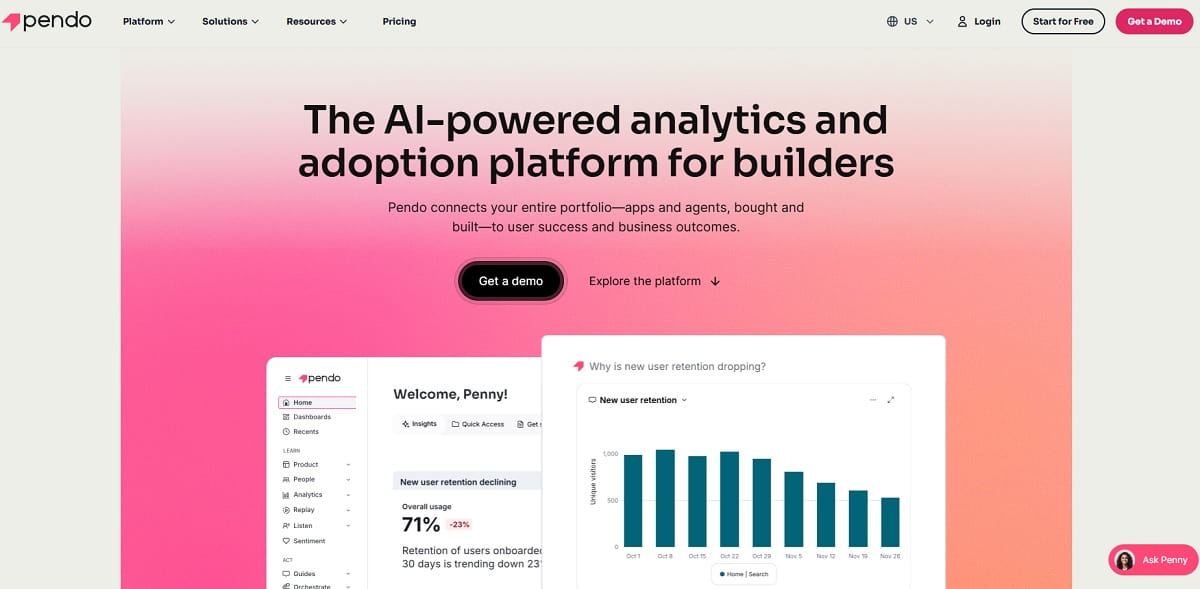
Pendo built the category most people now call software experience management: product analytics, in-app guides, session replay, NPS and sentiment surveys, and roadmapping, all behind one snippet. It works. The problem is what it costs and how it is sold. Pendo does not publish paid pricing at all, and procurement data from Vendr puts the median Pendo contract at $49,000 per year, with real deals landing anywhere between $18,335 and $151,741 across 580 tracked purchases. That is the number that sends most teams looking for Pendo alternatives.
This guide is built from primary sources. Every price, limit and product status below was checked against the vendor’s own pricing page, documentation or newsroom in 2026 — not against last year’s listicles, which is why several of them are now wrong. We start with Plerdy, because the most common mistake in a Pendo replacement is buying another guidance platform when the actual gap is evidence: teams know what users clicked and still have no idea why they dropped. Plerdy covers that layer — heatmaps, session recordings, conversion funnels, event tracking and on-site surveys — starting free and topping out at $253 per month, which is roughly what a mid-size Pendo contract costs per week.
After Plerdy we work through the full-platform replacements, the digital adoption platforms, the pure product analytics engines, and the session replay tools — sorted by the job you are actually replacing, because “Pendo alternative” means five different products depending on which half of Pendo you use.
Pendo Alternatives At a Glance
The short answer: if you need behavioral evidence and feedback on a web product without an enterprise contract, use Plerdy. For the closest full-platform swap, use Amplitude or Userpilot. For enterprise employee adoption, use Whatfix or WalkMe. For pure product analytics, use Mixpanel, PostHog or Heap. For session replay depth, use Fullstory or LogRocket.
| # | Tool | Replaces Which Part of Pendo | Entry Pricing (Verified 2026) | Best For |
|---|---|---|---|---|
| 1 | Plerdy | Analytics, replay, surveys, funnels | Free forever; from $21/mo annual | Web teams that need the “why” cheaply |
| 2 | Amplitude | Analytics, guides, surveys, replay | Free 2M events/mo; usage-based | The closest full-platform replacement |
| 3 | Userpilot | Analytics, in-app flows, surveys | From $299/mo (2,000 MAU) | PLG teams wanting a 1:1 swap |
| 4 | PostHog | Analytics, replay, surveys, flags | Free 1M events/mo; usage-based | Engineering-led product teams |
| 5 | Mixpanel | Product analytics | Free 1M events/mo; usage-based | Deep self-serve event analysis |
| 6 | Whatfix | In-app guidance, adoption analytics | Quote-only (flat fee + licenses) | Enterprise employee adoption |
| 7 | Appcues | In-app guides and onboarding | Quote-only (from 3,000 MAU) | Non-technical teams shipping fast |
| 8 | Chameleon | In-app guidance, deep customization | From $279/mo (2,000 MTU) | Design-precise in-app UX |
| 9 | UserGuiding | In-app guides, surveys, knowledge base | From $174/mo annual | The published-price budget option |
| 10 | Heap by Contentsquare | Autocapture product analytics | Bundled into Contentsquare | Retroactive analysis without tagging |
| 11 | Fullstory | Session replay + product analytics | Free 30,000 sessions/mo | Qualitative depth at scale |
| 12 | WalkMe (SAP) | Enterprise digital adoption | Quote-only | Multi-app enterprise workflows |
| 13 | Gainsight PX | Analytics + in-app engagements | Quote-only, free trial | Customer-success-led product teams |
| 14 | LogRocket | Replay, analytics, error tracking | From $176/mo | Engineers debugging the experience |
| 15 | Userflow (Beamer) | In-app onboarding flows | From $400/mo annual | Fast, developer-friendly onboarding |
Three things in this table did not exist in the “Pendo alternatives” lists published last year: Userflow now sells two repackaged products instead of the old Startup/Pro tiers, Hotjar no longer exists as a standalone destination, and Smartlook is in end-of-life. We cover all three below.
What Pendo Actually Does, And Which Job You Are Replacing
Pendo bundles five jobs that most vendors sell separately. Naming the one you are replacing is the difference between a good shortlist and an expensive mistake.
| Pendo Module | The Job It Does | What a Replacement Must Have |
|---|---|---|
| Product Analytics | Feature adoption, paths, funnels, retention | Event capture and cohort analysis |
| In-App Guides | Tooltips, walkthroughs, banners, checklists | No-code targeting and publishing |
| Session Replay | Watching real sessions for context | Recording, search, friction signals |
| Sentiment (NPS/CSAT/PMF) | In-app surveys and scores | Targeted survey delivery |
| Listen / Roadmaps | Feedback aggregation and planning | Feedback intake and prioritization |
According to Pendo’s own pricing page, those modules are split across tiers: the Free plan covers 500 monthly active users with analytics, guides, Pendo-branded roadmaps and Pendo-branded NPS. Base adds product analytics and guides at a custom price, Core adds session replay, and Ultimate adds Sentiment, Orchestrate, Listen and Data Sync. Pendo also runs a free beta called Novus with no MAU limit during beta, covering continuous product monitoring, Slack recommendations, AI-generated PRs and GitHub auto-instrumentation.
That structure explains the most common complaint. Teams buy Base for analytics, then discover session replay is one tier up, then discover surveys are two tiers up. Each step is a renegotiation.
Practical test before you shortlist anything: open your Pendo account and check which modules you have actually used in the last 90 days. In most audits, teams find they use analytics heavily, guides occasionally, and everything else almost never — which means they are paying platform prices for a point-solution workload.
What Pendo Really Costs In 2026
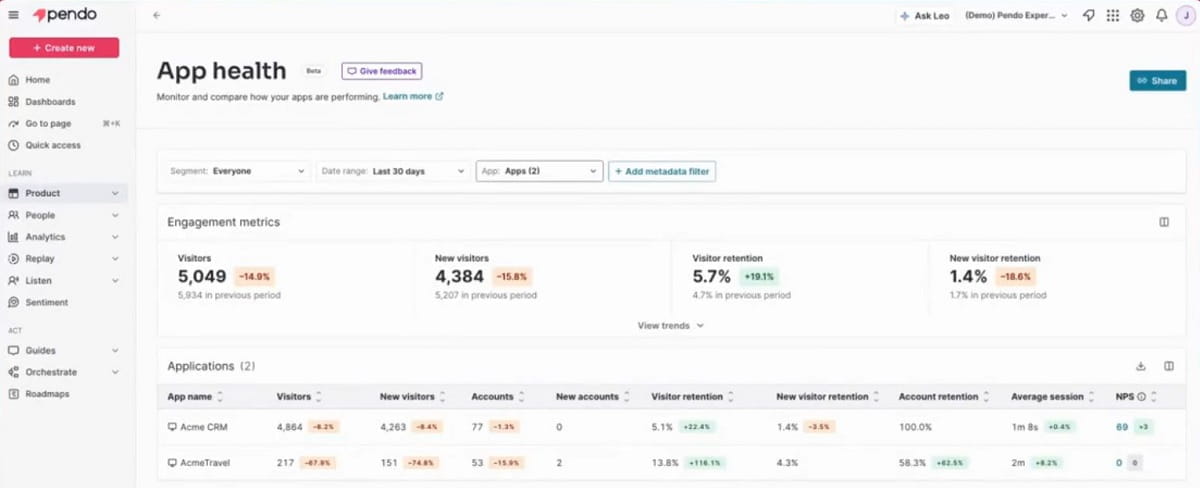
Pendo publishes no list prices for paid plans. The most reliable public numbers come from procurement platforms that aggregate signed contracts.
| Source | Data Point | Detail |
|---|---|---|
| Vendr marketplace | Median annual contract | $49,000/year |
| Vendr marketplace | Observed range | $18,335 – $151,741 |
| Vendr marketplace | Sample size | 580 purchases, updated February 2026 |
| Pendo pricing page | Free tier | 500 MAU, analytics + guides + branded NPS |
| Pendo pricing page | Novus beta | Free, no MAU limit during beta |
A few notes on reading those numbers honestly. The Vendr figures are a distribution of what buyers signed, not a rate card, and they include multi-module and multi-app deals. They do not tell you what your quote will be. What they do establish is the order of magnitude: Pendo is a five-figure annual commitment for almost everyone past the free tier, and the spread between the low and high end is more than eight times, which is what you would expect from MAU-scaled, seat-influenced, module-bundled pricing.
There is no reliable public benchmark for “how much teams save by switching,” and any listicle that gives you a precise percentage invented it. What you can measure is your own baseline: pull your current MAU count, list the modules you actually use, and price the same workload against the published rate cards in this guide. For the seven tools here that publish prices, that comparison takes an afternoon.
Why Teams Look For Pendo Alternatives
Across the vendor comparisons, review sites and migration posts we read for this guide, the same five reasons repeat.
- Pricing scales against you. MAU-based pricing means the bill grows exactly when your product succeeds. Teams describe renewals that jump by a third after a good year.
- The modules you need are one tier up. Session replay sits above the entry tier; Sentiment surveys sit above that. The platform you bought is rarely the platform you demoed.
- Analytics depth hits a ceiling. For teams doing serious cohort, path and retention work, dedicated analytics engines go deeper than a bundled analytics module.
- Guides still need engineering for anything complex. No-code covers tooltips and modals; branded, conditional, multi-step experiences tend to pull in a developer anyway.
- You are only using half of it. This is the big one. Paying platform pricing for one module is the single most common reason a Pendo replacement search starts.
There is a sixth reason that rarely makes the lists: Pendo keeps getting bigger. The company acquired Zelta AI in July 2024, Forwrd.ai in 2025, and Chisel Labs in February 2026 — its fourth acquisition in 18 months and its third AI-native startup. If your objection to Pendo is that it does too much for what you need, that trend is not reversing.
Pendo Alternatives By Job To Be Done
This is the framework that saves the most money. Sort candidates by which Pendo job they replace, then only compare inside a lane.
| Lane | The Job | Strong Options |
|---|---|---|
| Behavioral evidence | Understand why users behave the way analytics says they do | Plerdy, Fullstory, LogRocket, Contentsquare |
| Product analytics | Measure feature adoption, funnels, retention, cohorts | Amplitude, Mixpanel, PostHog, Heap |
| In-app guidance (customer-facing) | Onboard and activate users inside your product | Userpilot, Appcues, Chameleon, UserGuiding, Userflow |
| Digital adoption (employee-facing) | Drive adoption of internal software and workflows | Whatfix, WalkMe, Userlane, Apty |
| Feedback and research | Capture the “why” directly from users | Sprig, Perspective AI, Plerdy surveys |
Two lanes are frequently confused, and the confusion is expensive. Customer-facing in-app guidance (Userpilot, Appcues, Chameleon) is priced by monthly active users of your product. Employee-facing digital adoption (WalkMe, Whatfix) is priced by employee seats and is built for driving adoption of Salesforce, Workday, SAP and internal tools. Buying an enterprise DAP to onboard SaaS trial users is a classic overspend.
A third distinction matters just as much: analytics tells you what happened, replay and heatmaps tell you why. Most teams leaving Pendo replace the analytics half and quietly drop the qualitative half, then rebuild it six months later. Budget for both from the start.
How We Chose And Verified These Tools
None of the top-ranking Pendo alternative guides publish a methodology, so here is ours.
- Every tool had to pass a replacement test. We wrote the sentence “a team can replace Pendo with X for [specific job] because [current, verified capability]” for each entry. If we could not write it honestly with an official source, the tool did not make the list.
- Pricing came from the vendor’s own pricing page in 2026, or from a named procurement dataset where the vendor publishes nothing. Where a vendor is quote-only, we say quote-only instead of guessing a number.
- Status was re-checked, not assumed. Three tools that appear on competing lists have changed materially: one is in end-of-life, one wound down entirely, and one no longer exists as a standalone brand. They are covered in a separate section rather than ranked.
- We did not pad the list to hit a round number. Fifteen tools survived the check. Adjacent products that help alongside Pendo but do not replace any of its jobs — documentation tools, research panels, changelog widgets — are mentioned where useful and are not ranked as alternatives.
- No invented statistics. Where no reliable public benchmark exists, we say so and explain how to measure it in your own account.
The 15 Best Pendo Alternatives In 2026
1. Plerdy — Best For Behavioral Evidence, Feedback And CRO On a Budget
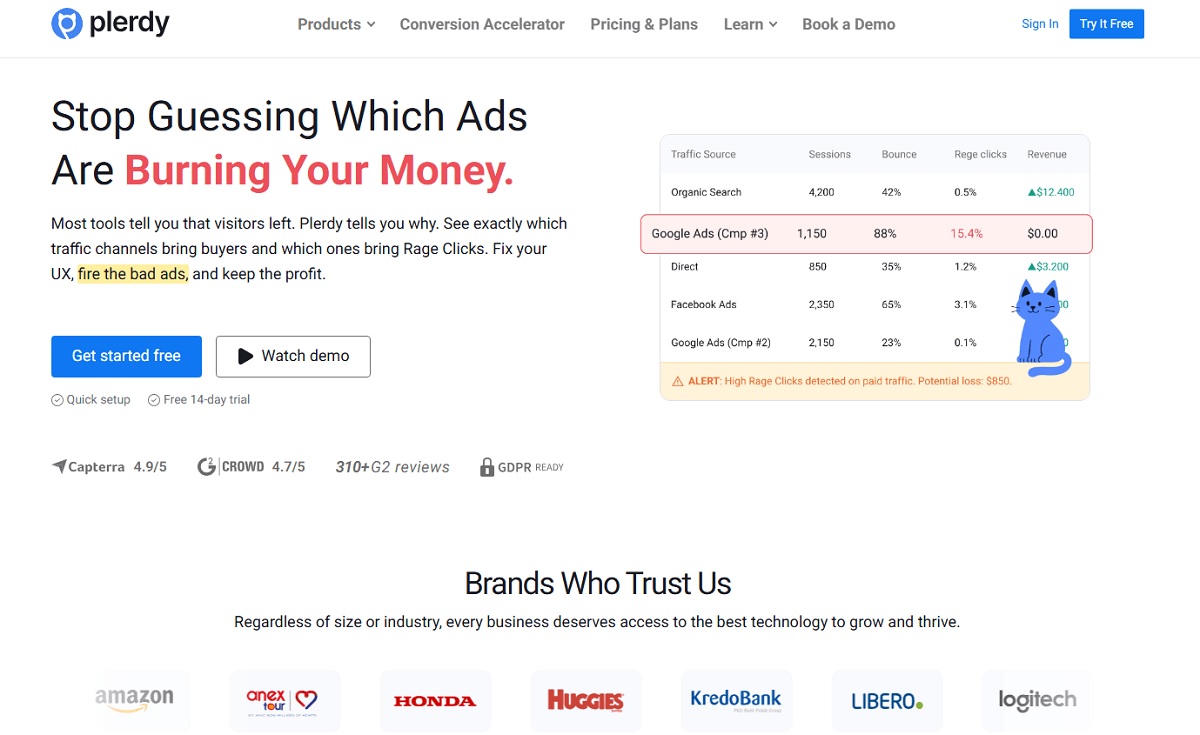
Plerdy is a website and product behavior platform that covers the half of Pendo most teams under-use and most replacements forget: seeing what users actually do, and asking them why. It combines heatmaps, session recordings, conversion funnels, event and goal tracking, on-site surveys and pop-ups, form analytics, ecommerce tracking, error monitoring and an SEO layer in one script — and it is the only tool in this guide with a genuinely free forever tier plus a published rate card that tops out below $260 a month.
The strategic case for Plerdy in a Pendo replacement is simple. Pendo tells you that a large share of users abandoned onboarding at step three. It does not tell you that the step-three button sits below the fold on 1366×768 screens, that the field triggering the drop-off is the one everyone rage-clicks, or that the users who churn all came from one paid campaign. Plerdy’s heatmap tool and session recordings answer those questions directly, and conversion funnels tie them back to revenue.
Best For: teams replacing Pendo’s evidence and feedback layer, and anyone who needs to prove UX friction before spending on a guidance platform.
Key Features
- Click, scroll, move and rage-click heatmaps segmented by device, traffic source and campaign
- Session replay with input-field recording controls and privacy masking
- Conversion funnel analysis with drop-off attribution by segment
- Event and goal tracking without a developer for standard interactions
- Smart forms, NPS and on-site surveys through the website feedback tool
- Unlimited A/B testing on every plan, including the free one
- Ecommerce sales tracking and JavaScript error monitoring
How It Compares To Pendo
Plerdy replaces Pendo’s analytics, session replay and sentiment layers for web products and web funnels, at roughly 1% to 5% of a median Pendo contract. What it does not replace is Pendo’s deep in-app guidance for complex SaaS walkthroughs: Plerdy’s on-site messaging covers surveys, NPS and targeted pop-ups, not multi-step branching product tours inside an authenticated application. If guided walkthroughs are the reason you bought Pendo, pair Plerdy with a guidance tool from lane three rather than swapping one for the other.
Use Cases
- A SaaS team that uses Pendo mainly for funnels and NPS and wants to cut a five-figure contract to a three-figure one
- A marketing or growth team that needs heatmaps and replay evidence before running experiments
- An ecommerce operation tying UX friction directly to revenue per session
Pros
- Free forever plan with real limits, not a 14-day trial
- Published pricing from $21/month annual to $253/month annual, no sales call
- Unlimited A/B testing on every tier, including free
- Heatmaps, replay, funnels, forms, surveys, ecommerce and SEO in one script
- GDPR-oriented controls and data collection opt-outs
Cons
- Not a digital adoption platform: no complex branching in-app walkthroughs
- Web-first, so native mobile app instrumentation is not its strength
- Session and heatmap volumes are capped per tier rather than sold as unlimited
Pricing (Verified 2026)
| Plan | Monthly | Annual | Session Replays | Heatmaps/Day |
|---|---|---|---|---|
| Free | $0 | $0 | 500 | 100 |
| Startup | $32 | $21/mo | 5,000 | 500 |
| Scale | $64 | $42/mo | 10,000 | 1,500 |
| Thrive | $108 | $70/mo | 30,000 | 3,000 |
| Enterprise 1 | $149 | $97/mo | 55,000 | 7,000 |
| Enterprise 2 | $248 | $161/mo | 120,000 | 15,000 |
| Enterprise 3 | $390 | $253/mo | 250,000 | 50,000 |
Source: Plerdy pricing, September 2026. Annual billing carries a 35% discount.
2. Amplitude — Best Overall Pendo Replacement For Analytics Plus Guides
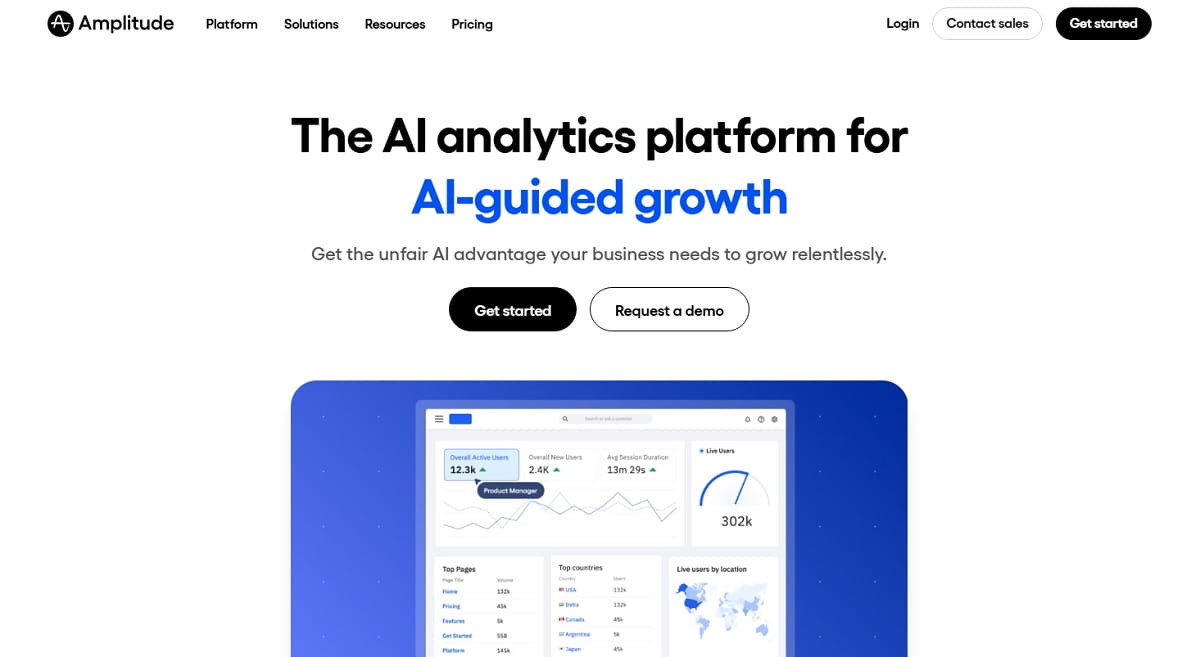
Amplitude is now the closest thing to a full-platform Pendo replacement, and that is a recent development. Amplitude was a pure product analytics engine for years; in 2026 its own platform description lists Product and Marketing Analytics, Session Replay, Feature and Web Experimentation, Activation, Guides and Surveys, and Voice of Customer as native capabilities. That list maps onto Pendo’s module grid almost one for one.
Two acquisitions drove the change. Amplitude acquired Kraftful, an AI-native Voice of Customer startup, in July 2025, folding feedback analysis into the platform. In May 2026 Amplitude took over the Statsig brand and customer base for experimentation, after OpenAI acquired the Statsig team — a detail worth knowing if experimentation is central to your evaluation, because the platform’s roadmap and the people who built it now sit in different companies.
Best For: teams whose primary Pendo job is analytics, who want guides and surveys included rather than as a separate contract.
Key Features
- Behavioral cohorts, funnels, paths, retention and lifecycle analysis
- Session replay tied directly to analytics charts
- Guides and Surveys for in-app messaging and NPS
- Feature and web experimentation with feature flags
- AI-assisted analysis and Voice of Customer feedback synthesis
How It Compares To Pendo
Amplitude goes considerably deeper than Pendo on analysis — cohorting, pathing and retention are its core competence rather than a bundled module. Its Guides and Surveys are newer and less mature than Pendo’s guidance engine, which has had a decade of iteration. If analytics depth is your reason for leaving, Amplitude is the strongest swap. If in-app guidance is 80% of your Pendo usage, a dedicated guidance tool will serve you better.
Use Cases
- A product org that outgrew Pendo’s reporting ceiling
- Teams consolidating analytics, replay, experimentation and feedback into one contract
- Data teams that need warehouse-grade export and modelling
Pros
- 2M events per month free, forever, with no credit card
- 10,000 monthly session replays on the free tier
- Genuinely deep behavioral analysis
- Guides, surveys and experimentation now native
Cons
- Event-based pricing gets expensive fast at scale
- Guides are less mature than purpose-built guidance platforms
- Statsig roadmap continuity is an open question after the OpenAI deal
Pricing (Verified 2026): Free plan with 2M events/month, 10K session replays and limited Experiments, Guides and Surveys. Plus starts at $0 and scales by events up to 70M with heatmaps included. Growth and Enterprise are custom-quoted, with 20K and 50K monthly session replays respectively. Source: Amplitude pricing.
3. Userpilot — Best Closest 1:1 Pendo Alternative For PLG Teams
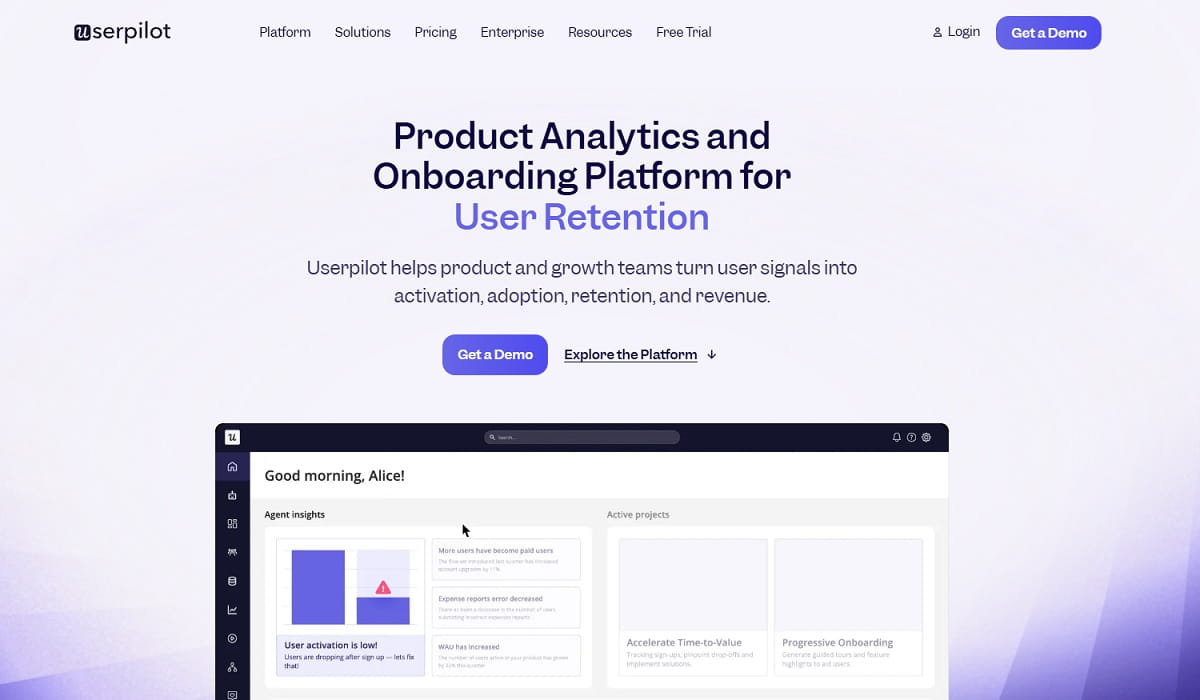
Userpilot is the most direct feature-for-feature swap on this list for product-led growth teams. It bundles in-app flows, product analytics, surveys and NPS, session replay and a resource centre in one platform, targeting exactly the mid-market buyer who finds Pendo’s quote uncomfortable.
Best For: mid-market PLG teams that want Pendo’s shape without Pendo’s contract.
Key Features
- No-code in-app flows: tooltips, modals, checklists, banners, hotspots
- Product analytics with funnels, paths, cohorts and retention
- NPS and advanced in-app surveys
- Session replay on Growth and Enterprise tiers
- Resource centre and event autocapture
How It Compares To Pendo
Userpilot covers the same jobs with published entry pricing, which is the whole pitch. The trade-off is scale: Pendo’s analytics and enterprise governance run deeper, and Userpilot’s MAU tiers climb steeply — $299/month buys 2,000 MAU, and the next tier starts at $849/month. For a product with 50,000 monthly actives, run the numbers carefully before assuming it is cheaper.
Use Cases
- PLG SaaS teams wanting onboarding and analytics in one tool
- Mid-market companies replacing Pendo without an enterprise procurement cycle
- Teams that need in-app flows plus surveys with a published starting price
Pros
- Published starting price, no mandatory sales call to see a number
- Genuinely closest 1:1 module coverage to Pendo
- Session replay available in-platform
- Strong survey and NPS tooling
Cons
- MAU tiers escalate sharply above the Starter plan
- Session replay is an add-on on Growth rather than included
- Mobile engagement is an add-on until Enterprise
Pricing (Verified 2026): Starter $299/month for up to 2,000 MAU. Growth from $849/month starting at 2,000 MAU, with unlimited session replays as an add-on. Enterprise custom, including 10k MAU. Source: Userpilot pricing.
4. PostHog — Best Open-Source All-In-One For Engineering-Led Teams
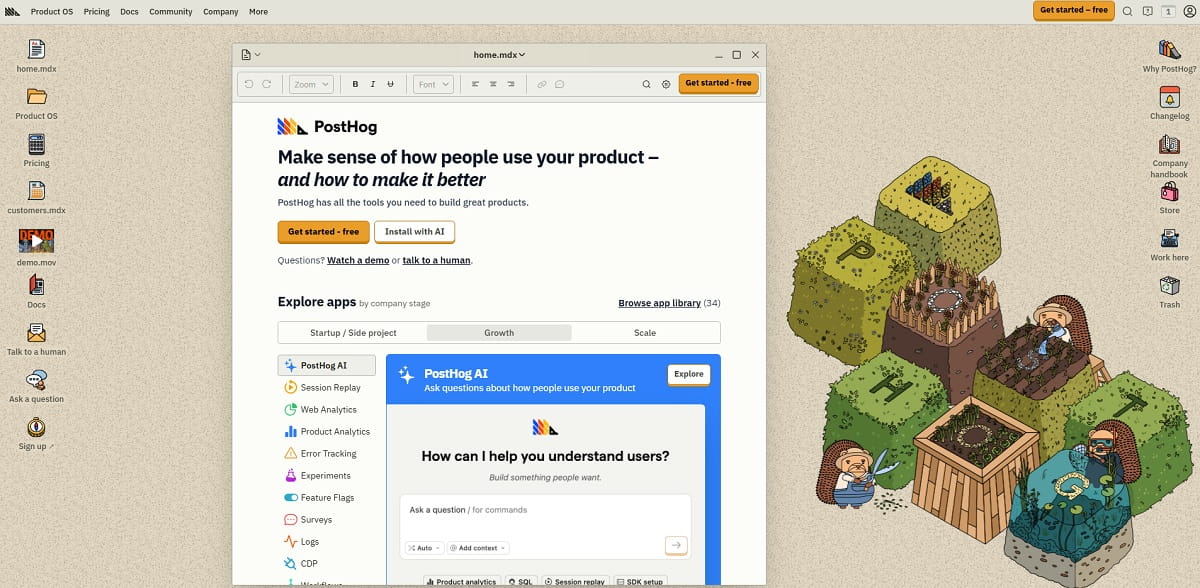
PostHog is the developer-first answer to Pendo: product analytics, session replay, feature flags, experiments, surveys and a data warehouse in one open-source platform, with the most generous free tier in this guide and per-product usage-based billing after that.
Best For: technical teams that want Pendo’s data jobs plus experimentation, without a sales process. See also our guide to PostHog alternatives.
Key Features
- Product analytics with funnels, retention, paths and SQL access
- Session replay with console logs and network waterfalls
- Feature flags and experiments in the same tool
- In-app surveys including NPS
- Self-host option and per-product billing limits
How It Compares To Pendo
PostHog replaces Pendo’s analytics, replay and survey layers outright and adds experimentation Pendo does not have. What it does not replace is Pendo’s polished no-code guidance: PostHog surveys are not multi-step branded product tours, and the platform assumes someone on the team is comfortable with instrumentation and SQL. For engineering-led products, that is a feature. For a marketing-led onboarding team, it is a blocker.
Use Cases
- Engineering-led product teams consolidating five tools into one
- Startups that need real analytics on a zero budget
- Teams with data-residency or self-hosting requirements
Pros
- Free tier covers 1M events, 5K recordings, 1M flag requests and 1,500 survey responses monthly
- Open source with a self-host path
- Feature flags and experiments included
- Per-product billing limits prevent surprise invoices
Cons
- No no-code in-app guidance comparable to Pendo guides
- Assumes technical comfort with events and queries
- Free tier retention is one year versus seven on paid
Pricing (Verified 2026): Free monthly allowances of 1M analytics events, 5K session recordings, 1M feature flag requests and 1,500 survey responses; experiments billed with feature flags. Adding a card unlocks unlimited usage, six projects and seven-year retention. Source: PostHog pricing.
5. Mixpanel — Best For Deep Self-Serve Event Analytics
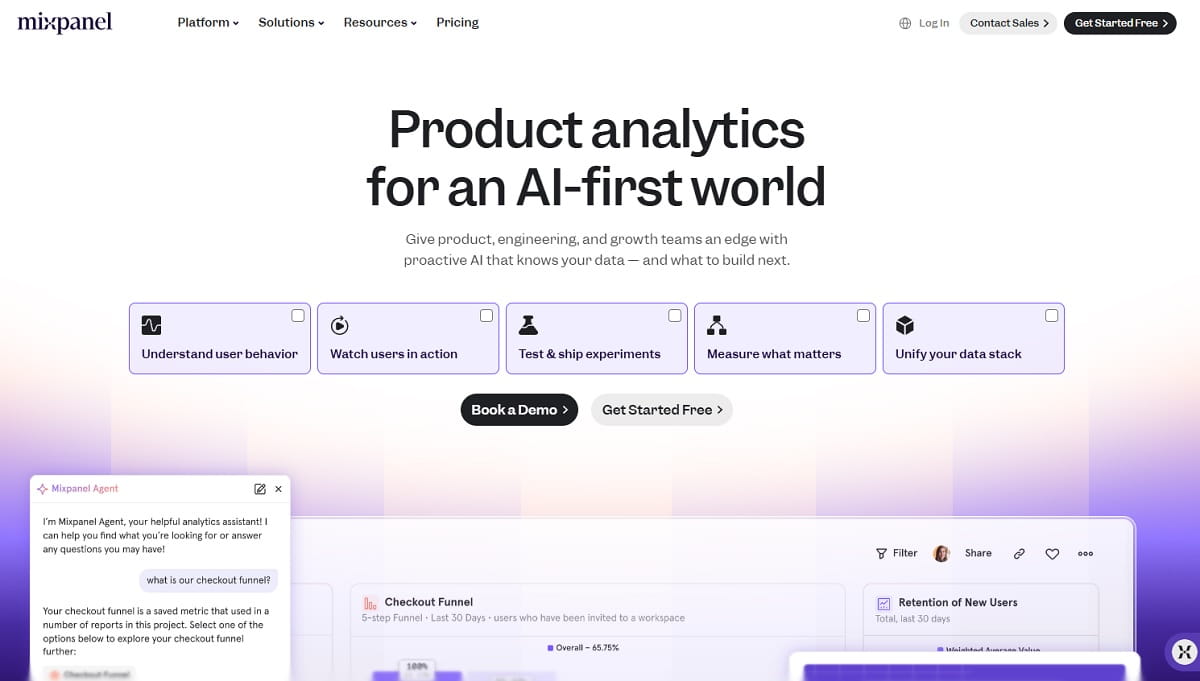
Mixpanel is the specialist that replaces exactly one Pendo module and does it better. If your team’s complaint is “Pendo’s reporting hits a ceiling,” Mixpanel is the standard answer: event-based analytics with fast, self-serve funnels, retention, flows and cohorts that non-analysts can actually build.
Best For: teams replacing Pendo’s analytics and nothing else. Compare with our Mixpanel alternatives breakdown.
Key Features
- Event analytics with funnels, retention, flows and impact reports
- Session replay integrated with analytics
- Feature flags and experiments
- Warehouse connectors and first-party tracking domains on Enterprise
- Unlimited seats on every plan, including free
How It Compares To Pendo
Mixpanel is deeper and faster on analysis but does nothing for in-app guidance, so it is a partial replacement by design. Teams typically pair it with a guidance tool or with Plerdy for the qualitative layer. Its free tier — 1M events and 10K session replays monthly with unlimited seats — is more generous than Pendo’s 500 MAU cap for most product teams.
Use Cases
- Product teams that need genuine analytical depth on a self-serve plan
- Companies replacing only Pendo’s analytics module
- Startups eligible for the first-year-free program
Pros
- Unlimited seats on all plans, so analytics is not rationed by licence
- 1M events and 10K session replays free forever
- Fast, genuinely self-serve report building
- Startup program gives qualifying companies their first year free
Cons
- No in-app guidance or onboarding flows at all
- Event-volume pricing punishes chatty instrumentation
- Feature flag counts are tightly capped below Enterprise
Pricing (Verified 2026): Free forever with up to 1M events/month, 10K session replays, 1k MEU for experiments and 10 active feature flags. Growth starts at $0 and scales to 20M events/month with 500K session replays. Enterprise custom, up to 1T events/month. Startups founded under five years ago with ≤$8M funding get their first year free. Source: Mixpanel pricing.
6. Whatfix — Best For Enterprise Digital Adoption And Employee Training
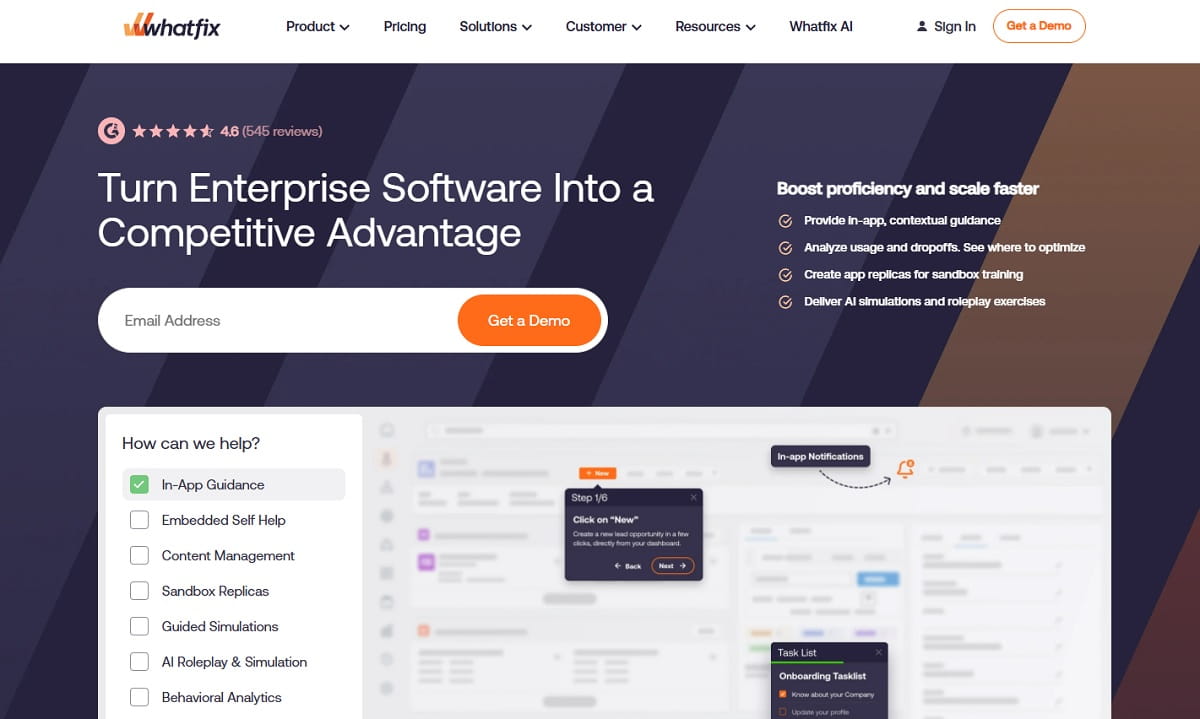
Whatfix is a digital adoption platform aimed at large organisations rolling out software to employees. It is a genuine Pendo competitor on the guidance side and it goes further on training, with in-app guidance, product analytics, and Mirror, a sandbox that replicates applications for hands-on practice and AI-powered roleplay.
Best For: enterprises whose Pendo use case is employee software adoption rather than product activation.
Key Features
- In-app guidance, walkthroughs, task lists and self-help widgets
- Product Analytics, available free with any DAP plan
- Mirror application simulation for hands-on training
- Web, desktop, mobile and OS-level (Windows/Mac) support
- Multi-app enterprise plans
How It Compares To Pendo
Whatfix is stronger than Pendo for employee-facing adoption and formal enablement, and weaker as a product analytics engine for a customer-facing SaaS product. If you bought Pendo to onboard employees onto Salesforce or an internal ERP, Whatfix is the better-fitted tool. If you bought Pendo to activate trial users, it is over-specified.
Use Cases
- Enterprise rollouts of Salesforce, Workday, SAP or internal applications
- Formal training programs needing simulation environments
- Organisations needing desktop and OS-level guidance, not just web
Pros
- Product Analytics included free with any DAP plan
- Mirror simulation has no direct Pendo equivalent
- Broad platform coverage including desktop and OS
- Built for multi-app enterprise governance
Cons
- No published pricing at all
- Overkill and overpriced for customer-facing SaaS onboarding
- Implementation is an enterprise project, not a weekend
Pricing (Verified 2026): Quote-only. Whatfix states that “pricing for each product and plan is composed of a flat fee, plus user license fees,” with employee-facing apps priced per employee and customer-facing apps priced per MAU. Source: Whatfix pricing.
7. Appcues — Best For Non-Technical Teams Shipping In-App Experiences
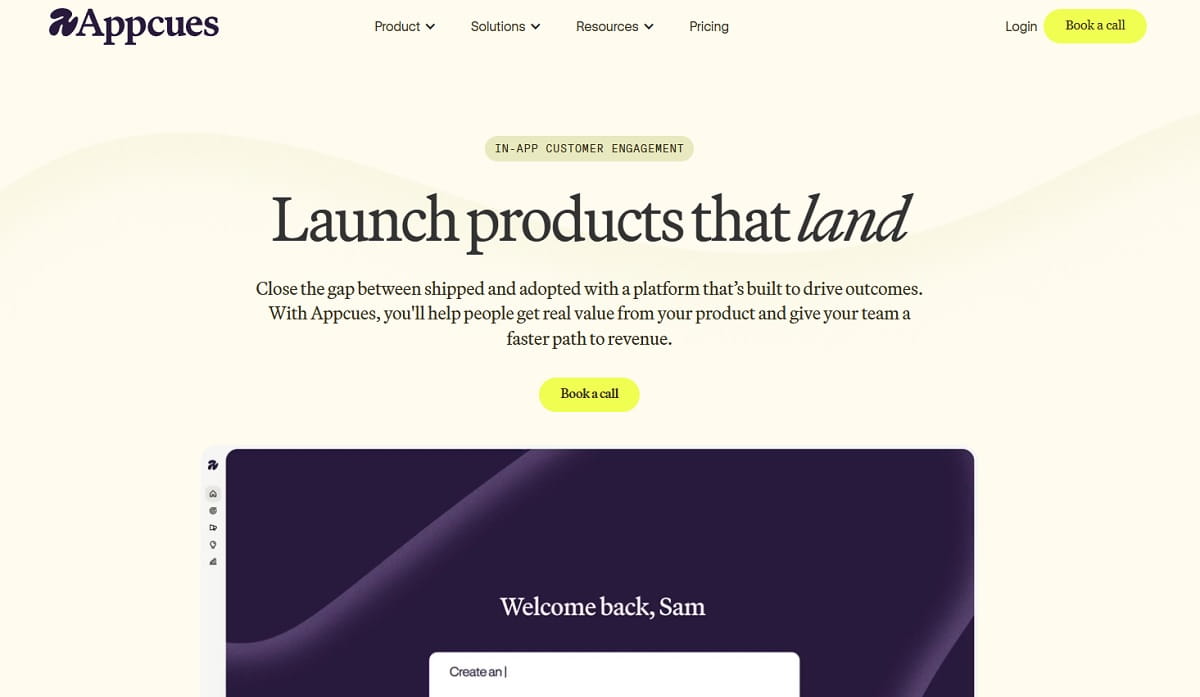
Appcues is the long-standing no-code choice for product and growth teams who want to build in-app onboarding without touching the codebase. Its pitch against Pendo has always been speed and simplicity rather than platform breadth.
Best For: non-technical teams whose Pendo usage is guides, checklists and onboarding flows.
Key Features
- No-code builder for tours, modals, tooltips, checklists and banners
- Every experience type, feature and integration included on all plans
- User targeting and segmentation
- In-app analytics on experience performance
- Email as an additional channel on paid tiers
How It Compares To Pendo
Appcues is easier for a non-technical marketer or PM to operate and covers guidance well, but it is not an analytics platform — you will still need something for funnels, cohorts and retention. Note a 2026 change: Appcues no longer publishes prices. Its plans are now structured by MAU and experience count, with figures given by quote.
Use Cases
- Growth teams shipping onboarding changes weekly without engineering
- Companies replacing only Pendo’s guides module
- Teams wanting every feature on the entry plan rather than tier-gated
Pros
- Every experience type and integration on every plan, from day one
- Genuinely no-code, fast to launch
- Dedicated CSM from the entry tier
- Long track record and mature builder
Cons
- Prices are no longer published; demo required
- Not an analytics replacement
- Reporting history is tier-limited (12/24/36 months)
Pricing (Verified 2026): Three plans. Start covers up to 3,000 MAU with 10 published experiences and 12 months of reporting history. Grow starts at 3,000 MAU with 25 experiences and 24 months of history. Enterprise offers custom volumes, 100 experiences and 36 months of history. No prices published. Source: Appcues pricing.
8. Chameleon — Best For Design-Precise In-App Guidance
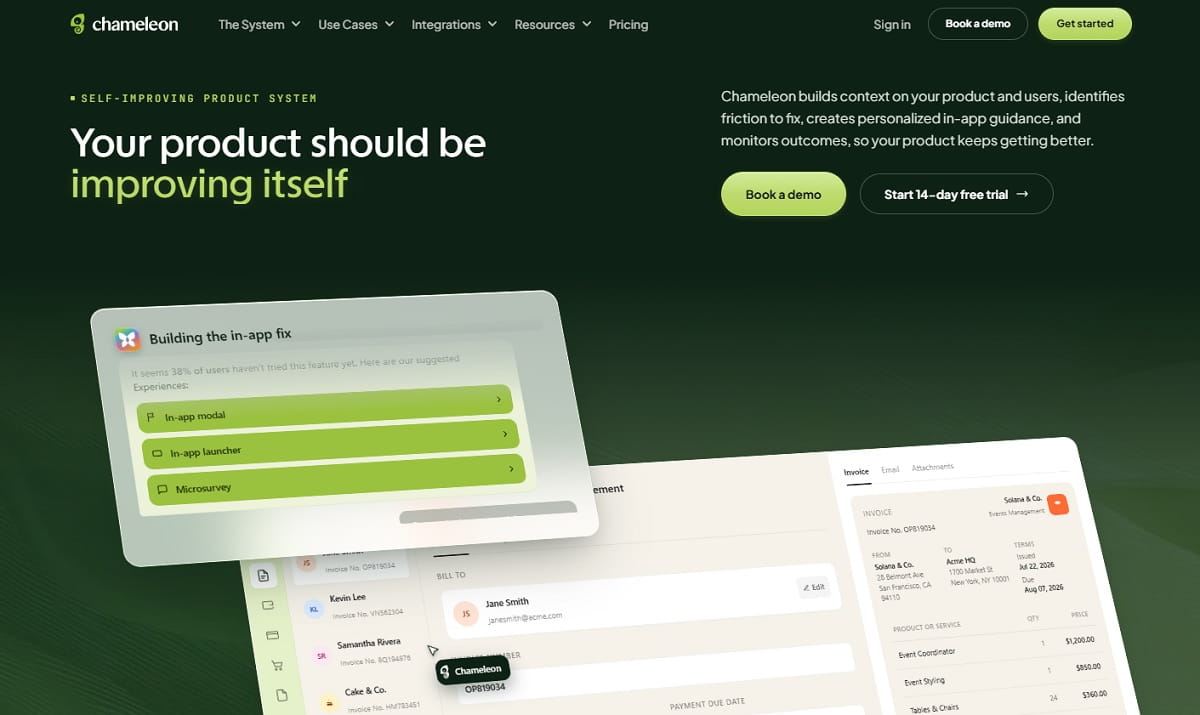
Chameleon targets teams that find most guidance tools visually generic. It offers themes, custom CSS, A/B testing on experiences, localisation and an AI-assisted builder, aimed at product teams who care that in-app messaging looks like part of the product rather than an overlay.
Best For: teams for whom in-app guidance has to match the product’s design system exactly.
Key Features
- Themes and custom CSS for pixel-level control
- A/B testing and goals on in-app experiences
- Localisation into multiple languages
- HelpBar, AI interactive demos and agent-based building
- Governance suite on higher tiers
How It Compares To Pendo
Chameleon beats Pendo on design control and experience-level experimentation; it does not attempt Pendo’s analytics depth or roadmapping. Its published Startup plan at $279/month for 2,000 MTUs is one of the few transparent entry points in the guidance lane, though the jump to Pro at $750/month for 5,000 MTUs is steep.
Use Cases
- Design-led product teams that reject templated overlays
- Teams running experiments on onboarding flows themselves
- Products shipping in multiple languages
Pros
- Published pricing across Startup, Pro and Growth
- Best-in-class design control and theming
- A/B testing and goals built into experiences
- 14-day trial with full Enterprise-level access
Cons
- Pricing climbs quickly from Startup to Pro
- Not an analytics platform
- Live experience counts are capped below Growth
Pricing (Verified 2026): Startup starts at $279 for 2,000 MTUs with 10 live experiences. Pro from $750/month for 5k MTUs with up to 20 live experiences, A/B testing and custom CSS. Growth from $1,250/month for 5k MTUs billed annually, with unlimited live experiences. Enterprise custom. Source: Chameleon pricing.
9. UserGuiding — Best Budget Option With Published Pricing
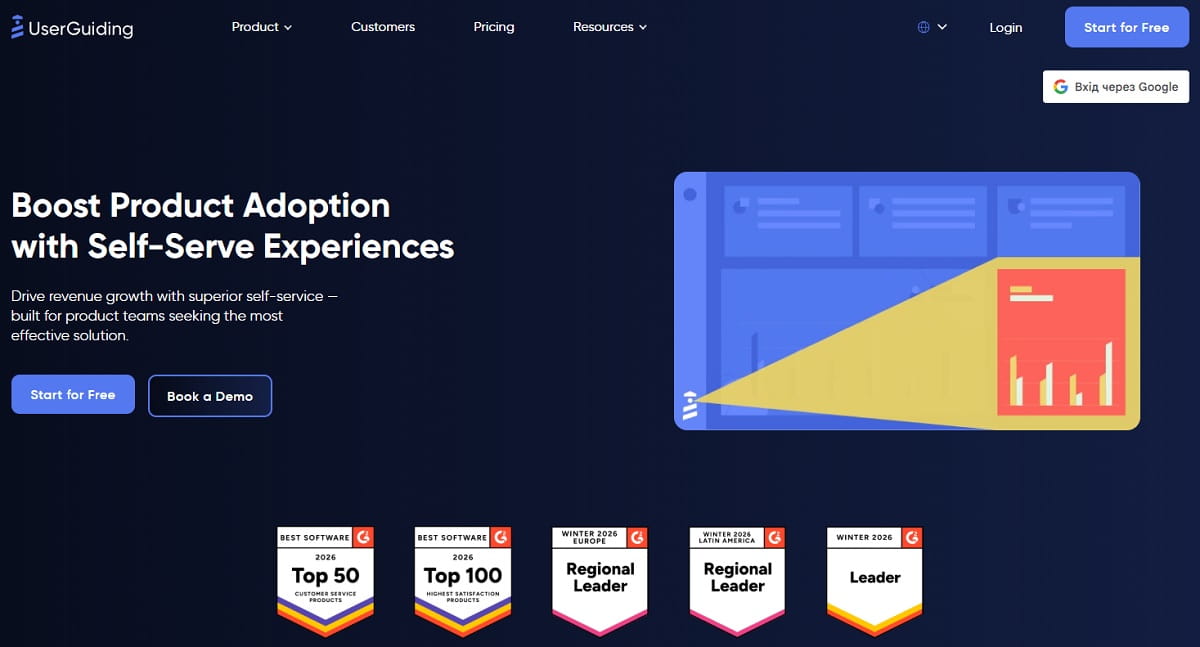
UserGuiding is the value pick in the guidance lane and one of the very few vendors here that publishes a complete rate card with limits attached. It covers onboarding experiences, surveys with AI insights, a knowledge base, product updates and, on Growth, no-code event tracking and session replay.
Best For: budget-conscious teams that want a published price and can live inside metered limits.
Key Features
- In-app onboarding experiences with an AI assistant
- Surveys with AI-generated insights
- Knowledge base and product update announcements
- No-code event tracking and session replay on Growth
- Localisation and custom alerts on Growth
How It Compares To Pendo
UserGuiding covers the guidance and survey jobs at roughly a twentieth of a median Pendo contract, with the caveat that everything is metered: 15 active guides on Starter, 40 on Growth, 1 survey on Starter, 5 on Growth, and 1 seat on Starter. It is the right call for a small team running a focused onboarding program, and the wrong call for an organisation with many parallel campaigns.
Use Cases
- Small SaaS teams needing in-app onboarding with a known monthly cost
- Companies replacing Pendo’s guides module on a tight budget
- Teams that want a knowledge base and guides from one vendor
Pros
- Fully published pricing with explicit feature limits
- Session replay and event tracking included on Growth
- 30-day money-back guarantee
- Knowledge base included rather than sold separately
Cons
- Hard caps on guides, hotspots, surveys and seats
- One seat on Starter is restrictive for a team
- Analytics depth is basic compared to dedicated engines
Pricing (Verified 2026): Starter $174/month billed yearly, from 2,000 MAU, with 15 active guides, 10 hotspots, 1 survey and 1 seat. Growth $349/month billed yearly with 40 guides, 40 hotspots, 5 surveys, 3 seats, session replay and no-code event tracking. Enterprise custom with unlimited experiences and SAML SSO. Source: UserGuiding pricing.
10. Heap by Contentsquare — Best For Retroactive Autocapture Analytics
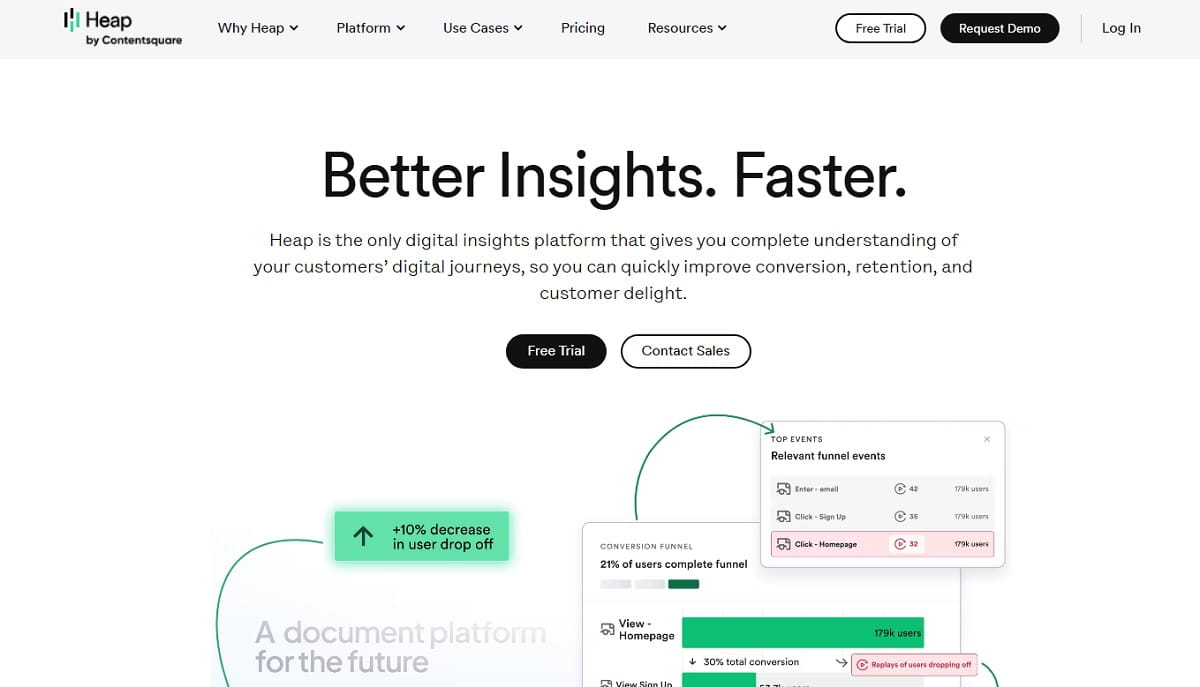
Heap pioneered autocapture: instead of defining events in advance, it records every interaction and lets you define events retroactively, so you can answer questions about last quarter that nobody thought to instrument. Contentsquare completed its acquisition of Heap in December 2023, and Heap now operates as the product analytics capability inside the Contentsquare experience intelligence platform.
Best For: analytics teams that value retroactive autocapture and are comfortable buying inside the Contentsquare platform. See also our Heap alternatives and Contentsquare alternatives guides.
Key Features
- Autocapture of all interactions with retroactive event definition
- Funnels, journey maps, retention charts and cohort segmentation
- AI-assisted friction discovery
- Integration with Contentsquare zone-based and session analytics
- Web and mobile capture
How It Compares To Pendo
Heap’s autocapture removes the tagging debt Pendo teams accumulate, and its retroactive analysis is genuinely differentiated. It does not do in-app guidance. The practical consideration in 2026 is packaging: Heap is now bought as part of Contentsquare rather than as a standalone analytics contract, so evaluate the whole platform and its pricing model rather than the historical Heap product.
Use Cases
- Teams that keep discovering they failed to instrument something important
- Organisations that want product analytics and experience analytics from one vendor
- Analysts doing retrospective cohort work
Pros
- Retroactive analysis without pre-planned tagging
- Strong journey and friction discovery
- Backed by Contentsquare’s broader experience analytics
- Mature web and mobile capture
Cons
- No in-app guidance layer
- Now sold within Contentsquare rather than as a standalone product
- No published pricing
Pricing (Verified 2026): Contentsquare does not publish per-plan rates for product analytics on its pricing page; Heap is packaged within Contentsquare plans and quoted by sales. Contentsquare does publish a free plan covering 200k sessions per month on its Hotjar transition page. Source: Contentsquare.
11. Fullstory — Best For Session Replay Plus Product Analytics
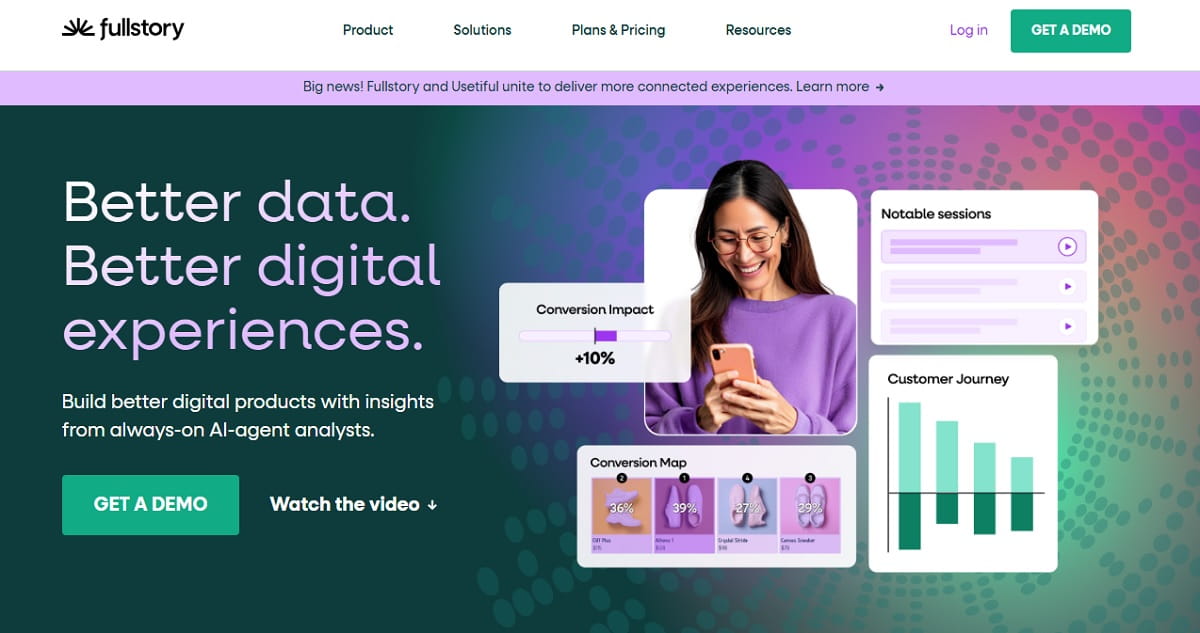
Fullstory is the enterprise-grade answer to the qualitative half of Pendo. It captures sessions with high fidelity, surfaces frustration signals like rage clicks and dead clicks, and layers product analytics, funnels and journeys on top of the same data.
Best For: teams whose Pendo replacement priority is understanding sessions, not sending guides. Compare with our Fullstory alternatives guide.
Key Features
- High-fidelity session replay with live session viewing
- Heatmaps and journey analysis
- Product analytics, funnels, retention and segmentation
- Omnisearch across session data
- Guides and Surveys, StoryAI and mobile analytics as add-ons
How It Compares To Pendo
Fullstory is stronger than Pendo on session replay and UX diagnostics, and comparable on analytics for web products. Guides and Surveys exist but as add-ons rather than core, so it is a partial replacement unless you buy up. Its free tier — 30,000 sessions per month, 12 months of retention and up to 10 users — is unusually generous for an enterprise-positioned tool.
Use Cases
- UX and product teams diagnosing friction at enterprise scale
- Companies replacing Pendo’s replay and analytics modules together
- Teams needing deep search across historical sessions
Pros
- 30,000 free sessions monthly with 12-month retention
- Excellent replay fidelity and frustration signal detection
- Analytics and qualitative data in one dataset
- Role-based access control and SSO across plans
Cons
- Paid pricing is entirely quote-based
- Guides, surveys and mobile analytics are add-ons
- Heavier and more expensive than mid-market alternatives
Pricing (Verified 2026): Fullstory Free includes 30,000 sessions per month, 12 months of data retention and up to 10 users. Business, Advanced and Enterprise are sales-led with no published rates. Mobile Analytics, StoryAI, Guides & Surveys and Multi-Org Management are add-ons. Source: Fullstory pricing.
12. WalkMe — Best For Enterprise Workflow Adoption Across Many Apps
WalkMe is the original digital adoption platform and remains the enterprise standard for guiding employees through complex, multi-application workflows. It is now part of SAP: SAP completed the acquisition on 12 September 2024 at an equity value of approximately US$1.5 billion, $14.00 per share.
Best For: enterprises driving adoption of internal software across many applications.
Key Features
- Cross-application guidance and workflow automation
- Employee-facing and customer-facing DAP editions
- Deep enterprise application coverage including SAP
- Adoption analytics and workflow measurement
- Automation of repetitive multi-step tasks
How It Compares To Pendo
WalkMe is built for a different buyer than Pendo. It excels where a process spans several systems and where the users are employees rather than customers. It is not a product analytics platform for a SaaS product, and its implementation is a formal enterprise project. The SAP acquisition matters practically: expect roadmap alignment toward SAP’s ecosystem and Joule.
Use Cases
- Enterprise change management across ERP, CRM and HR systems
- Employee onboarding and process compliance at scale
- Organisations already standardised on SAP
Pros
- Deepest cross-application workflow guidance available
- Strong automation capabilities beyond simple tooltips
- Backed by SAP’s enterprise support and roadmap
- Mature governance and security posture
Cons
- No published pricing; enterprise procurement only
- Heavy implementation and maintenance burden
- Poor fit for customer-facing SaaS activation
Pricing (Verified 2026): Quote-only. WalkMe’s pricing page publishes no rates, stating only that “our pricing plans are designed for any organization to benefit from digital adoption.” Source: WalkMe pricing.
13. Gainsight PX — Best For Customer-Success-Led Product Teams
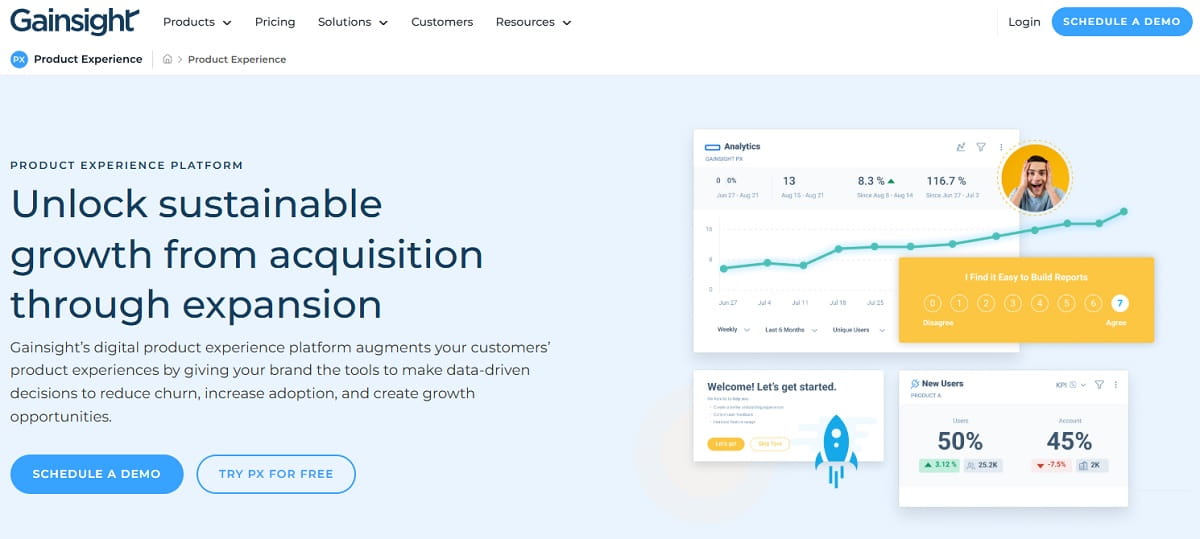
Gainsight PX sits at the intersection of product analytics and customer success, which is exactly where a lot of Pendo deployments actually live. It combines product analytics, in-app guides and engagements, an In-App Hub, and user surveys, with the distinguishing advantage of tying product usage to customer health when paired with Gainsight’s customer success platform.
Best For: B2B SaaS teams where customer success and product need the same adoption data.
Key Features
- Product analytics with adoption and usage tracking
- In-app guides, engagements and the redesigned In-App Hub
- User surveys and feedback collection
- Web, mobile and desktop support
- Engagement Goals to measure whether in-app messages drive the intended action
How It Compares To Pendo
Gainsight PX is the closest philosophical twin to Pendo on this list — same module mix, same buyer. The difference is the customer success context: if your product team and CS team need one view of adoption and account health, PX has an integration story Pendo cannot match. In 2026 the product added Engagement Goals, rage click detection as a behavioral signal, and an MCP server so AI assistants can query PX data in natural language.
Use Cases
- B2B SaaS where CS owns expansion and needs product usage signals
- Teams already running Gainsight for customer success
- Product orgs wanting adoption analytics tied to account health
Pros
- Tight coupling between product usage and customer health
- Analytics, guides and surveys in one product
- Active 2026 roadmap including MCP and rage click signals
- Free trial available without procurement
Cons
- No published pricing
- Most valuable when you already own Gainsight CS
- Less analytical depth than dedicated analytics engines
Pricing (Verified 2026): No published rates. Gainsight directs buyers to request pricing or start a free trial. Source: Gainsight pricing.
14. LogRocket — Best For Engineering Teams Debugging The Experience
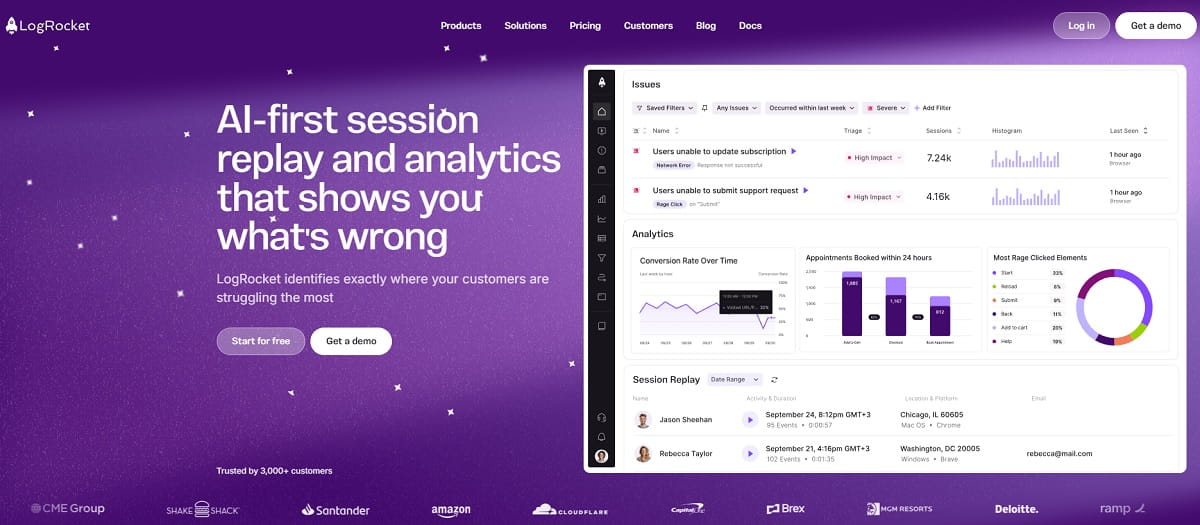
LogRocket merges session replay, product analytics and frontend error tracking into one timeline, so a drop-off in a funnel can be traced to the exact console error that caused it. For teams whose Pendo frustration is “we can see the drop but not the cause,” this is the most direct fix.
Best For: engineering-adjacent product teams that need root cause, not just the funnel. See our LogRocket alternatives comparison.
Key Features
- Session replay with console, network and Redux state
- Product analytics with path analysis and conversion funnels
- Frontend error tracking and performance monitoring
- Clickmaps, heatmaps and rage-click maps
- AI session summaries, issue detection and funnel insights on Pro
How It Compares To Pendo
LogRocket replaces Pendo’s replay and analytics jobs and adds engineering diagnostics Pendo does not attempt. It has no in-app guidance layer. Its published entry price of $176/month makes it one of the few tools here where an engineering team can start without procurement.
Use Cases
- Engineering teams tying UX friction to technical root cause
- Product teams that need both analytics and error context
- Companies replacing Pendo’s replay module with something more diagnostic
Pros
- Published entry pricing from $176/month
- Unlimited analytics, error and log events on all plans
- Surveys and heatmaps included
- Self-hosted deployment available on Enterprise
Cons
- No in-app guidance or onboarding flows
- AI features gated to Pro and above
- Session-based pricing needs volume planning
Pricing (Verified 2026): Core starts at $176/month, scaling from 25K to 4M+ sessions per month. Pro scales with sessions and is included free above 100K sessions/month. Enterprise is custom with unlimited seats and self-hosting. 14-day free trial. Source: LogRocket pricing.
15. Userflow — Best For Fast, Developer-Friendly SaaS Onboarding
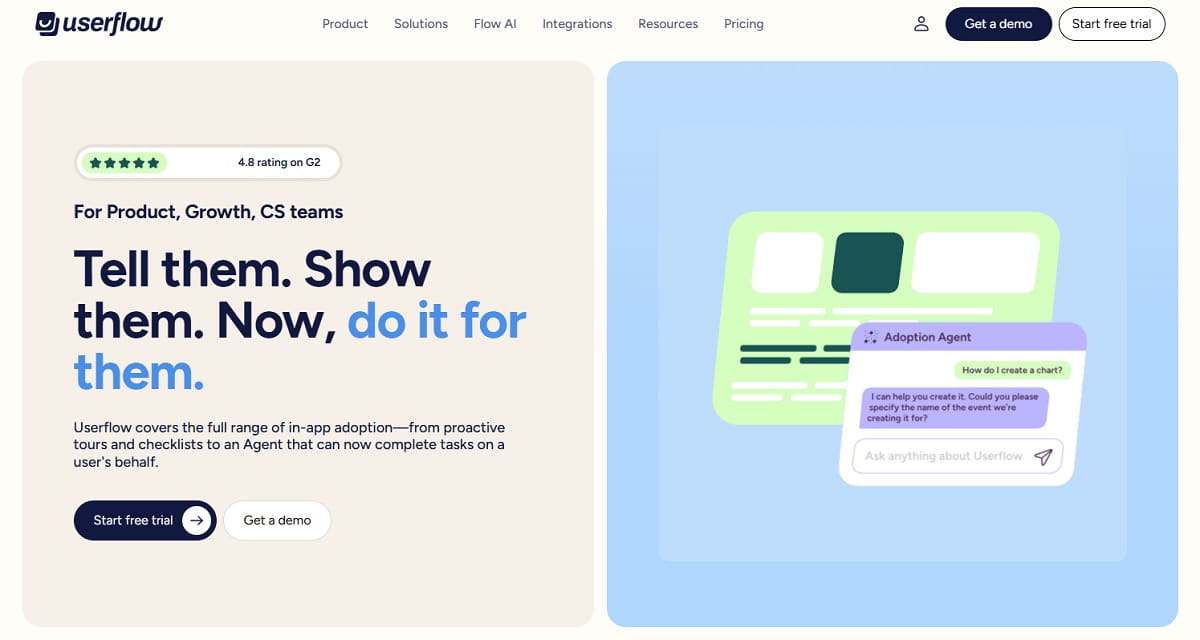
Userflow is a modern onboarding platform known for the speed of its builder, acquired by Beamer in February 2024 in a deal reported at more than $60 million. It has since been repackaged, and this is where most Pendo alternative lists are now out of date.
Best For: SaaS teams replacing Pendo’s guides with something faster and cheaper to operate.
Key Features
- Fast no-code builder for flows, checklists and surveys
- Adoption Studio for proactive in-app experiences
- Adoption Agent for inbound, AI-answered user questions
- Shared Flow library across both products
- Strong API, environments and versioning for developers
How It Compares To Pendo
Userflow is faster to build in than Pendo and considerably cheaper at small scale, but it replaces only the guidance job. In 2026 it split into two purchasable products rather than the older Startup and Pro tiers: Adoption Studio at $500/month ($400/month billed annually, including 1,000 MAUs) and Adoption Agent at $100/month ($80/month annually). Existing Startup and Pro customers are grandfathered on their current plan and pricing. Any list still quoting Userflow’s old tier names is describing a plan you can no longer buy.
Use Cases
- SaaS teams that want onboarding flows shipped this week
- Products wanting an AI assistant answering in-app questions
- Developer-friendly teams that want versioning and environments
Pros
- Genuinely fast builder with a low learning curve
- Published pricing in structured data on the pricing page
- Two products that work standalone off one Flow library
- 14-day trial per product, no credit card
Cons
- Guidance only; no product analytics engine
- Repackaging means older comparisons are unreliable
- Base plan includes only 1,000 MAUs before overage
Pricing (Verified 2026): Adoption Studio $500/month, or $400/month billed annually, including 1,000 MAUs. Adoption Agent $100/month, or $80/month billed annually. 14-day trial for either product. Source: Userflow pricing.
Who Owns What In 2026: The Consolidation Map
The product experience category consolidated hard, and several tools recommended on competing lists no longer exist the way those lists describe them. This table is the single most useful thing you can check before booking a demo.
| Tool | Status In 2026 | What Changed | Verified Source |
|---|---|---|---|
| Hotjar | Merged into Contentsquare | hotjar.com now redirects to Contentsquare; “the two platforms have merged into a single platform” | contentsquare.com/hotjar |
| Heap | Owned by Contentsquare | Acquisition completed December 2023; now Contentsquare’s product analytics capability | Contentsquare press |
| WalkMe | Owned by SAP | Acquisition completed 12 September 2024, ~US$1.5 billion | SAP News |
| Userflow | Owned by Beamer | Acquired February 2024; repackaged in 2026 into Adoption Studio and Adoption Agent | TechCrunch |
| Smartlook | End-of-life at Cisco | Last order date 31 May 2026; last date of support 31 August 2027 | Cisco EoL notice |
| June | Wound down | Standalone product shut down 8 August 2025; team joined Amplitude | June announcement |
| Statsig | Team at OpenAI, brand at Amplitude | Amplitude took over the brand and customers in May 2026 | MarTech |
| Kraftful | Folded into Amplitude | Acquired July 2025; standalone platform shut down | Amplitude blog |
| Pendo | Independent, acquiring | Zelta AI (2024), Forwrd.ai (2025), Chisel Labs (February 2026) | Pendo newsroom |
Tools To Cross Off Your Pendo Shortlist
Three products still appear on well-ranked Pendo alternative lists and should not be on yours.
Smartlook. Cisco acquired Smartlook and has published an end-of-sale and end-of-life notice: the last day to order was 31 May 2026, the last day to renew or add to an existing subscription was 31 August 2026, and the last date of support is 31 August 2027, after which dashboards and historical data become inaccessible. Do not start a migration onto a platform with a published shutdown date. Our Smartlook alternatives guide covers the replacements.
June. June’s standalone B2B product analytics platform wound down on 8 August 2025 and the founding team joined Amplitude, with customers given 30 days to export or migrate. If a list still recommends June as a lightweight Pendo alternative, that list has not been updated in over a year.
Hotjar as a standalone product. Hotjar is not discontinued, but it is no longer a separate destination: hotjar.com redirects to Contentsquare, and Contentsquare states plainly that “Hotjar is now part of Contentsquare. The two platforms have merged into a single, more powerful experience intelligence platform.” Signups now go through Contentsquare, with a unified free plan covering 200k sessions per month. Evaluate it as Contentsquare, on Contentsquare’s terms — our Hotjar alternatives guide has the full picture.
How To Migrate Off Pendo Without Losing Your Data
Switching a product experience platform is mostly a data and instrumentation problem, not a feature problem. A migration that goes badly usually failed at step one.
- Export your historical analytics before you cancel. Pendo’s data lives in Pendo. Pull your key reports, funnels, feature adoption tables and NPS history to CSV or your warehouse while the contract is live. Once it lapses, the reconstruction cost is far higher than the renewal you avoided.
- Inventory your live guides. List every published guide, its targeting rules, and its performance. Most teams discover that a third of their guides have not been edited in a year and do not need to be rebuilt at all.
- Run both tools in parallel for one full cycle. Install the replacement alongside Pendo for at least 30 days. Event definitions differ between platforms, and you need one period where you can reconcile the two before you trust the new numbers.
- Rebuild the highest-traffic guides first. Rank guides by impressions and rebuild the top five. Ship those, verify targeting, then work down the list. Do not attempt a big-bang rebuild.
- Re-baseline your metrics, do not compare across tools. Autocapture tools and manually instrumented tools count events differently. A 12% change in “activation rate” after a migration usually means the definition changed, not the users. Set a new baseline and measure from there.
- Keep a qualitative layer from day one. The most common regret after replacing Pendo with a pure analytics engine is losing the ability to see what a struggling user actually did. Whether that is Plerdy session recordings, Fullstory or LogRocket, budget for it in the initial swap rather than six months later.
How To Choose The Right Pendo Alternative
| If Your Situation Is… | Choose | Why |
|---|---|---|
| We mostly use Pendo for funnels, NPS and watching sessions | Plerdy | Same jobs, published pricing, free tier to validate first |
| We need analytics depth plus guides in one contract | Amplitude | Analytics, replay, guides, surveys and experimentation native |
| We want the closest 1:1 replacement, mid-market budget | Userpilot | Flows, analytics, surveys, replay with a published entry price |
| Our team is engineering-led and hates sales calls | PostHog | Open source, generous free tier, flags and experiments included |
| We only need better analytics | Mixpanel or Heap | Deeper analysis; Heap adds retroactive autocapture |
| We onboard employees onto internal software | Whatfix or WalkMe | Employee-facing DAPs with multi-app workflow coverage |
| We need guides only, non-technical operators | Appcues or UserGuiding | No-code builders; UserGuiding publishes prices |
| In-app UX must match our design system | Chameleon | Themes, custom CSS, experience-level A/B testing |
| Customer success owns adoption | Gainsight PX | Product usage tied to account health |
| We need root cause, not just the drop-off | LogRocket or Fullstory | Replay plus errors, performance and frustration signals |
| We need onboarding flows shipped this week | Userflow | Fastest builder; $400/month annual entry |
Three rules that hold regardless of which row you land on. First, price the tool at next year’s MAU, not this year’s — every vendor here scales by usage, and the tool that is cheapest at 5,000 users is often not cheapest at 50,000. Second, insist on a parallel-run period in the contract. Third, do not buy a platform to replace a module; if you use one of Pendo’s five jobs, buy one tool for that job and keep the difference.
What The Data Does And Does Not Tell You
Comparison articles in this category are full of confident numbers — “teams save 60% switching,” “onboarding completion improves by 25%.” Those figures are almost never sourced, and we are not going to add to them.
Here is what is actually verifiable in 2026. Pendo’s median annual contract is $49,000 across 580 tracked purchases, with a range of $18,335 to $151,741, per Vendr. Seven of the fifteen tools in this guide publish rate cards you can check yourself; eight do not. Pendo’s free tier stops at 500 monthly active users. Those are facts with sources attached.
What no public dataset can tell you is what a switch will do to your activation rate, because that depends on your product, your users and what you rebuild. There is no reliable public benchmark for post-migration performance in this category, and anyone presenting one is estimating.
How to generate your own number instead. Pick one onboarding flow. Before you switch anything, measure three things for 30 days: completion rate by step, where users drop, and what they do in the 60 seconds before dropping. The first two come from your analytics tool. The third needs session replay and heatmaps — that is precisely what Plerdy’s heatmaps and conversion funnel analysis are for, and you can run that measurement on the free plan before spending anything. Repeat the same measurement 30 days after the migration. That comparison is worth more than any published industry average, because it is about your product.
Frequently Asked Questions
What Is The Best Pendo Alternative In 2026?
There is no single best one, because Pendo bundles five different jobs. For behavioral evidence and feedback on a web product, Plerdy is the best value, starting free and topping out at $253 per month. For the closest full-platform replacement, Amplitude covers analytics, session replay, guides, surveys and experimentation natively. For a 1:1 mid-market swap, Userpilot is closest in shape at $299 per month for 2,000 MAU.
How Much Does Pendo Actually Cost?
Pendo does not publish paid pricing. Procurement data from Vendr, based on 580 tracked purchases and updated in February 2026, puts the median annual contract at $49,000, with observed deals ranging from $18,335 to $151,741. Pendo does publish a free plan covering 500 monthly active users with analytics, in-app guides, Pendo-branded roadmaps and Pendo-branded NPS surveys, plus a free beta called Novus with no MAU limit during the beta.
What Is The Best Free Pendo Alternative?
It depends on the job. For product analytics, PostHog’s free tier covers 1M events, 5K session recordings, 1M feature flag requests and 1,500 survey responses per month, and Mixpanel’s covers 1M events with 10K session replays and unlimited seats. For behavioral evidence, Plerdy has a free forever plan with 500 session recordings, 100 daily heatmaps and unlimited A/B testing. For session replay volume, Fullstory Free gives 30,000 sessions a month with 12-month retention.
Can I Replace Pendo With One Tool?
Sometimes, but usually not without a compromise. Amplitude, Userpilot and Gainsight PX cover both the analytics and in-app guidance halves in one contract. Everything else on this list is strong at one half. Most teams end up with two tools — an analytics or evidence platform plus a guidance platform — and still pay less than a median Pendo contract.
Is Hotjar Still A Pendo Alternative?
Hotjar still exists, but not as a standalone product. Contentsquare states that Hotjar is now part of Contentsquare and that the two platforms have merged into a single experience intelligence platform; hotjar.com redirects there, and signups go through Contentsquare’s unified free plan covering 200k sessions per month. Evaluate it as Contentsquare rather than as Hotjar, and expect Contentsquare’s packaging and pricing model.
Which Pendo Alternatives Publish Their Prices?
Seven of the fifteen: Plerdy, Userpilot, Chameleon, UserGuiding, LogRocket, Userflow, and — for their free and usage-based tiers — Amplitude, Mixpanel and PostHog. Whatfix, WalkMe, Appcues, Fullstory, Gainsight PX and Heap by Contentsquare are quote-only. Appcues stopped publishing prices, so older comparisons quoting an Appcues monthly rate are out of date.
What Is The Difference Between A Digital Adoption Platform And Pendo?
A digital adoption platform such as WalkMe or Whatfix is built to guide employees through third-party and internal software across many applications, and is priced by employee seats. Pendo is built primarily to guide and measure users inside your own product, and is priced by monthly active users. Buying an enterprise DAP to onboard SaaS trial users is one of the most common and most expensive mis-purchases in this category.
Do I Need Session Replay If I Have Product Analytics?
Analytics tells you what happened and where users dropped; it does not tell you why. Session replay and heatmaps show the rage clicks, the below-the-fold buttons and the form fields people abandon. Teams that replace Pendo with a pure analytics engine typically rediscover this within two quarters and add a qualitative tool anyway, so it is cheaper to include it in the original swap.
Will Switching From Pendo Improve My Activation Rate?
There is no reliable public benchmark that answers this, and any specific percentage you see quoted is an estimate rather than measured data. The honest answer is that switching tools changes what you can see, not what your users do. Measure one onboarding flow for 30 days before the migration and 30 days after, using the same event definitions, and compare against your own baseline rather than an industry average.
How Long Does A Pendo Migration Take?
Plan for one full billing cycle of parallel running. The instrumentation work is usually days, the guide rebuild depends on how many published guides you have, and the reconciliation of event definitions between two platforms is the part teams underestimate. Rebuild your five highest-traffic guides first, verify targeting, then work down the list rather than attempting a single cutover.
The Bottom Line On Pendo Alternatives
Pendo is a good product with a pricing model that punishes partial use. The median contract of $49,000 a year buys five modules, and most teams genuinely use two.
So start by naming the job. If it is evidence — funnels, replay, heatmaps, surveys — Plerdy does it from free to $253 a month with a published rate card and no sales call. If it is analytics depth, Amplitude, Mixpanel, PostHog and Heap all go further than a bundled module. If it is in-app guidance for your own product, Userpilot, Appcues, Chameleon, UserGuiding and Userflow cover it, three of them with published prices. If it is employee adoption across internal systems, Whatfix and WalkMe are the enterprise standards.
And check the status before the demo. Smartlook has a published shutdown date, June is gone, Hotjar is now Contentsquare, WalkMe is SAP, Heap is Contentsquare, and Userflow sells two products that did not exist under those names last year. Half the “Pendo alternatives” lists ranking today still recommend at least one of those as though nothing changed.
The cheapest first move is to measure before you buy. Install a free behavioral layer, watch 30 days of real sessions in your onboarding flow, and you will know which half of Pendo you actually need to replace — usually before the first sales call is booked.