

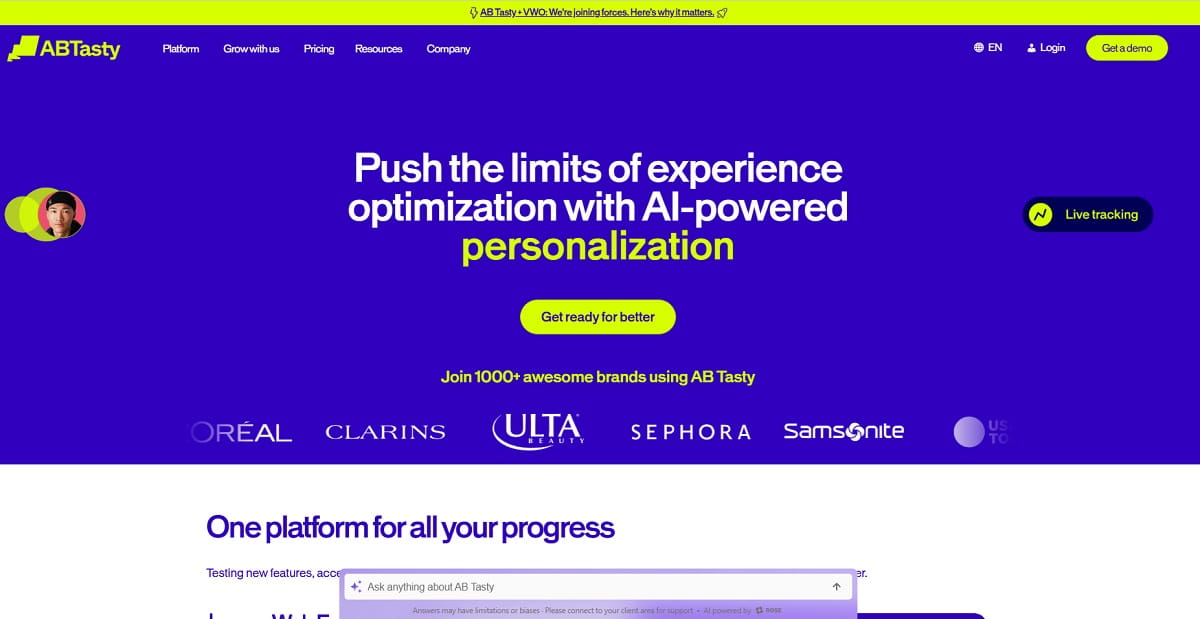
AB Tasty spent a decade as the European answer to Optimizely: a marketer-friendly experimentation and personalization suite with a visual editor, EmotionsAI segmentation, feature flags, and e-merchandising in one tag. Then, on 20 January 2026, it stopped being an independent vendor. AB Tasty and VWO announced a definitive agreement to combine, backed by Everstone Capital, creating a platform with more than $100 million in ARR and over 4,000 customers. That single fact invalidates almost every “AB Tasty alternatives” list published before this year, because nearly all of them recommend VWO — which is now the same company.
This guide rebuilds the shortlist from primary sources. Every platform below was checked against its own website, pricing page, or official documentation in September 2026 — not against older listicles. We start with Plerdy, because the most common reason an AB Tasty replacement disappoints is not the testing engine: it is that the team never had the behavioral evidence to know what was worth testing. Plerdy pairs heatmaps, session replay, funnels, and forms analytics with unlimited A/B testing on every plan, including the free one. After that we work through the enterprise suites, the mid-market platforms, and the developer-first engines that replace AB Tasty’s core job outright.
AB Tasty Alternatives At a Glance
The short answer: for mid-market teams that need behavioral evidence plus testing, use Plerdy. For a like-for-like enterprise replacement, use Optimizely or Kameleoon. For transparent mid-market pricing, use Convert Experiences or Mida. For ecommerce personalization at scale, use Adobe Target or Monetate. For engineering-led experimentation, use PostHog, GrowthBook, or Datadog Experiments.
| # | Platform | Core Strength | Entry Pricing | Best For |
|---|---|---|---|---|
| 1 | Plerdy | Behavior analytics + unlimited A/B testing | Free forever; from $21/mo annual | SMB and mid-market CRO teams |
| 2 | Optimizely | Enterprise experimentation at scale | Sales-led, custom quote | Large orgs replacing AB Tasty 1:1 |
| 3 | Kameleoon | Hybrid client/server-side + personalization | From $495/mo | Closest feature-for-feature match |
| 4 | Convert Experiences | Privacy-first testing, published rate card | From $299/mo annual | Agencies and mid-market CRO |
| 5 | Adobe Target | AI personalization inside the Adobe stack | Sales-led, custom quote | Existing Adobe Experience Cloud users |
| 6 | Monetate | Personalization + zero-flicker testing | Sales-led, custom quote | Enterprise retail and commerce |
| 7 | Webtrends Optimize | Full-stack CRO plus managed service | Sales-led, traffic-scaled | Teams that want tooling and people |
| 8 | Mida | Performance-first lean experimentation | Free 100k MTU; from $299/mo | Speed-sensitive marketing teams |
| 9 | Personyze | Personalization-led all-in-one | Free 5k views; from $149/mo | Small teams replacing AB Tasty personalization |
| 10 | Omniconvert Explore | Ecommerce CRO with a survey layer | Free 50k tested users | DTC and ecommerce optimization |
| 11 | Crazy Egg | Visual behavior insight + simple tests | From $29/mo, free tier | Marketers who want quick split tests |
| 12 | PostHog | Product analytics, flags, experiments | Generous free tier, usage-based | Product-led and technical teams |
All pricing reflects publicly listed figures verified in September 2026. Enterprise platforms in this category are almost universally sales-led, and published entry prices rarely survive contact with a real contract.
What Changed At AB Tasty In 2026: The VWO Merger
This is the part every other list on this query gets wrong, so it is worth being precise.
On 20 January 2026, AB Tasty and VWO entered a definitive agreement to combine. Everstone Capital, already VWO’s majority shareholder, invested additional capital to remain the largest institutional shareholder. VWO co-founder Sparsh Gupta became CEO of the combined organization; AB Tasty co-founders Rémi Aubert and Alix de Sagazan took the chief customer and strategy officer and chief revenue officer roles. The official VWO announcement puts the combined entity at $100 million-plus ARR and 4,000-plus customers, with close to 90% of revenue from the US and European markets. AB Tasty’s own homepage now carries “VWO & AB Tasty” branding.
What does that mean for you today? VWO’s customer-facing post is unusually direct: “All existing client relationships, contracts, pricing, service levels, and support remain unchanged.” Nothing breaks this quarter. But the same post also states that “over time, clients can expect a more integrated experience across experimentation, personalization, behavioral insights, and optimization, supported by a unified platform vision.” Two overlapping products with one roadmap owner rarely both survive as first-class citizens.
The practical consequences for your shortlist:
- VWO is no longer an AB Tasty alternative. It is the same vendor. Any list that recommends VWO as your escape route from AB Tasty is recommending you stay put. Treat them as one line item in procurement, not two.
- Renewal timing matters more than usual. If your AB Tasty contract renews before the unified platform is announced, you are negotiating without knowing which platform you will be on in two years.
- Migration leverage is highest now. Vendors on this list will discount aggressively against a consolidating competitor. Convert Experiences already advertises free VWO migration on its pricing page.
- This is not a crisis. A profitable, better-capitalized vendor with 4,000 customers is a more stable supplier than a subscale independent one. Reassess, do not panic.
If you are evaluating from the other direction, our VWO alternatives guide covers the same merger from the VWO customer’s point of view.
Why Teams Look For an AB Tasty Alternative
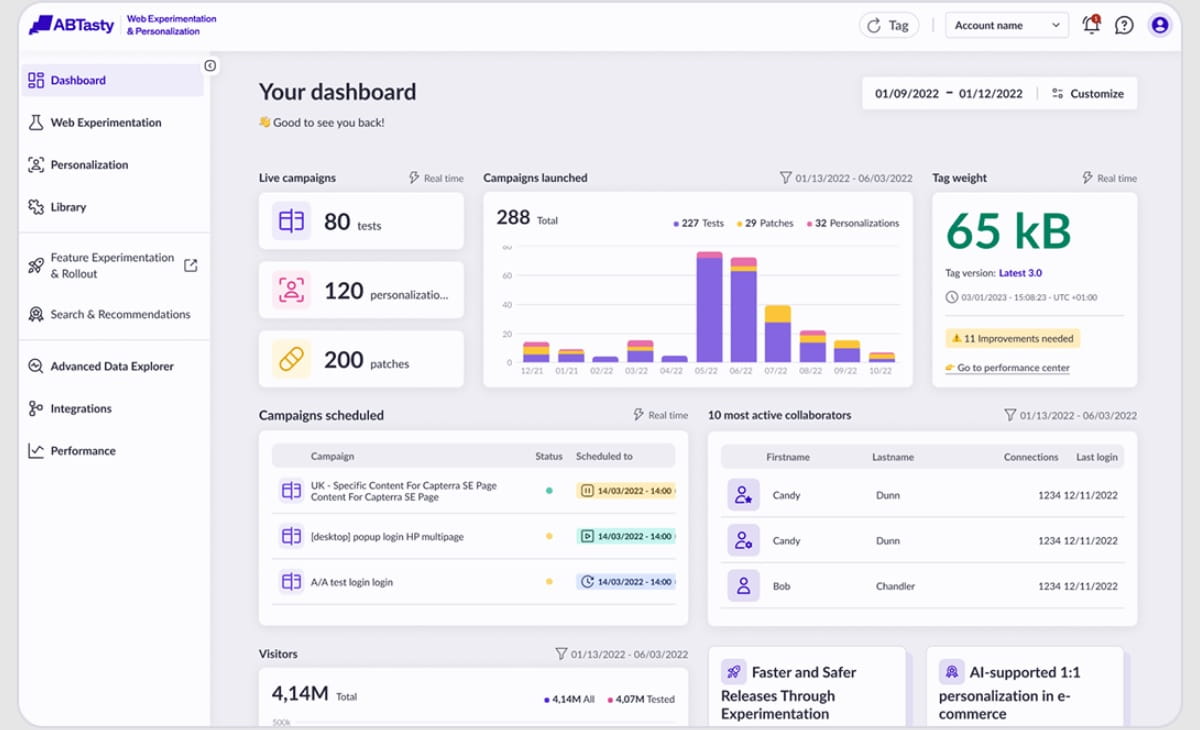
The feature list is rarely the problem. AB Tasty’s Web Experimentation, Feature Experimentation, Personalization, Rollouts, and E-Merchandising modules are genuinely capable, and EmotionsAI has no exact equivalent anywhere else. Teams leave for structural reasons.
- Opaque, enterprise-scale pricing. AB Tasty publishes no tiers; every deal is custom-quoted on traffic, seats, and modules. Third-party procurement datasets put typical annual spend well into five figures and often past $100,000. Budget owners cannot model cost before a sales call, and that alone disqualifies the platform for many mid-market teams.
- Test velocity does not justify the contract. Most teams that churn were shipping a handful of experiments per quarter. At that cadence the constraint is hypotheses and analyst bandwidth, not the engine. An enterprise licence does not fix a hypothesis shortage.
- No native session replay or heatmapping. AB Tasty is an experimentation and personalization platform, not a behavior analytics suite. The qualitative layer that tells you what to test usually arrives through a second vendor, which means a second bill.
- Consolidation uncertainty. As above: one roadmap owner, two overlapping suites, no published timeline.
- Implementation weight. Tag management, targeting logic, and QA rituals in AB Tasty are specific enough that most serious deployments involve an implementation partner. That cost lands before the first test ships.
Be honest about which of these applies to you. If your bottleneck is test velocity rather than tooling, switching platforms moves the problem instead of solving it.
What AB Tasty Actually Does — The Capabilities You Need To Replace
Before comparing anything, write down which of AB Tasty’s product areas you actually use. Most teams use two.
| AB Tasty Capability | What It Covers | Hardest To Replace? |
|---|---|---|
| Web Experimentation | A/B, MVT, and split URL tests via visual editor | No — widely available |
| Feature Experimentation | Server-side tests and feature flags across apps | Partly — needs a flags platform |
| Personalization | Segment-based experiences, AdaptiveCX predictions | Partly — few tools match the depth |
| EmotionsAI | Emotional-need segmentation of visitors | Yes — no direct equivalent |
| E-Merchandising | Search, recommendations, merchandising rules | Yes — usually a separate vendor |
| Evi and AI agents | AI hypothesis, variant, and report assistance | No — most vendors shipped this in 2026 |
If EmotionsAI or e-merchandising is load-bearing for your program, accept up front that no single replacement covers it and plan for two tools. If you only use Web Experimentation plus basic targeting — which is the common case — the market is wide open and considerably cheaper.
How We Chose These AB Tasty Alternatives
This list is deliberately built to a rule, because the fastest way to write a bad alternatives article is to pad it with tools that do not actually replace anything.
- It must do the core job. Every platform in the main list runs real A/B tests on a live website with either a visual editor or a documented no-code path. Analytics-only and survey-only tools were excluded, however good they are.
- Status verified at the source. Positioning, capabilities, and pricing were read off each vendor’s own site or docs in September 2026. Products that were acquired, absorbed, or restricted to one host platform are handled separately in their own sections rather than ranked.
- Pricing stated as published. Where a vendor publishes numbers, the numbers are here. Where a vendor is sales-led, it says so. No estimates are presented as list prices.
- Compared back to AB Tasty specifically. Each entry names the AB Tasty capability it replaces and the trade-off you accept, not a generic feature dump.
- No invented benchmarks. There is no reliable public benchmark for average conversion lift by testing platform, so none is quoted. Lift depends on your traffic, your hypotheses, and your baseline — measure it on your own site.
The 12 Best AB Tasty Alternatives And Competitors
1. Plerdy
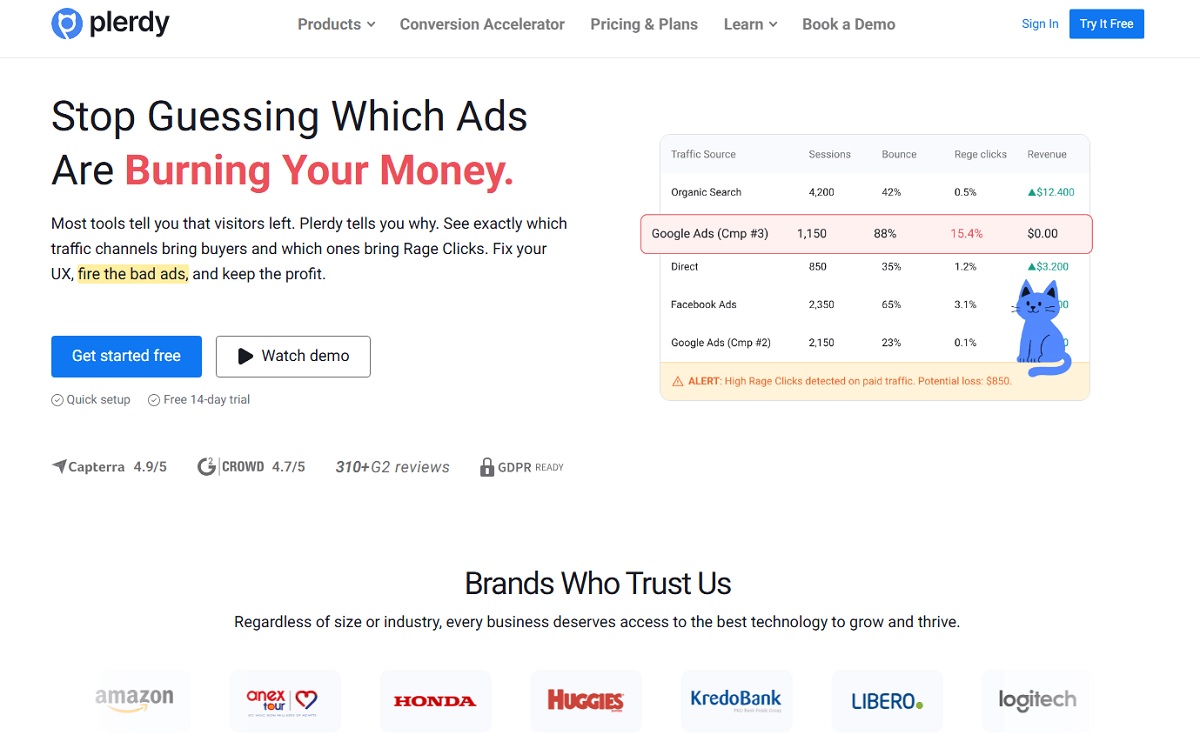
Plerdy attacks the problem from the opposite end to AB Tasty. Instead of selling a large experimentation engine and leaving you to source the qualitative layer, it bundles the evidence-gathering tools — heatmaps, session replay, conversion funnels, forms analytics, pop-up surveys, SEO checks — with unlimited A/B testing in a single script. For the very large group of teams whose real constraint is “we do not know what to test,” that ordering is the whole point.
Key Features
- Unlimited A/B testing on every plan, including the free tier, with a visual editor for colors, copy, CSS, margins, and layout
- Click, scroll, move, and stay heatmaps segmented by device, traffic source, and country
- Session replay plus conversion funnel analysis to locate the drop-off before you build a variant
- Goal tracking on button clicks and thank-you pages, with native Google Analytics 4 event integration
- Device, geography, and traffic-source targeting, plus scheduled end dates per test
Use Cases
- Ecommerce teams validating product-page and checkout changes with heatmap evidence behind each hypothesis
- SaaS marketing teams testing landing pages and pricing pages without an enterprise contract
- Agencies running CRO for multiple clients who need behavior data and testing under one bill
Pros: Behavioral evidence and experimentation in one tool; unlimited tests on all tiers; transparent public pricing; fastest setup on this list — one script and a GA4 connection.
Cons: Not an enterprise experimentation platform. No server-side feature-flag infrastructure, no EmotionsAI-style emotional segmentation, and no e-merchandising engine. If you need multi-armed bandits with a dedicated statistics team, look at Optimizely.
Pricing: Free forever plan with unlimited A/B testing. Startup $21/mo, Scale $42/mo, Thrive $70/mo, and Enterprise tiers from $97 to $253/mo on annual billing. See the Plerdy pricing page.
Best For: SMB and mid-market teams that want to close the hypothesis gap and run tests on the same budget AB Tasty would have spent on onboarding.
2. Optimizely
Optimizely is the closest thing to a like-for-like enterprise swap. It matches AB Tasty on web experimentation, adds deeper server-side and feature-flag capability, and now leads with what it calls Agentic Experimentation — AI woven through the hypothesis, build, and analysis stages. If your AB Tasty deployment is genuinely enterprise-grade, this is the shortlist entry your procurement team will expect to see.
Key Features
- A/B, multivariate, multi-page, and server-side testing with a mature visual editor
- Feature Management for flags, progressive rollouts, and kill switches
- Statistics engine designed for always-valid inference and peeking resistance
- Behavior-based audience targeting and experiment governance for large teams
- Agentic Experimentation layer for AI-assisted test creation and analysis
Use Cases
- Enterprises running dozens of concurrent experiments across multiple properties
- Organizations that need experiment governance, approvals, and audit trails
- Teams combining marketing tests with product feature rollouts on one platform
Pros: Genuine enterprise depth; the strongest statistics story in the category; scales past where mid-market tools stop; well-supported SDK ecosystem.
Cons: Every plan is individually packaged and quoted — Optimizely states plainly that there is no rate card. Implementation and enablement are real projects. Overkill for teams shipping under ten tests a quarter.
Pricing: Sales-led. Optimizely confirms on its plans page that every plan is individually packaged. No free tier.
Best For: Large organizations replacing AB Tasty one-for-one without reducing scope. Our Optimizely alternatives guide covers the reverse comparison.
3. Kameleoon
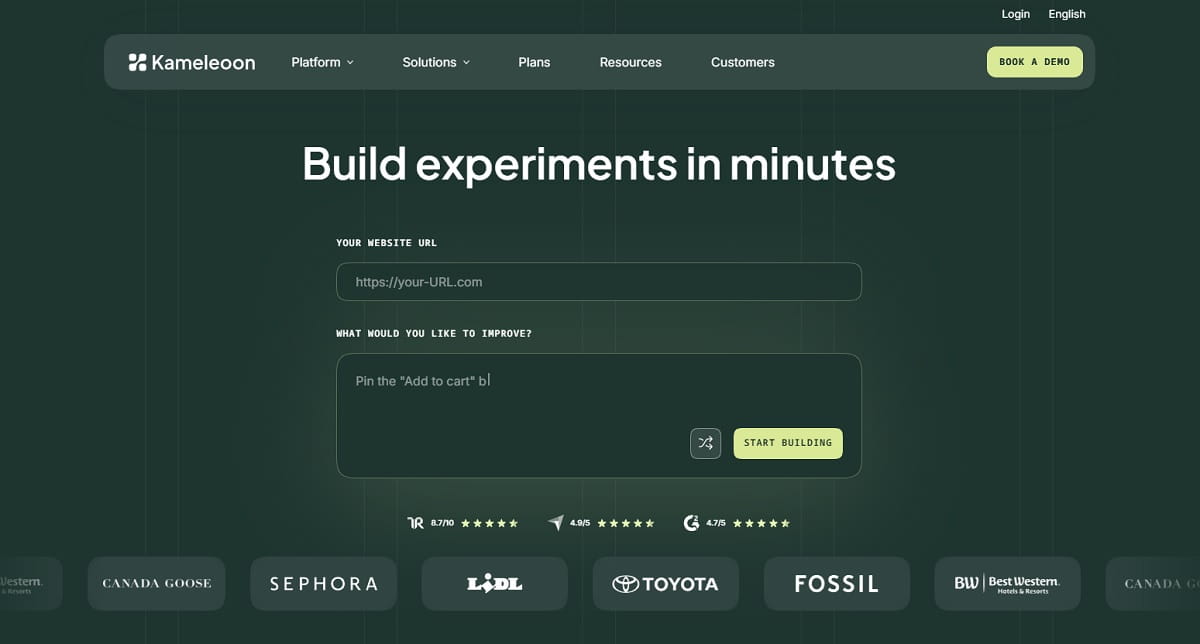
If you want the smallest possible behavioral change for your team, Kameleoon is the answer. It is the other major European experimentation vendor, it covers the same job areas AB Tasty does — web testing, feature management, personalization, mobile app testing, recommendations — and it now publishes an entry price, which AB Tasty never did.
Key Features
- Hybrid client-side and server-side delivery, which limits flicker on critical templates
- Prompt-Based Experimentation for building variants from natural-language instructions, with full code access retained
- Feature management and progressive rollouts alongside marketing tests
- AI-driven personalization and product recommendations
- Mobile app experimentation via native SDKs
Use Cases
- Privacy- and residency-sensitive organizations in the EU that want an EU-headquartered vendor
- Teams migrating an existing AB Tasty setup with minimal retraining
- Sites where flicker on above-the-fold templates has been a recurring complaint
Pros: Nearest functional twin to AB Tasty; published starting price; hybrid delivery is a genuine technical advantage; strong European privacy posture.
Cons: The $495/mo Starter tier caps at 10 experiments and 50,000 monthly tracked users, so most real programs land in the custom Enterprise tier quickly. Premium modules are priced as add-ons and are not itemized publicly.
Pricing: Starter free trial for 30 days with 3 experiments. Starter from $495/mo with 10 experiments and 50,000 monthly tracked users. Enterprise is custom.
Best For: Teams that want a feature-for-feature AB Tasty replacement rather than a rethink of their program.
4. Convert Experiences
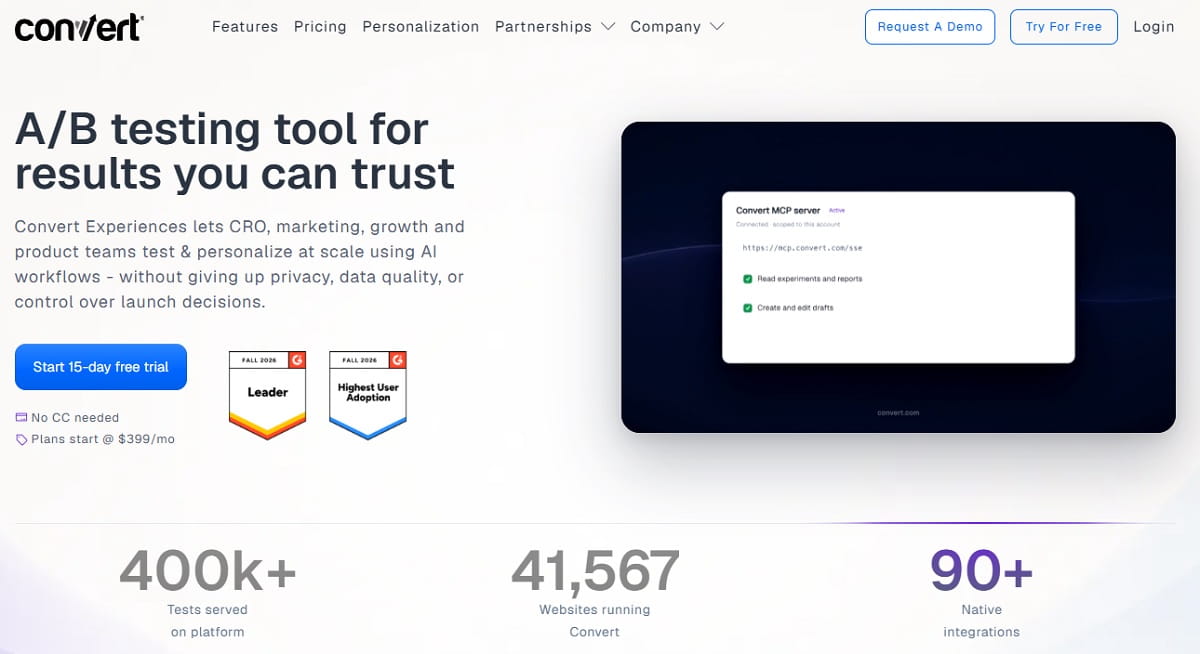
Convert is the transparency play. In a category where nearly everyone hides pricing, Convert publishes a rate card, a tested-user allowance, and a feature matrix — and it explicitly advertises free VWO migration, which is unusually relevant now that VWO and AB Tasty are one vendor.
Key Features
- A/B, split URL, multivariate, and multi-page testing with a visual and code editor
- Full-stack testing and feature flags on the Pro tier
- Multi-arm bandit auto-allocation and sequential testing
- Convert Signals and built-in heatmaps for lightweight behavioral context
- QA Wizard and sample-ratio-mismatch checks built into the workflow
Use Cases
- Agencies that need predictable per-client costs and collaborator seats
- Privacy-conscious teams that want minimal third-party data sharing
- Mid-market CRO programs migrating off an enterprise contract without losing test types
Pros: Published pricing with real numbers; strong test-integrity tooling such as the SRM check and QA wizard that many pricier tools lack; free migration assistance; a 15-day trial with no card.
Cons: Multivariate testing, full-stack, feature flags, and bandits sit behind the Pro tier. No personalization engine on AB Tasty’s scale and no e-merchandising. The tested-user allowance of 100,000 per month on both self-serve tiers is modest for high-traffic sites.
Pricing: Growth $399/mo monthly or $299/mo annual. Pro $599/mo monthly or $420/mo annual. Enterprise on request. Both self-serve tiers include 100,000 tested users per month.
Best For: Mid-market teams and agencies that want AB Tasty’s testing capability with a rate card they can put in a budget spreadsheet.
5. Adobe Target
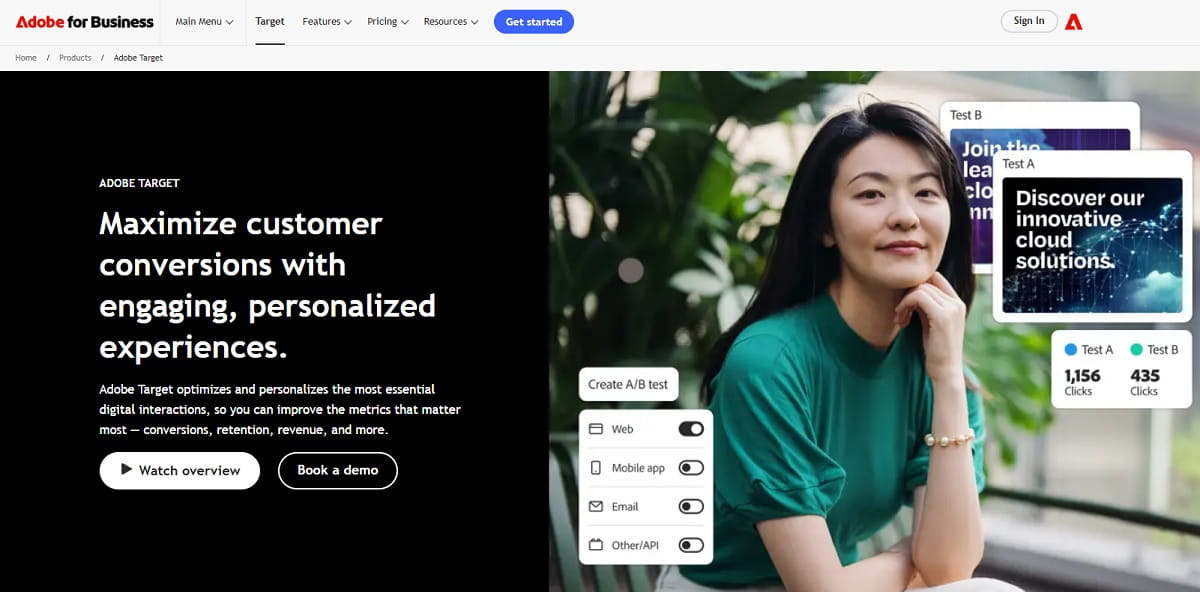
Adobe Target is the testing and personalization module of Adobe Experience Cloud, and it is the natural destination for AB Tasty customers who already own Adobe Analytics or Adobe Experience Platform. Its AI personalization — Auto-Target and Automated Personalization — is the closest mainstream analogue to what AB Tasty sells as AdaptiveCX.
Key Features
- A/B, multivariate, and multi-armed bandit optimization
- Auto-Target and Automated Personalization for algorithmic experience selection
- Shared audiences with Adobe Analytics and Adobe Experience Platform
- Server-side delivery and profile scripts for advanced targeting logic
- A rapidly expanding set of purpose-built AI agents across the Adobe stack
Use Cases
- Enterprises already committed to Adobe Experience Cloud
- Personalization programs that depend on unified customer profiles
- Regulated industries needing enterprise governance and support SLAs
Pros: Deepest personalization AI in the mainstream market; shared audiences remove a whole data-plumbing layer; enterprise support and compliance posture.
Cons: Not really a standalone product — cost and value both scale with how much Adobe you own. No published pricing. Implementation is heavy: tag management, profile scripts, and usually a partner. Standalone deployments face the strongest competitive pressure precisely because they do not use the integrations that justify the price.
Pricing: Sales-led and custom. Adobe publishes no list price for Experience Cloud modules.
Best For: Existing Adobe customers who want personalization and testing inside one stack. Our Adobe Target alternatives guide covers the opposite direction.
6. Monetate
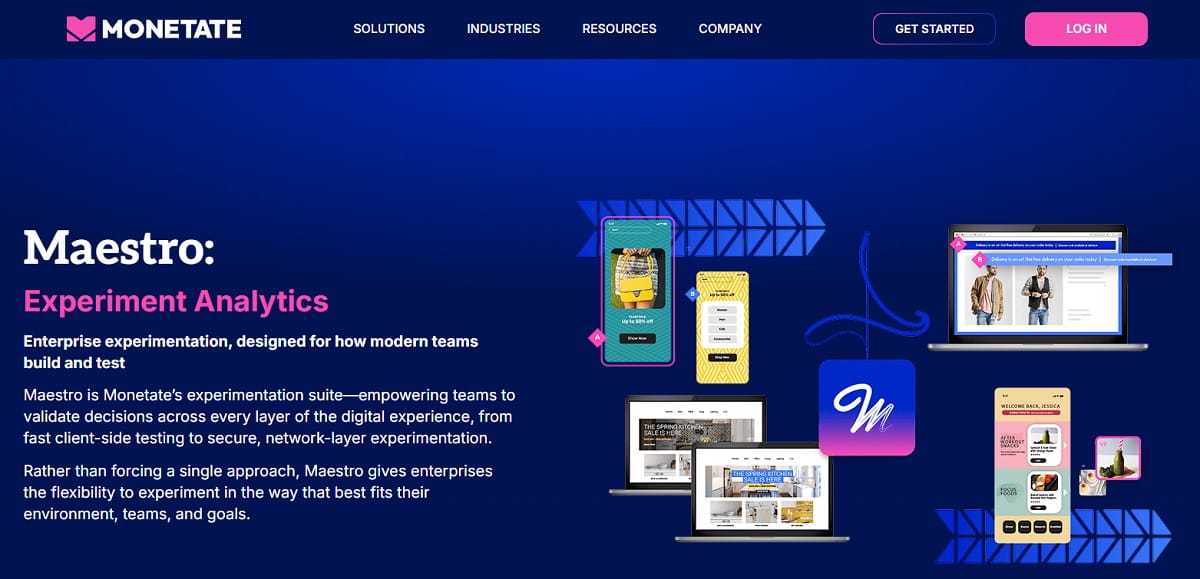
Monetate is the enterprise personalization specialist that absorbed the category’s best server-side testing engine. It acquired SiteSpect on 30 June 2025 and relaunched the combined offer as an Experience Optimization Platform, with the testing suite branded Maestro. In July 2026 it also acquired Simon AI, adding composable CDP capability.
Key Features
- Server-side, zero-flicker experiment delivery inherited from SiteSpect
- Real-time AI personalization and product recommendations
- Unified experimentation, personalization, and discovery in one platform
- Enterprise strategy consulting alongside the software
- CDP capability following the Simon AI acquisition
Use Cases
- High-traffic retail sites where flicker or client-side latency is unacceptable
- Enterprise personalization programs replacing AB Tasty’s E-Merchandising module
- Organizations that want a vendor with an in-house strategy team, not just a licence
Pros: Best-in-class zero-flicker delivery; genuine enterprise personalization depth; a single vendor for testing, personalization, and customer data.
Cons: Slowest to implement on this list by design — server-side delivery requires infrastructure work before the first test ships. Sales-led with no published pricing. Three acquisitions in roughly a year means integration risk of its own, so ask hard questions about roadmap.
Pricing: Sales-led and custom quote.
Best For: Enterprise retail and commerce teams replacing AB Tasty’s personalization and merchandising side.
7. Webtrends Optimize
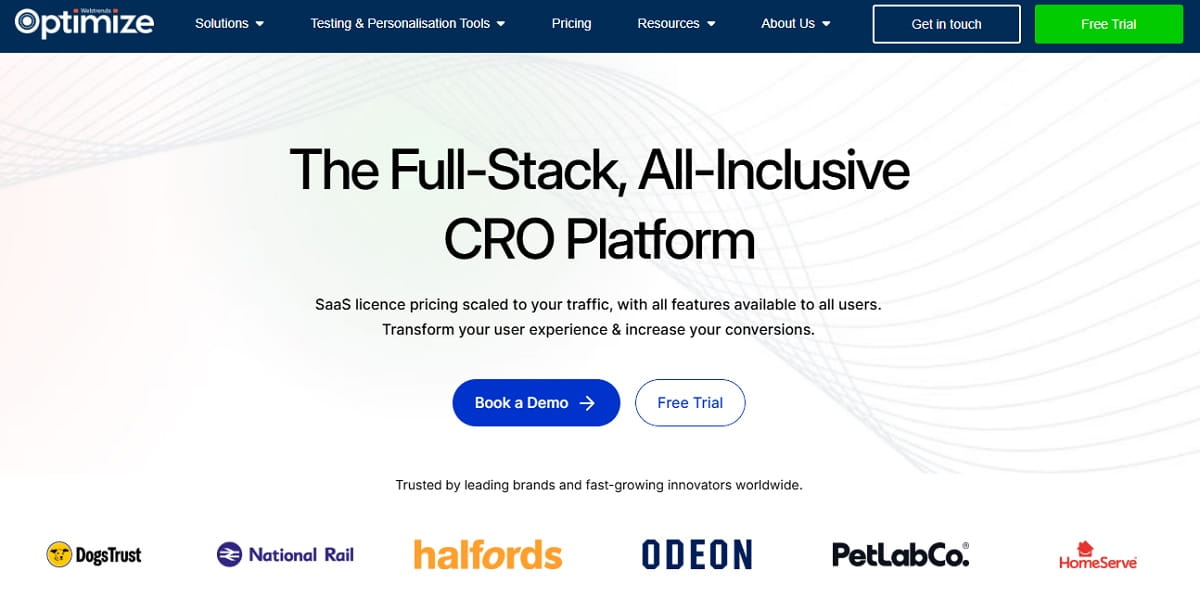
Webtrends Optimize is the tooling-plus-people option. It positions itself as a full-stack, all-inclusive CRO platform with licence pricing scaled to traffic, and it will supply the analysts and developers to run the program if your team cannot. For AB Tasty customers whose real problem was a hypothesis shortage rather than a feature gap, that combination is more useful than a bigger engine.
Key Features
- ABn testing, full and fractional multivariate tests, and multi-armed bandits
- Real-time behavioral personalization using affinity models and imported warehouse profiles
- Server-side experimentation, feature flags, REST and JSON APIs, URL redirects, and mobile app testing
- Data-driven merchandising, product recommendations, social proof messaging, and surveys
- Optional managed service with strategists and developers
Use Cases
- Teams with budget but no in-house CRO headcount
- Programs needing a broad test-type catalogue without stitching several vendors together
- Sites that require server-side delivery and data-warehouse-driven segmentation
Pros: Very broad feature surface for the price bracket; managed service closes the resourcing gap; strong on advanced test designs such as fractional multivariate tests.
Cons: Smaller brand and community than Optimizely or Adobe, so fewer independent tutorials and integrations. Pricing is not fully published — traffic-scaled licences are quoted on request. The interface is less polished than the market leaders.
Pricing: SaaS licence scaled to traffic, with a free trial available and figures on request.
Best For: Mid-market and enterprise teams that want the platform and the people from one supplier.
8. Mida
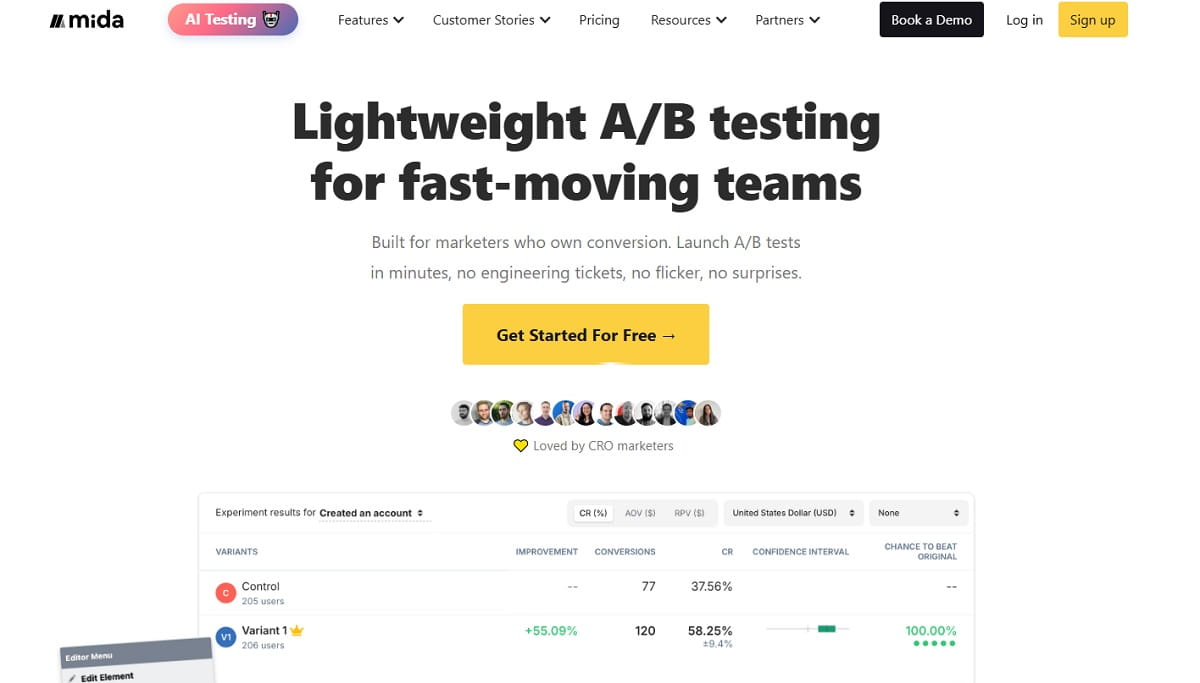
Mida is the deliberate anti-enterprise option, and it is the only vendor currently ranking for this query on a genuine product page rather than a blog post. Its pitch is narrow and credible: fast experiment delivery, a visual editor, AI-assisted variant creation, and pricing that does not require a procurement cycle.
Key Features
- Performance-first experiment delivery aimed at minimizing Core Web Vitals impact
- Visual editor plus AI credits for variant and hypothesis generation
- Personalization and advanced targeting rules on the Growth tier
- Monthly Tested Users pricing model with a clearly documented counting method
- Works on hosted site builders including Webflow, Wix, and Framer
Use Cases
- Marketing teams on site builders where heavier tags cause measurable slowdown
- Lean teams that want a free tier with real capacity rather than a 14-day trial
- Agencies needing predictable per-project costs
Pros: Genuinely free Sandbox tier at 100,000 monthly tested users with no time limit; the site-speed story is the clearest in the category; simple published pricing.
Cons: Sandbox caps at 2 variants, 2 tests, and 2 goals with 60-day retention. No enterprise governance, no e-merchandising, and no EmotionsAI equivalent. Smaller vendor, so assess continuity risk if you are an enterprise buyer.
Pricing: Sandbox free with 100,000 monthly tested users. Growth $299/mo billed annually, scaling to 2 million tested users. Enterprise is custom with a CRO consultant included.
Best For: Speed-sensitive marketing teams that want to keep testing after cancelling an enterprise contract.
9. Personyze
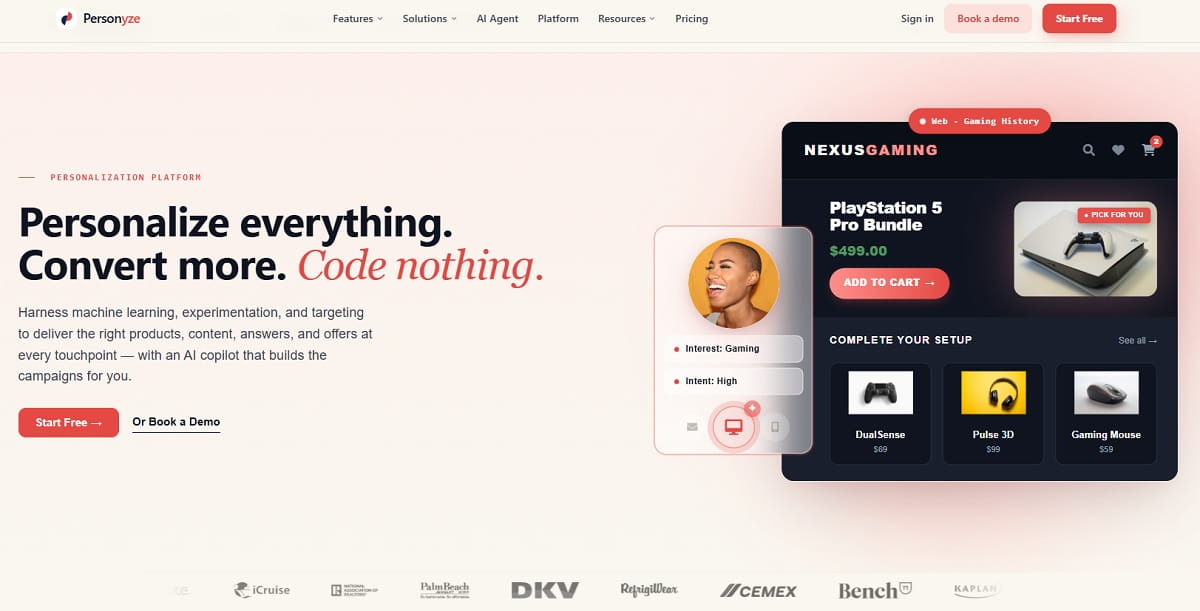
Personyze is the closest small-team analogue to AB Tasty’s personalization-plus-testing pairing. Behavioral personalization, A/B testing, AI content and product recommendations, banners and popups, and email recommendations all run off one tag — and unlike AB Tasty, every module is available on every plan, including the free one.
Key Features
- One-to-one personalization with behavioral, referral, CRM, and geographic triggers
- A/B testing and dynamic landing pages included at all tiers
- AI product and content recommendations, plus an AI copilot and page-level AI
- Targeted banners, popups, and social proof messaging
- Email recommendations through Klaviyo, HubSpot, and other providers from the Growth tier up
Use Cases
- Small ecommerce teams replacing AB Tasty’s personalization module on a fraction of the budget
- Publishers personalizing content recommendations by segment
- Teams wanting testing and onsite messaging without a second vendor
Pros: Every module on every plan; published pricing across five clear tiers; a 30-day money-back guarantee; genuinely cheap entry into personalization.
Cons: Pageview allowances are tight at the low end, at 5,000 per month on Free and 50,000 on Starter. Mobile SDKs and full API access require the Enterprise tier. Statistical reporting is lighter than dedicated experimentation platforms, so this is not the tool for a rigorous testing program.
Pricing: Free with 5,000 pageviews on one domain. Starter $149/mo with 50,000. Growth $250/mo, or $225/mo annual, with 100,000. Power $450/mo with 1 million. Enterprise from $1,450/mo with 10 million.
Best For: Small and mid-size teams whose AB Tasty usage was mostly personalization and onsite messaging.
10. Omniconvert Explore
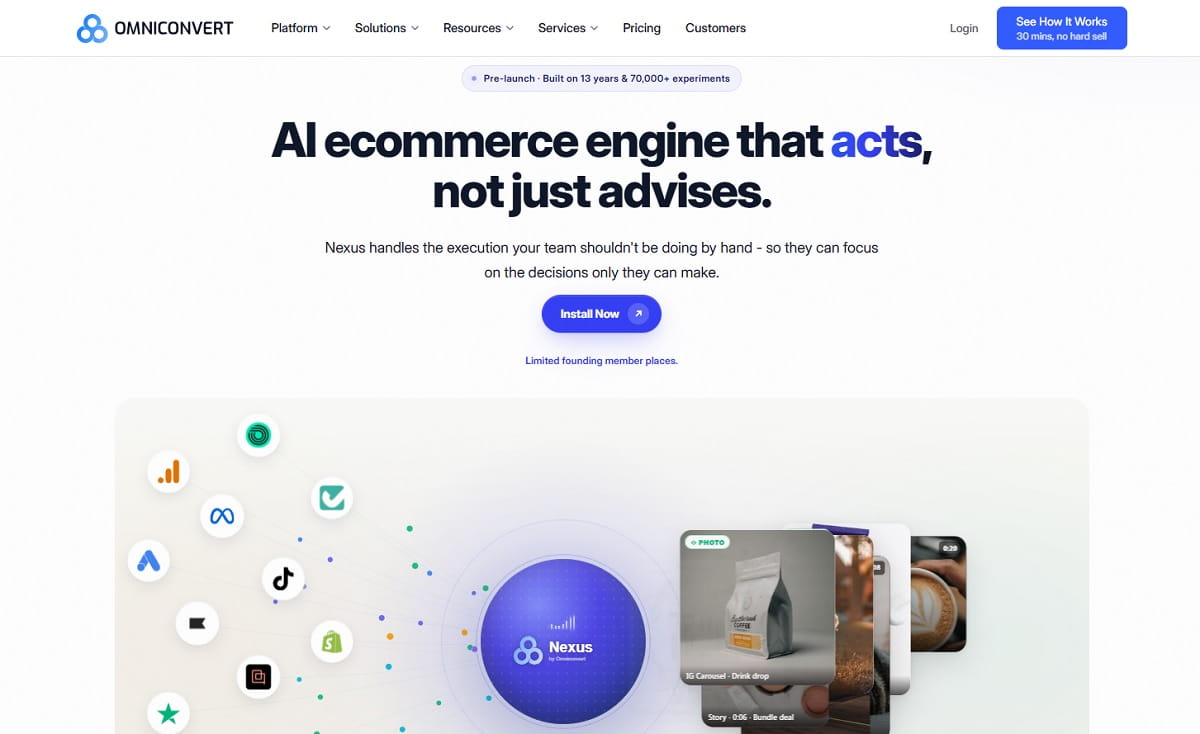
Omniconvert Explore is an ecommerce-first CRO platform that pairs A/B testing with an on-site survey layer, which makes it unusually good at generating the hypotheses that testing platforms assume you already have. Its current free tier is the most generous in the category.
Key Features
- A/B, split URL, and multivariate testing with a visual editor
- Web personalization and overlay campaigns
- Built-in on-site surveys, plus Pulse for NPS and customer experience
- Advanced segmentation for ecommerce behaviours and customer-value cohorts
- Full platform access on the free plan without feature gates
Use Cases
- Direct-to-consumer and ecommerce brands running a continuous survey, hypothesis, and test cycle
- Teams that need customer-value segmentation alongside experiments
- Shops validating merchandising and product-page changes on modest traffic
Pros: Free plan at 50,000 tested users per month with no feature limits; surveys plus testing in one tool closes the hypothesis loop; ecommerce segmentation is stronger than in general-purpose tools.
Cons: Paid tier prices are shown only through an in-app calculator, so budgeting requires a quote. Less suited to non-ecommerce use cases. Feature-flag and server-side capability is limited compared with Optimizely or Kameleoon.
Pricing: Explore free at 50,000 tested users per month, billed annually, with no card required. Paid tiers scale by tested users through 2 million and above. Pulse Expert from $290 per year.
Best For: Ecommerce and direct-to-consumer teams that want testing and voice-of-customer in the same platform.
11. Crazy Egg
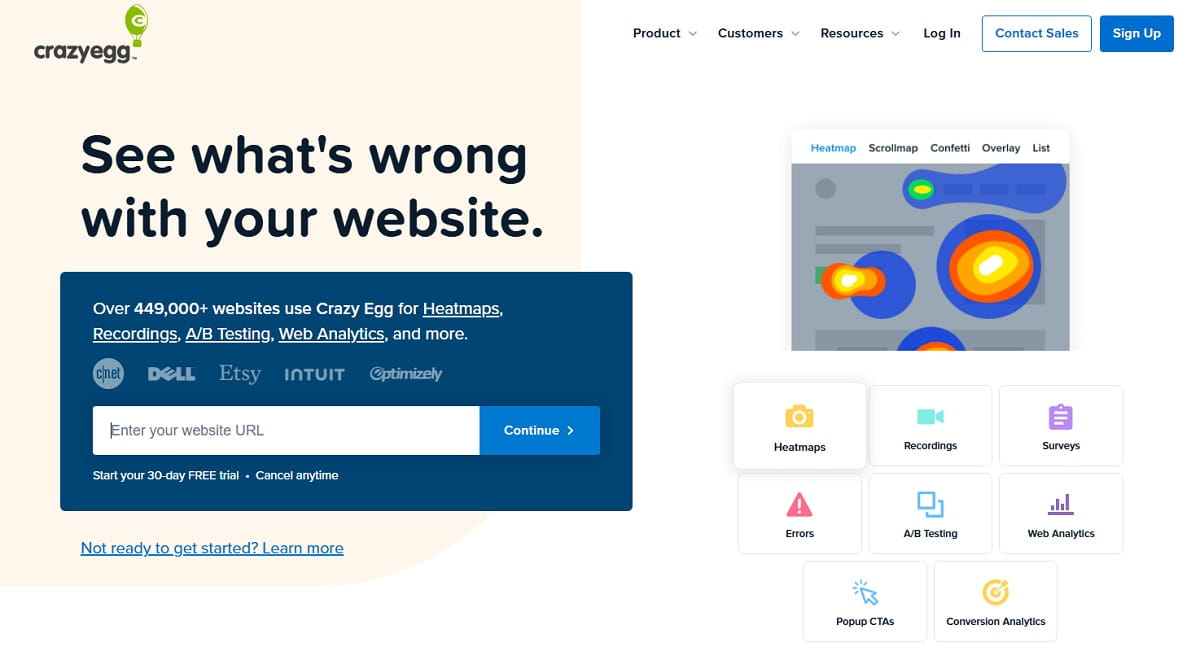
Crazy Egg is the visual-behavior specialist that also runs split tests, and it belongs on this list for the same reason Plerdy does: it covers the layer AB Tasty leaves to integrations. Six heatmap types, session recordings, surveys, and AI summaries give marketers the qualitative read, with straightforward A/B testing on top.
Key Features
- Click, scroll, move, confetti, overlay, and list heatmaps
- Session recordings with segment and behavior filters
- Built-in A/B testing on copy, calls to action, images, layouts, and signup flows
- On-site surveys and AI summaries across heatmap, survey, and recording data
- Traffic-source and device segmentation of every report
Use Cases
- Marketing teams that want visual evidence before and after each test
- Content and landing-page owners running simple two-variant tests
- Teams replacing AB Tasty’s testing with something a non-technical marketer can operate alone
Pros: Excellent heatmap depth; genuinely easy to operate; free tier plus low entry price; combines behavior data and testing.
Cons: No server-side testing, no feature flags, no personalization engine, and no multivariate depth. Not a replacement for AB Tasty’s enterprise capability — it replaces the marketing-testing slice only.
Pricing: From $29/mo with a free tier available.
Best For: Marketers who need quick split tests plus strong behavioral evidence. See our Crazy Egg alternatives comparison for the reverse view.
12. PostHog
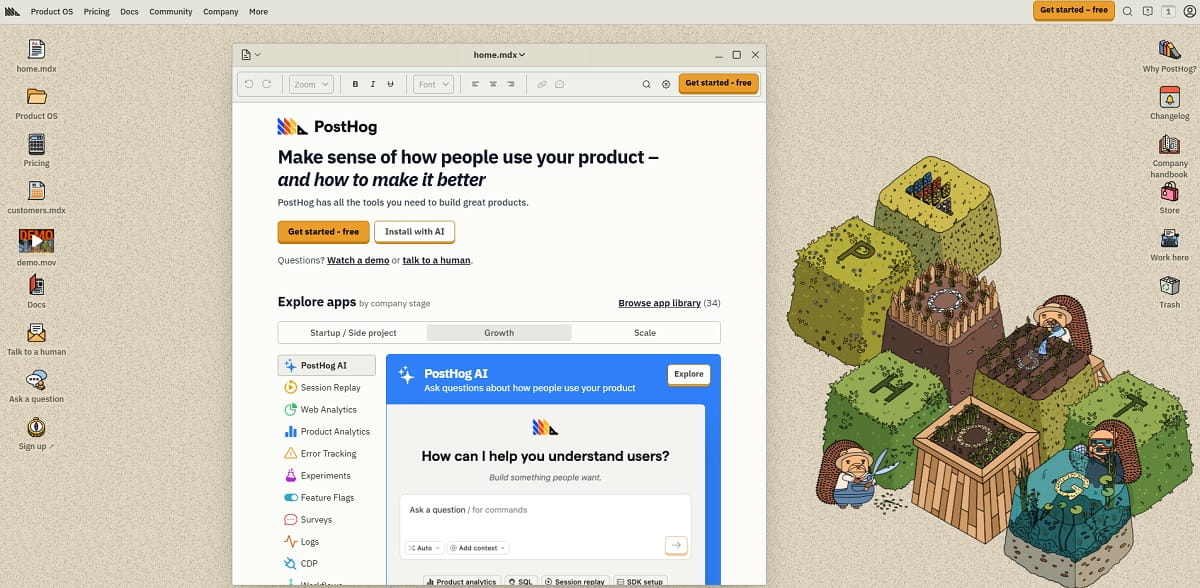
PostHog is what AB Tasty would look like if it had been built for product teams. Experiments, feature flags, product analytics, session replay, surveys, and error tracking sit in one open-source-rooted platform with a very generous free tier — and it now has a no-code web experiment editor, which puts it within reach of marketers too.
Key Features
- Experiments billed with feature flags, including 1 million free flag requests per month
- No-code web experiments via the PostHog toolbar, currently in beta, for text, CSS, and HTML changes
- Product analytics, session replay, surveys, and error tracking on the same event stream
- SDKs across every major language and framework for server-side experimentation
- Self-hosting available for teams with data residency requirements
Use Cases
- Product-led SaaS teams testing in-app flows and marketing pages together
- Engineering-led organizations that want flags and experiments in one system
- Teams consolidating analytics, replay, and experimentation to cut vendor count
Pros: The free tier is large enough to run a real program; one event stream for analytics, replay, and experiments; usage stops at free-tier limits so you cannot be surprise-billed; open source heritage.
Cons: The no-code web editor is explicitly beta, and PostHog’s own documentation recommends against it for single-page applications built on React, Vue, or Angular because re-rendering overwrites changes. Script tags, iframes, and data URIs are blocked. No personalization engine and no e-merchandising. Marketing-only teams will find the platform engineer-shaped.
Pricing: A monthly free tier on every product, then usage-based pay-as-you-go. Experiments are billed with feature flags.
Best For: Product-led and technical teams that want experimentation next to their analytics. See our PostHog alternatives guide for the other direction.
Developer-First AB Tasty Alternatives
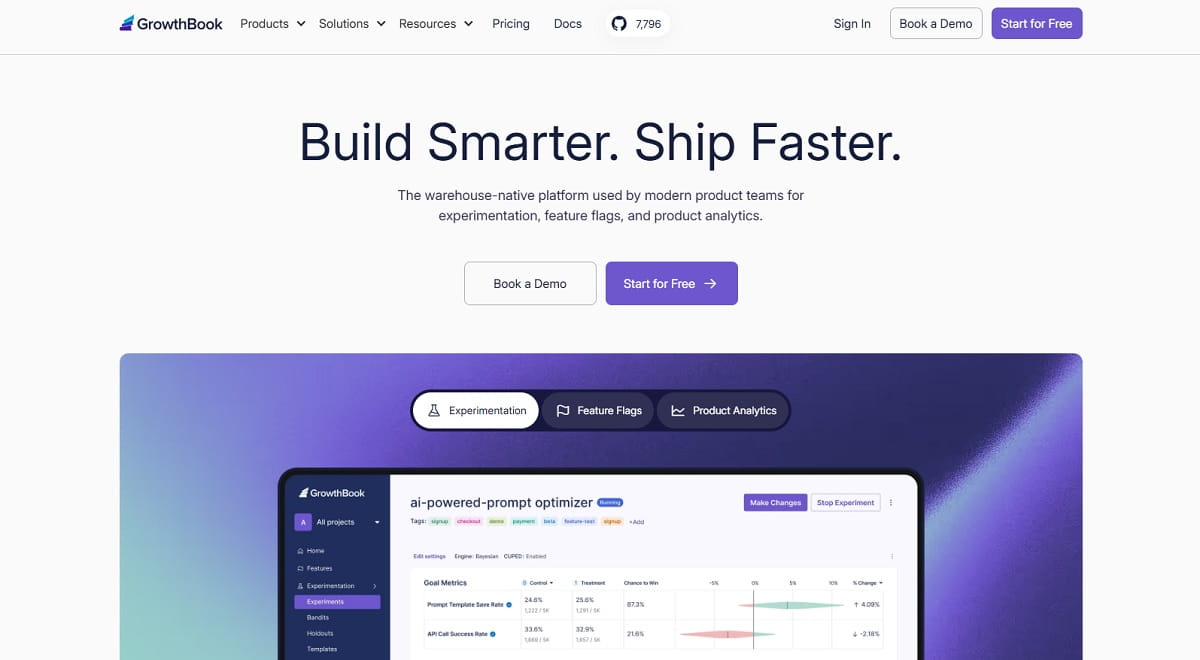
If nobody on your team needs a visual editor, the economics change completely. These platforms replace AB Tasty’s Feature Experimentation and Rollouts modules, not its marketer-facing side.
GrowthBook
Open-source experimentation that runs analysis directly against your warehouse — Snowflake, BigQuery, Redshift, Databricks, or ClickHouse — so experiment data never leaves your infrastructure. Cloud Starter is free for up to 3 seats with unlimited flags and experiments, Pro is $40 per seat per month up to 50 users, and self-hosted open source is free with unlimited seats. The visual editor and multi-armed bandits sit in the Enterprise tier.
Best For: Engineering teams that want full control, self-hosting, or strict data residency.
Datadog Experiments, Formerly Eppo
Eppo built the strongest warehouse-native statistics engine in the category, with CUPED variance reduction, sequential testing, and contextual bandits, and it is now part of Datadog and rebranded as Datadog Experiments. It is an excellent engine and a poor AB Tasty swap for marketers, because there is no meaningful visual editor. Pricing is sales-led.
Best For: Data teams already standardized on Datadog.
LaunchDarkly
Feature management first, experimentation second. If your AB Tasty usage was mostly Rollouts and progressive delivery rather than marketing tests, LaunchDarkly is the more natural home for that workload, with a free developer tier and usage-based paid plans.
Best For: Release-driven engineering organizations.
AB Tasty Alternatives To Approach With Care
Several products that appear on older AB Tasty lists no longer belong there. Each of these is a real product — the problem is a mismatch between what the listicles claim and what you can actually buy in 2026.
- VWO is now the same company as AB Tasty following the January 2026 combination. Recommending it as your alternative is recommending your current vendor.
- Statsig currently ranks second for this query on its own comparison page, and its ownership has changed twice in nine months. OpenAI acquired Statsig in September 2025 for $1.1 billion, and in May 2026 Amplitude took on the Statsig brand, platform, and customers while the original engineering team stayed at OpenAI. Amplitude has committed to maintaining and developing the platform across cloud and warehouse deployments, and trade press has noted that the deal raised legitimate continuity questions among customers. The product works today, but ask directly about roadmap ownership before signing multi-year.
- Webflow Optimize is the former Intellimize, acquired by Webflow in April 2024. It is a capable A/B testing and AI personalization tool that now requires your site to be on Webflow. If you are not, it is not an option.
- Zoho PageSense is often recommended as the budget pick, but A/B testing and personalization are Enterprise-tier features on Zoho’s published plan matrix. The Free and Professional tiers give you heatmaps and session recording only.
- Mastercard Dynamic Yield is still a strong ecommerce personalization engine, but Mastercard acquired it in 2022 and its old domain now redirects to a Mastercard product page. Expect an enterprise, relationship-led buying process.
- Google Optimize was discontinued on 30 September 2023. It still appears on alternatives lists. It does not exist.
The 2026 Consolidation Map: Who Owns What Now
Experimentation consolidated harder in the last eighteen months than in the previous five years. This table is the single most useful artifact to have open when someone sends you a 2024 shortlist.
| Product | Status In September 2026 | What Happened | When |
|---|---|---|---|
| AB Tasty | Combined with VWO | Definitive agreement, backed by Everstone Capital | Jan 2026 |
| VWO | Combined with AB Tasty | Same entity, with Sparsh Gupta as CEO | Jan 2026 |
| SiteSpect | Now Monetate Maestro | Acquired by Monetate | Jun 2025 |
| Simon AI | Part of Monetate | Acquired by Monetate | Jul 2026 |
| Statsig | Brand and customers at Amplitude | OpenAI bought the company, Amplitude took the platform | Sep 2025 and May 2026 |
| Eppo | Now Datadog Experiments | Acquired by Datadog | 2025 |
| Intellimize | Now Webflow Optimize | Acquired by Webflow, Webflow-only | Apr 2024 |
| Dynamic Yield | Mastercard product | Acquired by Mastercard | 2022 |
| Split | Part of Harness | Acquired by Harness | 2024 |
| Google Optimize | Discontinued | Sunset by Google | Sep 2023 |
Two lessons follow. First, verify ownership before you shortlist, because a third of the names on a two-year-old list have changed hands. Second, the vendors that stayed independent and published their pricing — Convert, Mida, Personyze, Omniconvert, Plerdy — are now a meaningfully different category of supplier from the ones inside private-equity roll-ups.
Best AB Tasty Alternatives By Use Case
| Your Situation | Recommended Platform | Why |
|---|---|---|
| You do not know what to test | Plerdy | Heatmaps, replay, and funnels plus unlimited A/B testing in one tool |
| Enterprise one-for-one replacement | Optimizely | Matches scope, statistics, and governance |
| Smallest change for your team | Kameleoon | Nearest feature twin with a published entry price |
| You need a rate card | Convert Experiences or Mida | Both publish real numbers |
| Already on Adobe | Adobe Target | Shared audiences remove the data-plumbing layer |
| Zero-flicker at enterprise scale | Monetate | Server-side delivery inherited from SiteSpect |
| No CRO headcount | Webtrends Optimize | Platform plus managed service |
| Personalization on a small budget | Personyze | Every module on every plan from $149/mo |
| Ecommerce hypothesis loop | Omniconvert Explore | Surveys and testing together, free at 50,000 users |
| Product-led SaaS team | PostHog | Experiments, flags, analytics, and replay on one event stream |
| Warehouse-native, engineers only | GrowthBook or Datadog Experiments | Analysis runs on your own data |
| Site speed is the constraint | Mida | Performance-first delivery is its whole pitch |
What Actually Breaks When You Migrate Off AB Tasty
The engine swap is the easy part. These five things cost real time, and none of them appear in a vendor demo.
- EmotionsAI segments do not port. AB Tasty’s emotional-need segmentation has no direct equivalent. If campaigns are built on those segments, you are not migrating them — you are rebuilding the targeting logic from behavioral primitives on the new platform. Export the segment definitions and the results before your contract lapses.
- Historical experiment data stays behind. Past results live in AB Tasty. Export the experiment library, hypotheses, variants, and outcomes as your institutional memory, because after the contract ends you cannot retrieve them. Teams consistently underestimate this and lose years of learning.
- Your measurement baseline resets. Different platforms count visitors, sessions, and tested users differently, and they use different statistical engines. Conversion rates on the new tool will not match the old numbers exactly, and that is not a bug. Run both in parallel for one full testing cycle if the contract allows — it is the cheapest insurance available.
- Flicker comes back if you move to a lighter client-side tool. A well-tuned AB Tasty implementation hides its own latency. Test anti-flicker handling on your slowest template before you sign, not after. This is where Kameleoon’s hybrid delivery and Monetate’s server-side layer earn their premium.
- QA rituals are platform-specific. Preview links, targeting previews, and delivery rules are muscle memory for your team. Expect a slower first quarter, and budget for it in your program forecast rather than treating the dip as a failure of the new tool.
Before any of this, close the hypothesis gap. Run Plerdy’s heatmaps and session replay on your key templates for two weeks and see whether your test backlog is actually full. If it is not, the platform was never the bottleneck.
How To Choose the Right AB Tasty Alternative
Answer four questions in order. The answers narrow twelve options to two.
- Which AB Tasty modules do you actually use? If it is Web Experimentation plus basic targeting, almost everything on this list works and you will save a lot of money. If EmotionsAI, AdaptiveCX, or E-Merchandising is load-bearing, accept that you need two tools and plan the budget accordingly.
- Who runs the tests? Marketers need a visual editor, which points to Plerdy, Kameleoon, Convert, Optimizely, Mida, Crazy Egg, or Personyze. Engineers do not, which points to GrowthBook, Datadog Experiments, LaunchDarkly, and PostHog’s SDK path.
- Is your bottleneck testing or knowing what to test? If you shipped fewer than roughly ten experiments last quarter, the constraint is hypotheses, not tooling. Start with behavioral evidence before buying a bigger engine — that is why Plerdy leads this list rather than Optimizely.
- Where must the data live? Warehouse-native or self-hosted requirements point to GrowthBook, PostHog, or Datadog Experiments. European residency points to Kameleoon. Standard software as a service is fine for everyone else.
Then run a paid pilot on your real traffic before signing anything annual. Every vendor here demos beautifully, and only your own data tells you whether the platform fits. Negotiate now, too, because a consolidating incumbent is the best leverage a buyer gets.
Frequently Asked Questions
What Is the Best AB Tasty Alternative In 2026?
There is no single best option, because AB Tasty does several different jobs. For enterprise experimentation at the same scope, Optimizely is the closest like-for-like replacement. For the nearest feature-for-feature twin with a published entry price, it is Kameleoon at $495 per month. For mid-market teams that need behavioral evidence alongside testing at a realistic price, Plerdy is the strongest fit, with unlimited A/B testing from the free plan upward.
Did AB Tasty Merge With VWO?
Yes. On 20 January 2026 AB Tasty and VWO announced a definitive agreement to combine, backed by Everstone Capital, forming a platform with more than $100 million in annual recurring revenue and over 4,000 customers. VWO co-founder Sparsh Gupta leads the combined organization. VWO has stated that existing contracts, pricing, service levels, and support remain unchanged, while also pointing to a unified platform vision over time. Treat VWO and AB Tasty as one vendor in procurement.
Is AB Tasty Being Discontinued?
No. AB Tasty is actively sold and developed, and its site still lists Web Experimentation, Feature Experimentation, Personalization, Rollouts, E-Merchandising, EmotionsAI, Evi, and AdaptiveCX. What has changed is that its roadmap now sits with the combined VWO organization, which has said it intends to move toward a unified platform without publishing a timeline. That is a planning consideration, not an end-of-life notice.
How Much Does AB Tasty Cost Compared To the Alternatives?
AB Tasty publishes no pricing, every contract is custom-quoted on traffic, seats, and modules, and third-party procurement data puts typical annual spend in the tens of thousands of dollars and often well above $100,000. Among alternatives with published figures, Plerdy is free forever or from $21 per month annually, Personyze from $149 per month, Mida free to 100,000 tested users then $299 per month annually, Convert Experiences from $299 per month annually, Kameleoon from $495 per month, GrowthBook from $40 per seat per month, and Omniconvert Explore free to 50,000 tested users. Optimizely, Adobe Target, Monetate, Webtrends Optimize, and Datadog Experiments are all sales-led.
Which AB Tasty Alternative Has the Best Free Plan?
Three are worth comparing directly. Plerdy’s free forever plan includes unlimited A/B testing plus heatmaps, session recordings, and SEO checks. Mida’s Sandbox tier allows 100,000 monthly tested users with no time limit, capped at 2 variants, 2 tests, and 2 goals. Omniconvert Explore is free at 50,000 tested users per month with no feature gates. PostHog and GrowthBook also have real free tiers, but both are shaped for technical teams.
Can Anything Replace AB Tasty’s EmotionsAI?
Not directly. EmotionsAI segments visitors by emotional need, and no other vendor ships the same model. The practical substitute is behavioral signals that correlate with those states — rage clicks, scroll hesitation, dead zones, long dwell times, rapid backtracking — read from heatmaps and session replay, then used to build your own segments. Plerdy and Crazy Egg both capture those signals natively, while Kameleoon and Optimizely offer AI-driven personalization built on behavioral rather than emotional models.
Is There an Open-Source AB Tasty Alternative?
Yes, with a caveat. GrowthBook is open source and free to self-host with unlimited seats, and PostHog has open-source roots with self-hosting available. Both replace the experimentation and feature-flag layers well. Neither replaces AB Tasty’s marketer-facing personalization or e-merchandising, and GrowthBook keeps its visual editor in the Enterprise tier, so an open-source stack works best when engineers own the tests.
Do I Need To Switch Now Or Can I Wait?
You can wait if your renewal is far out, since VWO has confirmed that existing contracts and support are unchanged. But use the time: export your experiment history and segment definitions now, and start your evaluation before renewal rather than during it. Buyers who evaluate under time pressure at renewal almost always pay more and get a worse migration.
Conclusion
The honest conclusion for most teams searching for AB Tasty alternatives in 2026 is that they were paying enterprise prices for mid-market test volume, and the merger simply gave them a reason to finally check. If that describes you, the answer is not a smaller version of AB Tasty — it is a tool that closes the hypothesis gap first, then a testing engine sized to the number of experiments you actually ship.
If you do need the enterprise tier, Optimizely and Kameleoon are the strongest direct replacements, Adobe Target and Monetate own the personalization side, and Convert, Mida, Personyze, and Omniconvert cover the mid-market with pricing you can actually read. For engineering-led programs, PostHog, GrowthBook, and Datadog Experiments are where serious experimentation now lives. Whatever direction you take, verify ownership and status before you shortlist, because a third of the names on a 2024 list have changed hands since.
Create a free Plerdy account and see where your visitors actually drop off before you choose your next testing platform.