

Voice of the Customer turns scattered comments, surveys, reviews, support conversations, and behavioral data into decisions your team can own. This guide shows how to build a practical VoC program that identifies customer friction, prioritizes the problems that affect revenue, and proves whether your changes worked.
What is Voice of the Customer?
Voice of the Customer (VoC) is a systematic process for collecting, analyzing, prioritizing, and acting on what customers need, expect, prefer, and struggle with. A real VoC program combines what customers explicitly say with what they do across the journey. It then assigns each important finding to an owner, changes the experience, and measures the result. Feedback collection alone is not VoC; the program becomes valuable when evidence leads to accountable action.
What Voice of the Customer Really Includes
The phrase sounds like a research method, but a mature Voice of the Customer program is an operating system. It listens across relevant touchpoints, makes different data sources comparable, identifies patterns, distributes findings to the right teams, and tracks action. Gartner describes VoC platforms around the same three connected capabilities: feedback collection, analysis, and action.
The word voice should not be interpreted too literally. Some signals are spoken or written, such as an interview or support ticket. Others are behavioral. A visitor who repeatedly clicks a non-clickable element, abandons a checkout step, or searches help documentation five times is communicating a problem without completing a survey.
Listen
Capture direct, indirect, and behavioral signals at meaningful journey moments.
Understand
Group evidence into themes, segments, causes, and measurable business impact.
Act
Assign owners, fix individual cases and systemic problems, then measure outcomes.
Important: a quarterly NPS survey is not a complete VoC program. It provides one signal. Without open-text context, journey data, ownership, and follow-up, the score tells you that something changed but often not what to fix.
Why a VoC program Matters for Growth
Teams usually have plenty of customer data. The problem is fragmentation. Sales hears objections, support sees recurring tickets, product receives feature requests, marketing reads reviews, and analytics shows drop-offs. When these signals live in separate tools, the business treats the same underlying problem as five unrelated issues.
A Voice of the Customer program connects those clues. For example, customers may say that shipping costs are unclear, support may receive delivery-price questions, and behavioral data may show exits immediately after shipping appears. Together, that evidence supports a stronger conversion hypothesis than any single source.
| Decision | Useful VoC evidence | Business outcome to measure |
|---|---|---|
| Fix checkout friction | Exit survey comments, funnel drop-offs, form errors, session replays | Checkout completion and revenue per visitor |
| Improve onboarding | CES responses, support tickets, feature usage, failed tasks | Activation, time to value, and trial-to-paid conversion |
| Prioritize a feature | Requests segmented by account value, churn reason, workaround behavior | Adoption, retention, expansion revenue |
| Rewrite positioning | Sales objections, review language, interviews, lost-deal notes | Qualified demo and signup conversion |
| Reduce service cost | Repeat contacts, complaint themes, self-service searches, failed resolutions | Contact rate, resolution time, repeat contacts |
VoC vs Customer Feedback, Customer Experience, and User Research
These concepts overlap, but they are not interchangeable. Keeping their roles clear prevents one survey from being asked to answer every business question.
| Concept | What it is | Typical question | Output |
|---|---|---|---|
| Customer feedback | Individual comments, ratings, complaints, suggestions, and responses | “What did the customer tell us?” | Raw input |
| Voice of the Customer | An ongoing system for collecting, analyzing, prioritizing, and acting on customer signals | “Which customer needs require action, and what changed afterward?” | Prioritized decisions and closed loops |
| Customer experience | The customer’s overall perception created by interactions with a company | “What experience are we delivering?” | Experience strategy and design |
| User research | Focused studies of user needs, behavior, mental models, and usability | “Why do these users behave this way?” | Deep findings for a defined research question |
| Market research | Study of customers, noncustomers, demand, categories, and competitors | “What market opportunity exists?” | Market and positioning decisions |
VoC uses customer feedback, but it adds governance and action. It can also incorporate focused user research and market research when those methods answer an important customer question. Plerdy’s guide to customer experience analytics covers the measurement layer in more detail.
The Three Types of Voice of Customer Data
A strong listening system combines direct, indirect, and inferred evidence. This classification is also reflected in Gartner’s current VoC platform criteria, which include direct feedback, indirect feedback, and operational or behavioral signals.
| Data type | Examples | What it reveals | Limitation |
|---|---|---|---|
| Direct | Surveys, interviews, feedback forms, usability studies, advisory boards | Stated needs, expectations, explanations, and satisfaction | What people say may differ from what they do |
| Indirect | Reviews, support tickets, chats, calls, social posts, community discussions | Unprompted language, recurring problems, objections, and sentiment | Loud or unhappy customers may be overrepresented |
| Inferred | Heatmaps, session replays, funnels, clickstream data, product usage, search logs | Actual behavior, friction, failed paths, and task completion | Behavior shows what happened, not always why |
Qualtrics recommends listening across digital experiences, calls, chat, SMS, email, social media, and review sites. The practical lesson is not to collect everything. Select the smallest combination of sources that can reveal the problem and verify its impact.
How to Build a Voice of the Customer Program
Use the following seven-step process. The order matters: starting with a tool or a giant survey usually produces more data without creating better decisions.
1. Define One Business Outcome and One Journey
Begin with a narrow decision such as reducing checkout abandonment, improving trial activation, lowering repeat support contacts, or understanding churn. Define the audience and journey stage. “Improve customer satisfaction” is too broad to guide collection or action.
Starter statement: “We need to understand why first-time mobile shoppers abandon delivery and payment so we can increase completed purchases without increasing acquisition spend.”
2. Map Touchpoints and Existing Evidence
List the moments where the customer attempts the target job. Then inventory data you already have before launching new research. Support tickets, reviews, sales calls, CRM loss reasons, site searches, funnels, and session recordings may already expose likely themes.
3. Choose Complementary Collection Methods
Pair one method that captures the customer’s explanation with one method that verifies behavior. A short website exit survey plus a funnel and session replay is often more diagnostic than a 25-question annual survey.
| Business question | Primary method | Validation method |
|---|---|---|
| Why do visitors leave a key page? | Triggered exit survey | Heatmap, funnel, and session replay |
| Why do new users fail to activate? | Post-task CES plus interviews | Event and product usage data |
| Which product problem drives churn? | Cancellation survey and support themes | Account behavior and retention analysis |
| Which message resonates? | Interviews and open-text survey | Landing-page experiment and conversion data |
| Where does support create effort? | Post-resolution CES and ticket review | Repeat contact and resolution data |
4. Write Neutral, Action-Oriented Questions
Ask about a recent, specific experience. Avoid questions that praise your solution inside the wording or force two subjects into one answer. Pew Research Center’s survey methodology guidance emphasizes that wording, response options, and question order can influence answers; it also recommends pretesting new questions.
5. Centralize Context, not Just Comments
Each response should retain useful metadata: touchpoint, date, device, plan, lifecycle stage, traffic source, account value, and consent status where applicable. Without context, a theme with 100 mentions may look more important than a theme affecting ten high-value accounts at immediate risk.
6. Analyze, Prioritize, and Assign Ownership
Convert raw language into a controlled theme list. Quantify frequency and severity, connect themes to behavior and business outcomes, and assign a named owner and due date. Keep representative customer language beside the numbers so teams understand the actual problem.
7. Close the Inner and Outer Loops
The inner loop responds to an individual customer: clarify, recover, solve, or follow up. The outer loop fixes a recurring system problem. Qualtrics explains closed-loop customer experience as responding directly to feedback through connected users, tickets, surveys, and dashboards. A complete program does both: help the person and prevent the issue from repeating.
Voice of Customer Survey Questions you Can Use
Do not show every question to every customer. Trigger two or three relevant questions after a meaningful event and reserve longer surveys or interviews for deeper research.
| Moment | Question | What it diagnoses |
|---|---|---|
| Product or service discovery | What information are you looking for today? | Intent and missing content |
| High-exit page | What stopped you from continuing today? | Objections, missing information, and friction |
| Completed purchase | What nearly prevented you from completing your purchase? | Hidden conversion barriers among buyers |
| Abandoned checkout | What is the main reason you did not complete your order? | Price, trust, shipping, payment, or technical issues |
| Onboarding | What was the hardest part of getting started? | Setup and time-to-value friction |
| Feature use | What were you trying to accomplish with this feature? | Jobs, expectations, and missing capabilities |
| Support resolution | How easy was it to resolve your issue today? | Customer Effort Score |
| Cancellation | What is the primary reason you are leaving? | Churn drivers and alternative solutions |
| Follow-up | What is the one change that would improve this experience most? | Customer-prioritized improvement |
Keep the scale direction and wording stable when tracking change. If you rewrite a question, label the change because the new result may not be directly comparable with the old baseline. For additional templates focused specifically on web pages, see these website survey questions.
How to Analyze and Prioritize VoC Data
Begin with a transparent codebook: theme name, definition, examples that belong, examples that do not, and subthemes. Review a sample manually before automating classification. AI can accelerate tagging and summaries, but a human should inspect high-impact themes, ambiguous comments, and any decision involving a small segment.
- Clean: remove duplicates, spam, test responses, and irrelevant records.
- Segment: separate lifecycle stage, device, channel, plan, customer value, and journey step.
- Code: label problem, requested outcome, sentiment, severity, and root-cause hypothesis.
- Quantify: calculate frequency, affected users or accounts, and trend.
- Validate: compare stated feedback with funnels, events, heatmaps, and session recordings.
- Prioritize: score impact and confidence, then estimate effort.
- Measure: set a baseline and review the same metric after the change.
VoC priority score = Reach × Severity × Business impact × Confidence ÷ Effort
Use a consistent 1–5 scale for each factor. This is a decision aid, not a scientific law. Keep the underlying evidence visible so teams do not debate only the final number.
| Theme | Reach | Severity | Impact | Confidence | Effort | Score |
|---|---|---|---|---|---|---|
| Unexpected shipping cost | 5 | 4 | 5 | 5 | 2 | 250 |
| Missing wish list | 3 | 2 | 2 | 3 | 3 | 12 |
| Mobile payment error | 2 | 5 | 5 | 5 | 2 | 125 |
The payment error has fewer mentions than the wish-list request but deserves higher priority because it blocks purchases and has strong behavioral confirmation. Frequency alone would rank these problems incorrectly.
Voice of Customer Metrics that Connect Feedback to Outcomes
No single “VoC score” measures the entire program. Use an input metric, an operational metric, and an outcome metric for each objective.
| Layer | Metrics | What it answers |
|---|---|---|
| Listening coverage | Response rate, touchpoint coverage, segment coverage, feedback volume | Are we hearing from the right customers at the right moments? |
| Experience signal | NPS, CSAT, CES, sentiment, issue frequency | What do customers feel or report? |
| Behavior | Task success, abandonment, repeat contact, rage clicks, feature adoption | What do customers actually do? |
| Action | Time to owner, time to close loop, actions completed, recurring issue rate | Does feedback create accountable change? |
| Business outcome | Conversion, retention, churn, revenue, support cost, expansion | Did the change improve the business result? |
Use NPS or CSAT when the program needs relationship or satisfaction signals, and CES when the question is specifically about effort. Do not treat movement in a survey score as proof of revenue impact until behavior and business metrics move as well.
Voice of the Customer Examples
Ecommerce Example: Customers Abandon Delivery
An ecommerce team sees a large drop between address and delivery. A one-question exit survey reveals “shipping price” and “delivery date” as recurring themes. A conversion funnel confirms that mobile users drop more often, while session replays show repeated taps on a delivery-information label that does not open.
The team moves estimated delivery and cost information earlier, makes the label interactive, and clarifies free-shipping eligibility. It tracks delivery-step completion, completed purchases, support questions, and the same survey themes for four weeks. This is VoC because direct feedback, behavior, action, and measurement form one loop.
SaaS Example: Trial Users Fail to Activate
A SaaS company asks inactive trial users, “What stopped you from completing setup?” The dominant answer is not missing features; users do not understand how to install the tracking code. Support tickets show the same issue. Event data reveals that many users open installation instructions but never verify installation.
The team adds a platform selector, a copyable snippet, verification feedback, and contextual help. It then measures installation completion, time to first value, support contacts, and trial-to-paid conversion by acquisition source. The VoC program prevents the team from building a requested feature while the real revenue leak is onboarding.
A Practical Plerdy Workflow
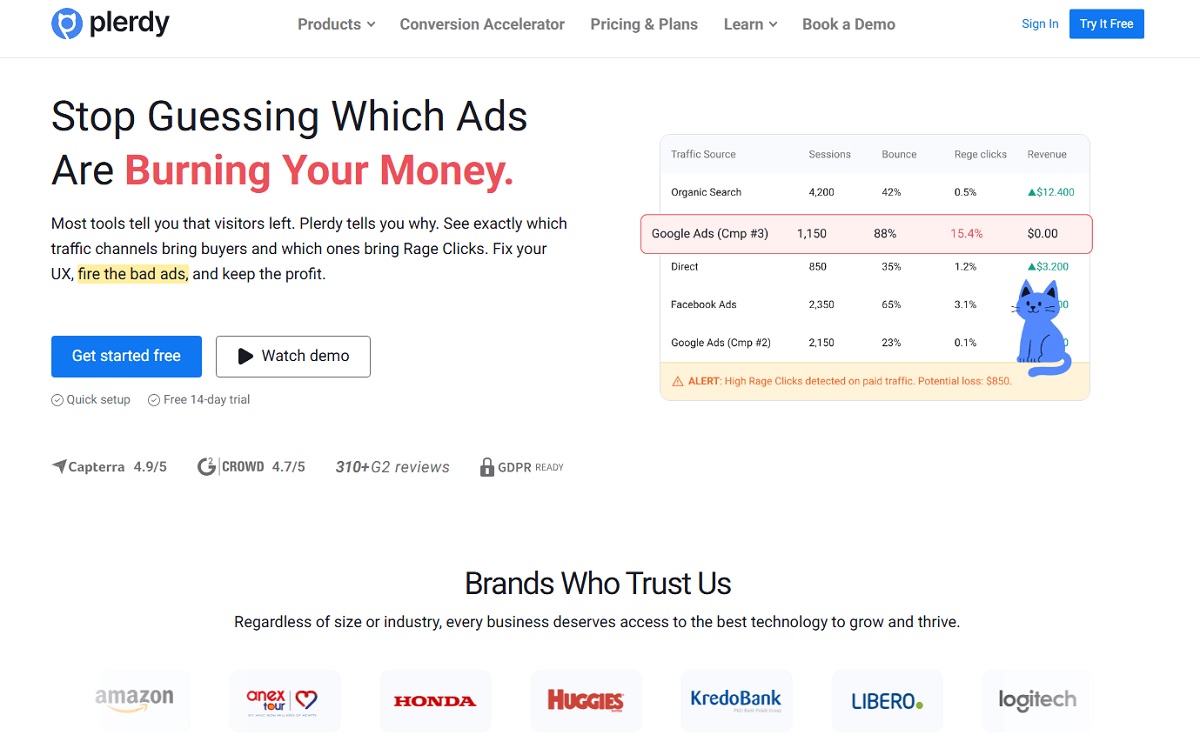
- Trigger a short survey with the Plerdy Website Feedback Tool after a relevant action or exit intent.
- Segment responses by page, device, source, or journey stage.
- Check the same segment in funnels to locate the drop-off.
- Use heatmaps to identify ignored, misleading, or frustrating interface elements.
- Review session recordings to understand the sequence around the problem.
- Release the smallest credible fix and compare the original VoC and behavioral metrics.
How to Choose Voice of Customer Tools
Choose software after defining the workflow. A small team investigating website friction may need targeted surveys, funnels, heatmaps, and session recordings. A global organization may need call transcription, multilingual text analytics, CRM integration, case management, role-based permissions, and governance.
| Capability | Questions to ask |
|---|---|
| Collection | Can it trigger feedback by page, event, segment, channel, and journey moment? |
| Context | Can responses retain device, source, lifecycle, plan, account, and behavior context? |
| Analysis | Does it support themes, sentiment, trends, filters, exports, and manual quality control? |
| Behavioral validation | Can teams connect comments to funnels, heatmaps, events, or session recordings? |
| Action | Can it create alerts, tickets, owners, service recovery, and recurring-problem workflows? |
| Measurement | Can dashboards connect VoC themes with conversion, retention, cost, or revenue? |
| Governance | Are consent, retention, access, redaction, and sensitive-data controls appropriate? |
If the immediate goal is comparing platforms, use Plerdy’s separate guide to customer feedback tools. The purpose of this article is to design the program that those tools must support.
A 30-day Voice of Customer Implementation Plan
| Week | Actions | Deliverable |
|---|---|---|
| 1: Scope | Choose one outcome and journey; name an executive sponsor and working owner; inventory existing signals. | One-page VoC charter and baseline |
| 2: Listen | Map touchpoints; launch one targeted survey; connect support, review, and behavioral evidence. | Collection map and tagged dataset |
| 3: Understand | Create the codebook; segment themes; validate with behavior; score priorities. | Top five opportunities with evidence |
| 4: Act | Assign owners; close urgent individual cases; launch one systemic fix; define post-change metrics. | Action register and measurement dashboard |
Start With One Revenue-Relevant Customer Journey
Use Plerdy to combine targeted website feedback with funnels, heatmaps, events, and session recordings. This lets your team see what customers say, where they struggle, and whether the fix improves conversion.
Create a free Plerdy account or explore the Website Feedback Tool.
Common Voice of Customer Mistakes
- Collecting without a decision: every survey should support a defined business or experience question.
- Listening only to survey respondents: add reviews, support evidence, and behavior to reduce channel bias.
- Counting mentions without context: segment by value, lifecycle, severity, and journey stage.
- Confusing a request with a root cause: investigate the job and workaround before committing to a feature.
- Changing questions too often: stable wording is essential for comparable trends.
- Automating before defining themes: AI scales inconsistent categories just as efficiently as good ones.
- Publishing dashboards without owners: an insight without responsibility and a due date is only a report.
- Closing only the inner loop: helping one unhappy customer does not remove the systemic cause.
- Measuring only NPS: pair perception with behavior, operations, and commercial outcomes.
- Ignoring privacy: minimize collected data, control access, redact sensitive information, and follow applicable consent and retention requirements.
Voice of the Customer FAQ
What is Voice of the Customer?
Voice of the Customer is a systematic process for collecting, analyzing, prioritizing, and acting on customer needs, expectations, preferences, and problems across the journey.
What is a Voice of the Customer program?
A VoC program is the ongoing operating system behind customer listening. It defines goals, data sources, analysis rules, owners, action workflows, and success metrics.
What are the three types of VoC data?
Direct data includes surveys and interviews; indirect data includes reviews, support tickets, and social conversations; inferred data includes behavioral and operational evidence such as funnels, clickstream data, and product usage.
How do you collect Voice of Customer data?
Use transactional surveys, interviews, website feedback, reviews, support conversations, call transcripts, usability tests, session replays, heatmaps, funnels, and product analytics. Select methods based on a specific decision.
How do you analyze Voice of Customer data?
Clean and segment it, code themes, quantify reach and severity, connect feedback with behavior and revenue, prioritize issues, assign owners, and compare the same outcome after changes.
What is the difference between VoC and customer feedback?
Customer feedback is raw input. VoC is the repeatable system that turns that input into contextualized evidence, priorities, accountable actions, and measured outcomes.
Which metrics belong in a VoC program?
Common metrics include NPS, CSAT, CES, sentiment, issue frequency, response rate, close-loop time, repeat contacts, retention, conversion, funnel completion, and revenue affected.
How often should a VoC program be reviewed?
Monitor urgent signals continuously, review operating themes weekly, prioritize cross-functional work monthly, and evaluate coverage and business impact quarterly.
Turn Customer Voice Into Accountable Action
A useful Voice of the Customer program does not begin with a giant survey or an expensive platform. It begins with one important customer journey and one business decision. Collect a direct explanation, validate it with real behavior, prioritize the problem using impact and confidence, assign an owner, and measure the outcome.
Once that loop works, expand it to the next journey. The goal is not to accumulate more feedback. It is to make better product, UX, marketing, and service decisions while customers can still feel the difference.