

SEO for locksmiths is the work of getting your business into the Google Map Pack and the organic top three for emergency searches like locksmith near me, car key replacement near me and locked out of house. Locksmith search engine optimization differs from ordinary local SEO in one decisive way: your category is one of Google’s “duress verticals”, which means it carries extra verification rules, an unusual amount of listing fraud, and buyers who choose in under sixty seconds.
That last point is where most locksmith websites quietly bleed money. A page can rank and still lose the call, because the phone number sits below the fold or the form asks for a street address before it asks for a phone. At Plerdy we build the behaviour analytics that show exactly where that happens — heatmaps that reveal which parts of your service page people actually touch on mobile, and an SEO Checker that flags the missing alt text and duplicate titles a crawl-based tool reports only after you pay for a crawl. This guide covers both halves: ranking, and then converting the traffic you win.
Everything below is built from measured data, and where the published numbers disagree with each other — and for locksmith keywords they disagree by a factor of three — we show you the disagreement instead of picking whichever figure looks best.
What This Guide Covers
- What Locksmith SEO Is (And Why It Is Not Normal Local SEO)
- The Fake Listing Problem That Shapes This Entire Industry
- Google’s Extra Verification Rules For Locksmiths
- Why Published Locksmith Search Volumes Disagree By 3x
- Google Business Profile: Where Locksmith SEO Is Won
- Website Structure That Ranks For Locksmiths
- On-Page SEO For Locksmith Service Pages
- Schema Markup For Locksmiths
- Technical SEO And Speed For Emergency Traffic
- Local Link Building And Citations
- AI Search And GEO For Locksmiths
- 10 Tools For Locksmith SEO, Compared
- Turning Rankings Into Phone Calls
- 12 Locksmith SEO Mistakes That Cost Calls
- DIY Vs Hiring a Locksmith SEO Company
- Your 90-Day Locksmith SEO Plan
- Locksmith SEO FAQ
What SEO For Locksmiths Actually Is (And Why It Is Not Normal Local SEO)
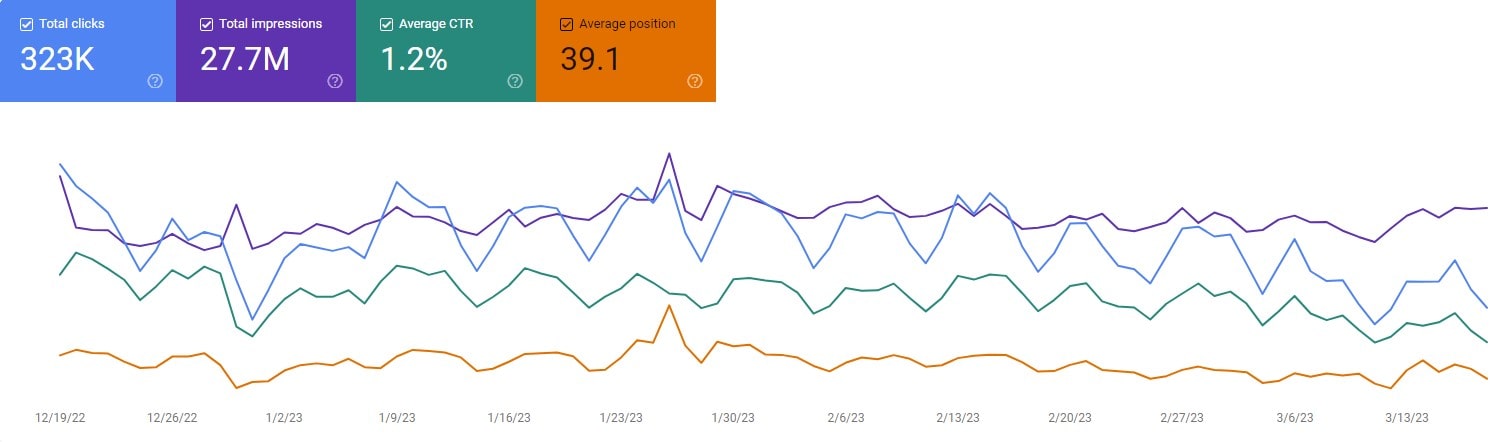
Search engine optimization for locksmiths starts from one behavioural fact. A dentist gets researched. A locksmith gets called. Someone standing beside a locked car at 11pm does not open five tabs, read reviews carefully and compare pricing pages — they tap the first result with a phone number and a plausible star rating. Everything about locksmith SEO follows from that behaviour.
Google’s own documentation says local ranking rests on three factors: relevance (“how well a Business Profile matches what someone is searching for”), distance (“how far each business is from the customer who’s searching”) and prominence (“how well-known a business is”). Google adds that prominence counts “how many websites link to your business and how many reviews you have” (Google Business Profile Help). For most industries those three factors are roughly balanced. For locksmiths, distance dominates — and that changes what you build.
| Factor | Typical Local Business | Locksmith |
|---|---|---|
| Decision time | Hours to days | Under 60 seconds |
| Primary surface | Organic results and website | Map Pack and Local Services Ads |
| Device split | Mixed desktop and mobile | Overwhelmingly mobile, often outdoors |
| Dominant ranking factor | Relevance and prominence | Distance, then prominence |
| Competitor type | Other real businesses | Real businesses plus fraudulent listings |
| Verification burden | Standard postcard or video | Advanced Verification plus licence and insurance checks |
| Content that converts | Long service explanations | Price range, response time, licence number, tap-to-call |
| Geographic footprint | One storefront | Service area, often 20–40 mile radius |
The practical consequence: a beautiful 3,000-word service page that ranks fifth organically will lose to a thin competitor sitting in the Map Pack. Map Pack first, organic second. If you only have budget for one, spend it on your Google Business Profile.
The Fake Listing Problem That Shapes This Entire Industry
No other trade competes against this much fraud, and any locksmith SEO advice that skips it is written by somebody who has not worked the vertical.
In March 2025 Google filed suit against a network of scammers and disclosed that it had removed more than 10,000 fraudulent business listings from Google Maps. The investigation started with a single complaint: a Texas business reported an unlicensed locksmith impersonating it on Maps. Google’s general counsel Halimah DeLaine Prado framed the pattern plainly — scammers concentrate on what Google internally calls “duress verticals”, the services people search for while stressed. Locksmiths and towing companies are the textbook cases (CBS News).
This is not new and it is not solved. Locksmiths have been fighting it in court for over a decade: a Virginia locksmith sued Google, Yellowbook and Ziplocal in 2014 and lost on Communications Decency Act immunity; fourteen locksmiths brought a class action against Google, Yahoo and Bing in 2017 arguing that spam listings drowned out legitimate results, and the appeals court dismissed it in 2019 (Wikipedia: Locksmith scam).
What this means for your SEO strategy, concretely:
| Consequence | What You Should Do About It |
|---|---|
| Fake listings sit closer to the searcher than you do, and distance is the dominant factor | Report them through Google Maps “Suggest an edit” → “Close or remove”. Persistent reporting works; sporadic reporting does not. |
| Paid search costs are inflated by fraudulent bidders | Prioritise Local Services Ads over standard Google Ads — LSA requires screening that scammers cannot pass. |
| Consumers arrive suspicious because they or a friend have been burned | Put your state licence number, insurance status and a real photo of a real technician above the fold. This is a ranking-adjacent trust signal and a conversion lever at once. |
| Google applies stricter verification to your category | Complete Advanced Verification early — it is a moat, not a hurdle. Every competitor who cannot pass it is removed from your Map Pack. |
| Review fraud is common in the vertical | Never buy reviews. Google’s enforcement in duress verticals is far more aggressive than in ordinary categories. |
Google’s Extra Verification Rules For Locksmiths
Since 2018 Google has required Advanced Verification for locksmith advertisers in the US and Canada. On top of that, Local Services Ads applies its own screening, and locksmith is explicitly listed as a category requiring an additional level of scrutiny. Per Google’s Local Services Help documentation for the United States, locksmiths must clear:
| Requirement Type | Specific Requirement |
|---|---|
| Background checks | Business check |
| Owner check | |
| Service professional check | |
| Insurance | General liability insurance |
| Professional liability insurance | |
| Licensing | Business license at state level |
| Owner license at state level |
Two things follow. First, gather these documents before you start any SEO work, because verification takes weeks and blocks the highest-converting surface you have. Second — and this is the part locksmiths miss — the same documents are your best on-page trust content. A service page that names your state licence number, your insurer and your years in business outperforms one that says “fully licensed and insured”, both with users and with quality raters assessing experience and trustworthiness.
Why Published Locksmith Search Volumes Disagree By 3x
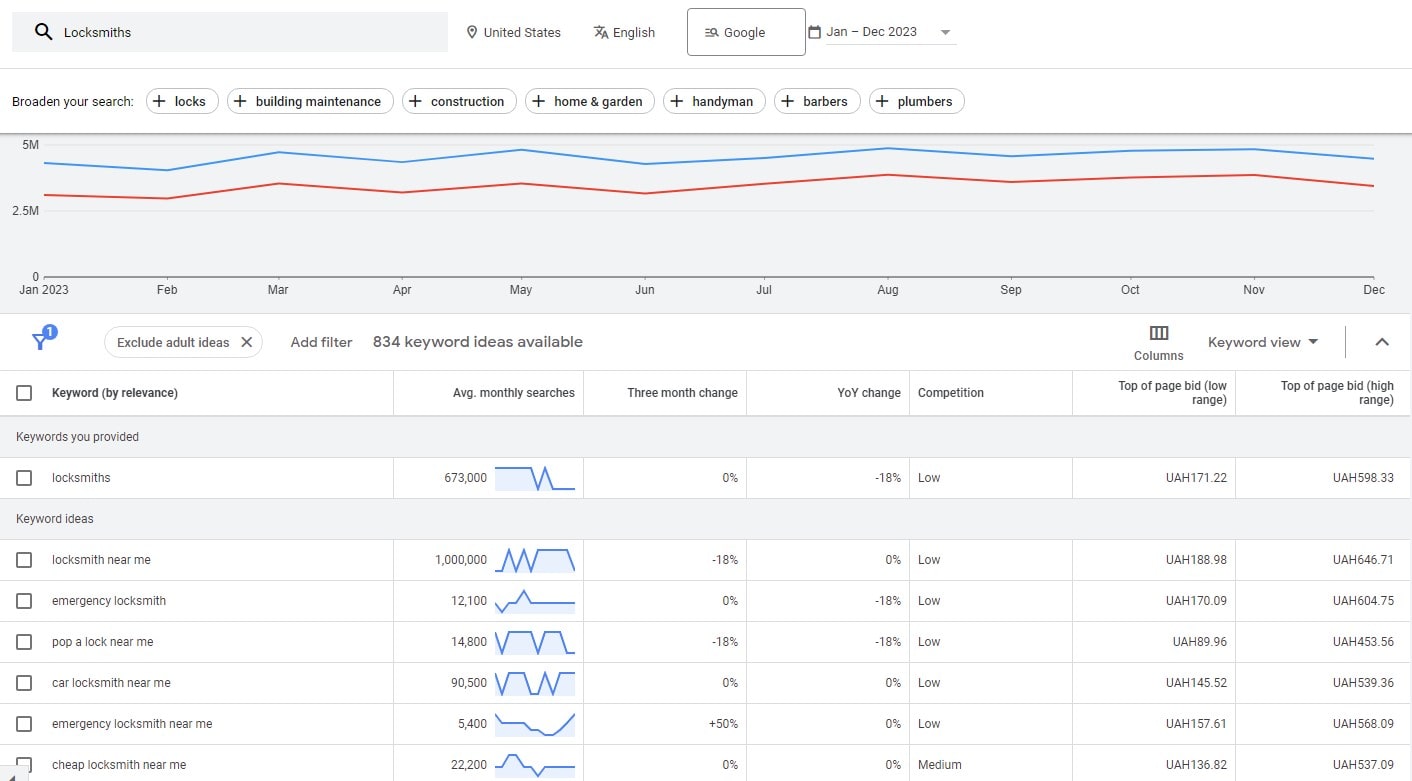
Here is something no other locksmith SEO guide will tell you: the search volumes published across the industry contradict each other badly, and most articles simply copy whichever number they found first.
We compared the figure published for the single most important keyword in the vertical, locksmith near me, across three guides published within four months of each other:
| Source | Published | Volume for “locksmith near me” |
|---|---|---|
| Loopex Digital | December 2025 (data stated as January 2026 estimates) | 204,000 |
| Comrade Web | April 2026 | 209,000 |
| MarketKeep | March 2026 | 673,000 |
A 3.3x spread on the same keyword in the same quarter. The explanation is mundane and it matters: different tools use different match aggregation. A figure near 673,000 almost certainly bundles close variants — locksmith close to me, locksmiths near me, local locksmith — into one row, which is exactly what Google Keyword Planner does by default. Figures near 205,000 report the phrase alone. Neither is wrong; they answer different questions.
What to do with this. Treat every published volume, including the ones in this article, as a relative ranking rather than a forecast. Use them to decide which page to build first, never to promise a client a traffic number. The only volume figure that describes your market is the impression count in your own Google Search Console, filtered to your service area — and the only Map Pack position that describes your market is one measured on a geo-grid, because a single “position” for a locksmith is meaningless when ranking changes every few blocks.
There is no reliable public benchmark for what a locksmith should expect in organic traffic after six months of SEO. Anyone quoting one is quoting a single client. Measure your own baseline before you start: record current Map Pack positions on a geo-grid, current GSC impressions and clicks for your top twenty keywords, and current call volume from organic. Without that baseline, you will not be able to prove the work paid for itself.
Local SEO For Locksmiths: Google Business Profile Is Where It Is Won
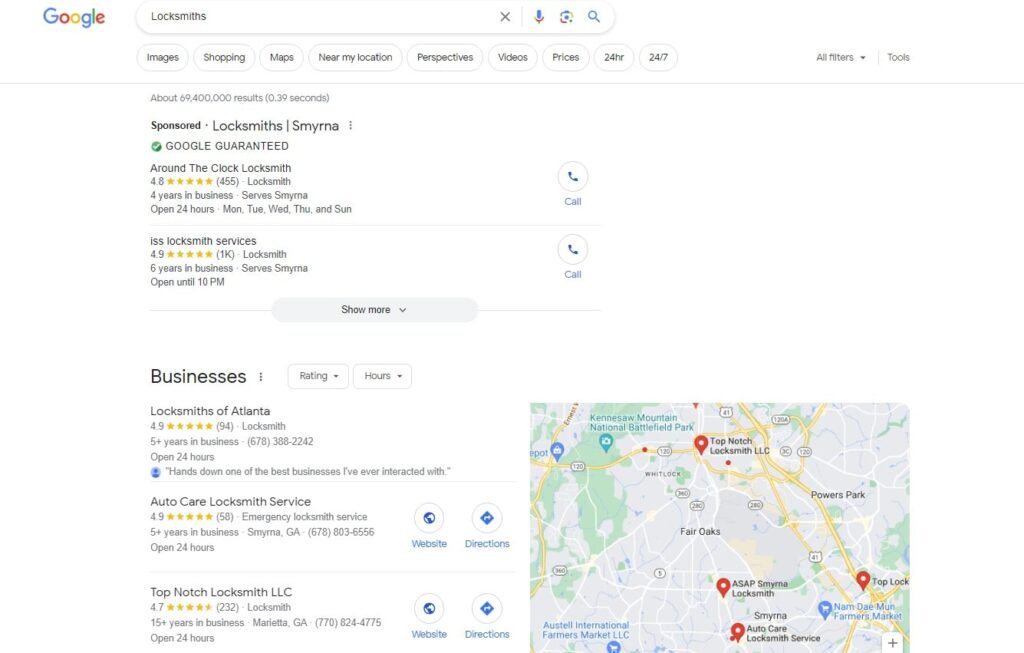
Local SEO for locksmiths comes down to one asset, and this is it. If you do nothing else in this guide, do this section. For a locksmith, the Google Business Profile is not a supporting asset — it is the product surface. Organic listings sit below the Map Pack on mobile, which is where nearly all lockout searches happen.
Choosing Categories That Match Real Searches
Your primary category carries more ranking weight than every secondary category combined. Set it to Locksmith and nothing else. Then add secondary categories only for services you genuinely perform, because an inaccurate category dilutes relevance and invites suspension in a vertical Google already watches closely.
Common secondary categories worth adding when they apply: Auto Locksmith, Safe & Vault Shop, Security System Installer, Key Duplication Service, Door Supplier. Do not add “Security Guard Service” or “Alarm Monitoring” unless you actually sell them.
Service Area Vs Storefront: Get This Right Once
Most locksmiths are mobile, which makes them a service-area business. Google treats the two configurations differently, and choosing wrong costs you visibility permanently.
| If You… | Configure As | Address Shown | Ranking Consequence |
|---|---|---|---|
| Have a shop customers walk into during posted hours | Storefront with service area | Yes, publicly visible | Ranks around the shop address; strongest option if you have a real shop |
| Work only from vehicles | Service-area business, address hidden | No | Ranks around a centroid you cannot control precisely; expect Map Pack visibility to fall off within a few miles |
| Have a shop but list a wide radius and hide the address | Misconfigured | No | Worst of both — you lose the address signal without gaining reach |
Set your service area to the radius you will actually drive within your stated response time. A 60-mile radius claim on a profile promising 20-minute arrival is a review problem waiting to happen, and review sentiment feeds prominence.
Reviews: the Prominence Lever You Control
Google states outright that “more reviews and positive ratings can help your business’s local ranking”. The bar consumers apply has moved sharply. In BrightLocal’s Local Consumer Review Survey 2026 (1,002 US adults surveyed via SurveyMonkey):
- 97% of consumers read reviews for local businesses
- 74% specifically look for reviews written in the last three months
- 31% will only use a business rated 4.5 stars or higher — up from 17% in 2025
- 68% require at least four stars
- 19% expect a same-day response to a review they leave
That 17%-to-31% jump in a single year is the most actionable statistic in this guide. A 4.2-star average that was acceptable in 2025 now disqualifies you for roughly a third of searchers.
The recency finding matters just as much for locksmiths. Three months is short — it means review generation has to be a standing process, not a campaign. Ask on site, at the moment the customer is relieved and their car is open, with a QR code on the invoice or a text sent from the van before you drive away.
Photos, Posts And Services
Upload photos that could not have come from a stock library: your actual van with its actual livery, a technician in branded uniform, your storefront, before-and-after shots of a repaired door frame. Fraudulent listings use stock imagery because they have nothing real to photograph, and users have learned to read the difference.
Fill the Services section completely, from the tables above» на «your customers actually use rather than internal jargon. “Car key replacement” belongs there; “automotive transponder services” does not, because nobody searches for it.
Measuring Map Pack Position Properly
A locksmith does not have one Map Pack position. You might rank first at your shop, fourth two miles north and invisible five miles east. A single rank-tracking number hides all of this. Geo-grid tools scan your ranking across a matrix of coordinates and return a map, which is the only honest representation of local visibility. See the tools section for options.
Website Structure That Ranks For Locksmiths
The mistake nearly every locksmith site makes is a single “Services” page listing twelve services in twelve paragraphs. That page cannot rank for any of them, because it is not specifically about any of them.
The Service × Location Page Matrix
Build one page per service, then one page per service per priority city. Start with the services you actually make money on, not the full catalogue.
| Page Type | URL Pattern | Primary Keyword | How Many to Build |
|---|---|---|---|
| Homepage | / | locksmith [primary city] | 1 |
| Core service | /car-key-replacement/ | car key replacement | 5–8, one per revenue service |
| Emergency service | /emergency-locksmith/ | 24 hour locksmith | 1 |
| City landing | /locksmith-denver/ | locksmith denver | 1 per city you actually serve |
| Service × city | /car-key-replacement-denver/ | car key replacement denver | Only for your top 2–3 services in your top 2–3 cities |
| Neighborhood | /locksmith-capitol-hill-denver/ | locksmith capitol hill | Only where search demand is proven in GSC |
| Pricing | /locksmith-prices/ | how much does a locksmith cost | 1 |
| Blog | /blog/[topic]/ | informational keywords | Ongoing |
The trap to avoid: generating 200 city pages from a template. Google has been demoting doorway pages for years, and a locksmith site with 200 near-identical pages is the canonical example. Build a city page only when you can put genuinely local content on it: named neighborhoods you cover, actual jobs completed there, local response times, a real customer review from that area.
What Every Locksmith Service Page Must Contain
| Element | Why It Is Required | Where It Goes |
|---|---|---|
| Tap-to-call phone number | The conversion action; must not require scrolling | Sticky header, above the fold |
| Stated response time | Primary decision criterion in an emergency | First screen |
| State licence number | Separates you from fraudulent listings | First screen and footer |
| Price range for this service | Removes the biggest hesitation; fraud operators refuse to quote | Above the fold or immediately below |
| Service area described in plain names | Relevance signal plus user confidence | Mid-page, with a map |
| Photo of a real technician | Trust signal that stock images cannot fake | Mid-page |
| Two or three reviews mentioning this service | Specific proof beats generic star ratings | Mid-page |
| What the job actually involves | Relevance depth and AI extraction | Main body |
| Insurance and bonding status | Commercial clients filter on this | Footer or trust bar |
| FAQ specific to this service | Long-tail coverage and snippet capture | Below main body |
This checklist is worth auditing on your live pages rather than assuming. A Plerdy heatmap will show you whether people ever scroll far enough to reach your licence number, and whether they are tapping something that is not a link — the tool records clicks on non-clickable elements, which is how you discover that visitors keep tapping your phone number graphic because it was never made tappable.
URL And Internal Linking Rules
- Keep URLs short and readable: /car-key-replacement-denver/, not /services/automotive/keys/replacement/denver-co/
- Link every city page to the relevant service pages and back, so neither is orphaned
- Link blog posts to the service page that answers the commercial version of the question — a post on “car key replacement cost” must link to the car key replacement service page
- Use the target keyword as anchor text on internal links, and vary it naturally across pages
- Keep every money page within two clicks of the homepage
On-Page SEO For Locksmith Service Pages
Title Tags And Meta Descriptions That Match Emergency Intent
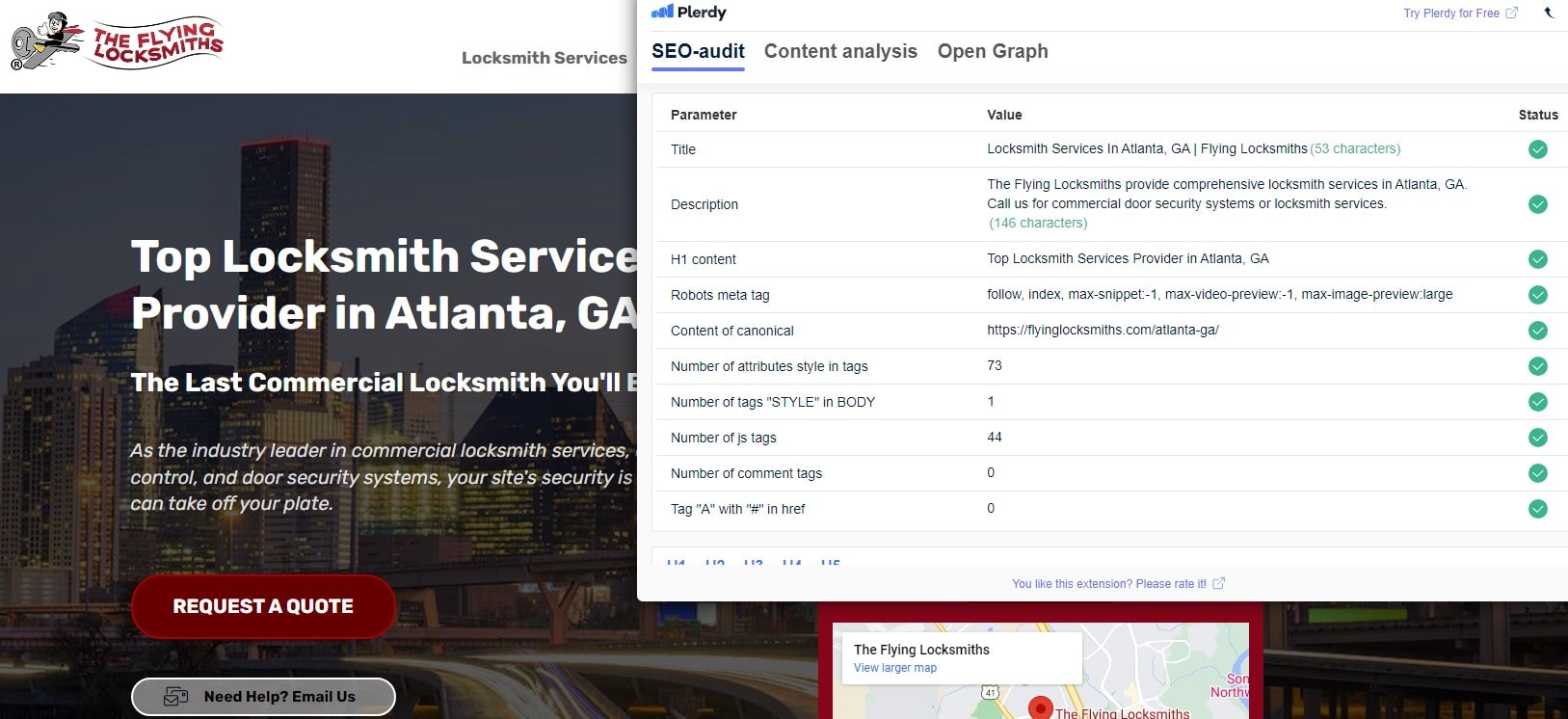
An emergency searcher scans the SERP for three things: are you open, are you close, and can I call you now. Write titles that answer all three inside 60 characters.
| Page | Title Tag Template | Meta Description Focus |
|---|---|---|
| Homepage | 24/7 Locksmith in [City] | Licensed & Insured | Response time, licence, phone number, service list |
| Emergency | Emergency Locksmith [City] — 20 Min Response | Availability, arrival time, call to action |
| Car keys | Car Key Replacement [City] | All Makes, On-Site | Vehicle coverage, price range, on-site capability |
| Rekeying | Lock Rekeying in [City] From $[X] per Lock | Price anchor, same-day availability |
| Commercial | Commercial Locksmith [City] | Master Key Systems | Business focus, insurance, account terms |
| Pricing | Locksmith Prices in [City]: 2026 Cost Guide | Transparency, no hidden fees, table preview |
Include the price when you can. In a category defined by bait-and-switch pricing, publishing a range is a competitive weapon — the fraudulent operators quoting “$19 service call” cannot follow you there.
Image Alt Text: the Cheapest Win Nobody Takes
Locksmith sites are photo-heavy and alt-text-poor. Every photo of a van, a lock, a key cutting machine and a technician is an opportunity in image search and an accessibility requirement. Write alt text that describes the image and includes the service and city where it is honest to do so — “Locksmith technician cutting a replacement car key in Denver” beats “img_4471”.
This is exactly the class of error that is invisible until something audits it. The Plerdy SEO Checker collects on-page SEO data daily for every page receiving traffic and flags missing alt text, missing or duplicate titles and descriptions, header structure problems, canonical issues and broken links — and keeps 30 days of history so you can see when something broke rather than only that it is broken.
Schema Markup For Locksmiths
Schema will not lift your rankings on its own. What it does is make your business machine-readable, which increasingly determines whether an AI answer can cite you. Use the “Locksmith” type — it is a recognised subtype of “LocalBusiness”, and being specific is better than generic.
Here is a complete microdata implementation you can adapt. Replace the bracketed values with your own:
<div itemscope itemtype="https://schema.org/Locksmith">
  <span itemprop="name">[Business Name]</span>
  <div itemprop="address" itemscope itemtype="https://schema.org/PostalAddress">
    <span itemprop="streetAddress">[Street]</span>
    <span itemprop="addressLocality">[City]</span>
    <span itemprop="addressRegion">[State]</span>
    <span itemprop="postalCode">[ZIP]</span>
    <span itemprop="addressCountry">US</span>
  </div>
  <span itemprop="telephone">[+1-555-000-0000]</span>
  <span itemprop="priceRange">$$</span>
  <div itemprop="areaServed" itemscope itemtype="https://schema.org/GeoCircle">
    <div itemprop="geoMidpoint" itemscope itemtype="https://schema.org/GeoCoordinates">
      <meta itemprop="latitude" content="[00.0000]">
      <meta itemprop="longitude" content="[-00.0000]">
    </div>
    <meta itemprop="geoRadius" content="40000">
  </div>
  <div itemprop="openingHoursSpecification" itemscope itemtype="https://schema.org/OpeningHoursSpecification">
    <meta itemprop="dayOfWeek" content="Monday Tuesday Wednesday Thursday Friday Saturday Sunday">
    <meta itemprop="opens" content="00:00">
    <meta itemprop="closes" content="23:59">
  </div>
</div>
Two warnings. First, only claim 24/7 hours if you genuinely answer at 3am — Google surfaces “Open now” based on this, and a missed call from a 3am search is worse than never appearing. Second, do not add “AggregateRating” markup you generate yourself from reviews you host; self-serving review markup is a documented cause of manual actions.
Technical SEO And Speed For Emergency Traffic
Emergency traffic is the least patient traffic on the internet, arriving on mobile data, often outdoors, sometimes on one bar of signal. Core Web Vitals are not an abstract score here — they are the difference between a call and a back button.
| Metric | What It Measures | Good Threshold | Most Common Locksmith Site Cause |
|---|---|---|---|
| LCP (Largest Contentful Paint) | When the main content appears | Under 2.5s | Uncompressed hero image of a van or storefront |
| INP (Interaction to Next Paint) | Responsiveness to taps | Under 200ms | Chat widgets and tracking scripts loading synchronously |
| CLS (Cumulative Layout Shift) | Visual stability | Under 0.1 | A sticky call bar or cookie banner injected after render, pushing the phone button under the thumb |
That CLS example is not hypothetical — it is the single most damaging layout bug on emergency service sites, because the element that moves is the one the user is trying to tap.
Beyond Core Web Vitals, the mobile checklist is short and non-negotiable: tap-to-call links using “tel:” rather than a phone number typed as text, tap targets at least 48 pixels, no interstitial popups on emergency pages, and a form no longer than name, phone and location. If you are running a chat widget, measure whether it earns its INP cost — on many locksmith sites it does not, because the user wants to call, not type.
Local Link Building And Citations For Locksmiths
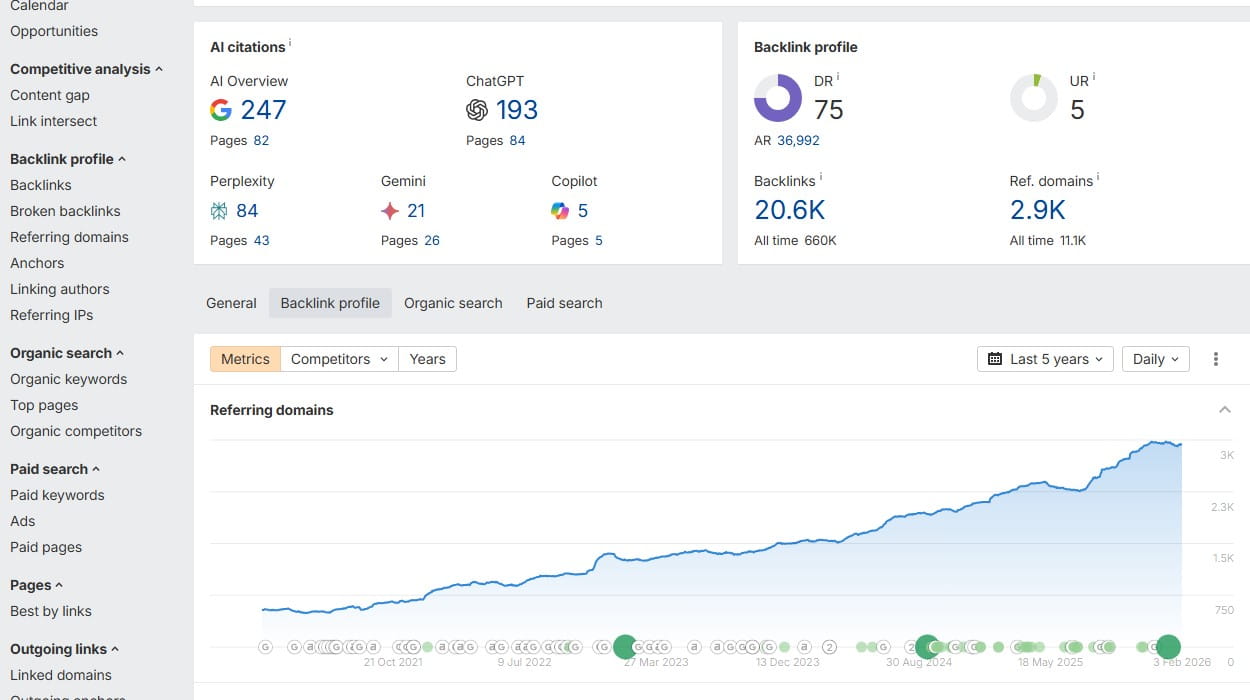
Prominence, in Google’s own words, counts “how many websites link to your business”. For a local service business the useful links are local, not national.
Citation Priority Tiers
| Tier | Platforms | Priority |
|---|---|---|
| Tier 1 — do first | Google Business Profile, Apple Business Connect, Bing Places, Yelp | Non-negotiable; these feed the map surfaces directly |
| Tier 2 — do next | Angi, Thumbtack, HomeAdvisor, Better Business Bureau, Facebook | Real lead sources as well as citations |
| Tier 3 — do when time allows | Nextdoor, Chamber of Commerce, Yellow Pages, industry directories such as ALOA member listings | Local relevance and NAP consistency |
NAP consistency matters more here than in ordinary verticals, because inconsistent data is one of the signals that distinguishes real businesses from fraudulent ones. Your Name, Address and Phone must be byte-identical everywhere. Pick one format for “Suite 200” versus “Ste 200” and never deviate.
Local Links Worth Earning
- Local news on lock security — after a local break-in wave, reporters need a quotable expert. Be the locksmith who answers the phone.
- Property management companies and landlord associations — a vendor listing is a link and a revenue channel simultaneously
- Car dealerships — many refer key programming out; a referral page link is easy to ask for
- Locksmith scam awareness content — a genuinely useful “how to verify a locksmith is legitimate” resource is the one asset in this industry that consumer-protection sites, universities and local government pages will link to
- Local sponsorships — youth sports, community events, neighborhood associations
- Trade associations — ALOA and state locksmith associations publish member directories
Skip guest posting on generic marketing blogs. A link from a national SEO blog does nothing for a business whose ranking is driven by distance and local prominence.
AI Search And GEO For Locksmiths
A growing share of “who should I call” questions never reach a blue link. They are answered inside an AI Overview or a chat assistant, which reads a handful of sources and summarises them. Generative Engine Optimization — GEO — is the practice of making your pages the ones that get read and cited.
For locksmiths the mechanics are unusually favourable, because AI systems are conservative about local recommendations and lean heavily on structured, verifiable facts. That plays directly to a licensed business and directly against fraudulent listings, which have no verifiable facts to offer.
| What AI Systems Reward | How to Provide It |
|---|---|
| Extractable direct answers | Answer the question in the first sentence under each heading, then explain. Never open with a story. |
| Structured data | Tables for anything comparative; “Locksmith” schema on every location page |
| Verifiable specifics | Licence numbers, founding year, named service areas, published price ranges |
| Consistent entity data | Identical NAP across every citation, so the system can resolve you as one entity |
| Question-shaped headings | H2s and H3s phrased as the questions people actually ask |
| Recency | Visible last-updated dates and content that reflects current rules |
| Third-party corroboration | Reviews, directory listings and local press that repeat the same facts |
One caution worth stating plainly: nobody has a reliable public benchmark for how much traffic AI citations send a local service business, and any agency quoting one is extrapolating from a single account. Treat GEO as insurance on your existing content structure rather than a channel with a forecastable return. The good news is that everything on that list improves conventional rankings too, so there is no trade-off to manage.
10 Tools For Locksmith SEO, Compared
Prices below were checked against each vendor’s own pricing page in August 2026. They change — verify before you buy.
Plerdy
Best for: understanding why ranked pages do not produce calls, and catching on-page SEO errors before they cost rankings.
Plerdy is the layer most locksmith SEO setups are missing. Rank trackers tell you where you rank; Google Analytics tells you how many people arrived. Neither tells you that 60% of mobile visitors on your emergency page never scroll far enough to reach the phone number, or that people keep tapping a graphic that was never made clickable. Plerdy does.
- Website Heatmap — click maps, scroll depth and mouse-movement maps, with mobile-versus-desktop comparison and segmentation by traffic channel, location and new-versus-returning visitors. It records clicks on non-clickable elements, which is how most missing tap-to-call bugs are actually found. The free plan covers 100 heatmaps per day.
- Session Replay — watch a real lockout visitor try to reach your phone number. Ten sessions teach more than a month of bounce-rate speculation.
- SEO Checker — daily automatic on-page analysis of every page receiving traffic: titles, meta descriptions, H1–H6 structure, image alt text, canonical tags, Open Graph, duplicate titles and descriptions, broken links, word count and readability, with 30 days of history so you can see when a change broke something.
- SERP Checker — analyses Google’s top 10 for your keyword and compares titles, meta descriptions, H1–H3 headings, content length and recurring terms, then turns that into a content brief. Country and language selection is supported, which matters for local work. Add-ons start at $8 per month for 50 keywords, and there is a free account plan.
- Pop-Up and Form Builder — capture the after-hours visitor who will not wait on hold, with a callback request rather than a lost session.
- Event Tracking — count tap-to-call events as conversions, which is the only conversion metric that matters for a locksmith.
Watch out for: Plerdy is behaviour and on-page analytics, not a backlink index. Pair it with Ahrefs or Semrush if you need link data.
Google Business Profile
Best for: the single highest-value asset in locksmith SEO. Free.
The profile itself plus its Performance reports, which show how many people found you via Maps versus Search, how many called, how many requested directions, and which queries surfaced you. Check the calls metric weekly; it is closer to revenue than any ranking number.
Google Search Console
Best for: the only impression and position data that describes your actual market. Free.
Filter Performance by page, then by query, to see which service pages earn impressions and where they sit. If a page has thousands of impressions and a position near 20, it is one structural improvement from page one — that is the highest-return work available to you.
Semrush
Best for: keyword research and competitor analysis at agency depth.
Per Semrush’s pricing page in August 2026, plans run SEO at $139/mo, Starter at $199/mo, Pro+ at $299/mo and Advanced at $549/mo on monthly billing, with roughly 15% off on annual. Extra users are $45/mo each.
Watch out for: this is heavy machinery for a single-location locksmith. A one-month subscription to build your keyword map, then cancel, is a legitimate strategy.
Ahrefs
Best for: backlink analysis and finding which local sites link to your competitors.
Per the Ahrefs pricing page in August 2026: Lite $129/mo, Standard $249/mo, Advanced $449/mo, Enterprise $1,499/mo on annual commitment. Ahrefs also offers a free tier giving limited access to Site Explorer and Site Audit for verified site owners — for most locksmiths that free tier is genuinely sufficient.
BrightLocal
Best for: local rank tracking, citation auditing and review management in one place.
Three platform tiers — Track, Manage and Grow — covering local rank monitoring up to 100 keywords, geo-grid mapping, citation tracking and Google Business Profile auditing, then adding listing sync and review collection at higher tiers. As of August 2026 BrightLocal has moved to quoted pricing on its pricing page rather than a published table, with annual billing discounted 25% and a 14-day trial requiring no card. Its Citation Builder is listed from $2 per citation.
Whitespark
Best for: citation building done properly, and buying only the piece you need.
Whitespark deliberately sells its tools separately rather than as a suite. Per its pricing page in August 2026: Local Citation Finder $33–$149/mo, Local Rank Tracker $14–$200/mo, Local Ranking Grids from $10/mo, Reputation Builder $79/mo per location, Local Platform $1/mo per location. Its one-time Listings Service runs $20–$999, and it offers a Yext Replacement Service at $399 per location one-time — relevant if you inherited a Yext subscription and want out of the rental model.
Local Falcon
Best for: geo-grid Map Pack tracking, which is the metric that actually describes locksmith visibility.
Local Falcon scans your Google Maps ranking across a grid of coordinates around your service area and returns a heat map of positions rather than a single number. For a mobile locksmith deciding whether to open a second base, this is the diagnostic. Pricing is credit-based and tiered; check current rates on the site, as the credit model has changed more than once.
Screaming Frog SEO Spider
Best for: one-off technical crawls of a site with template-generated city pages.
The free version crawls up to 500 URLs, which covers most locksmith sites entirely. Use it to find duplicate titles across city pages — the classic failure mode of a templated location structure.
Microsoft Clarity
Best for: a free second opinion on session recordings.
Free with no session cap. Its rage-click and dead-click detection overlaps with Plerdy’s non-clickable-element tracking; running both is redundant, but if budget is zero, Clarity is the floor.
Tool Comparison At a Glance
| Tool | Main Job | Entry Price (Aug 2026) | Free Tier | Priority for a Locksmith |
|---|---|---|---|---|
| Plerdy | Behaviour analytics + on-page SEO auditing | SERP Checker add-on from $8/mo | Yes | High — the only one that explains lost calls |
| Google Business Profile | Map Pack presence and call tracking | Free | Free | Essential |
| Google Search Console | Impressions, positions, indexing | Free | Free | Essential |
| Local Falcon | Geo-grid Map Pack tracking | Credit-based, see site | Trial | High |
| BrightLocal | Local rank tracking + citations + reviews | Quoted; 14-day trial | Trial | High for multi-location |
| Whitespark | Citation building, à la carte | From $10/mo per tool | No | Medium — buy the citation service once |
| Semrush | Keyword and competitor research | $139/mo | Limited | Medium — one month may be enough |
| Ahrefs | Backlink analysis | $129/mo | Yes (Site Explorer, Site Audit) | Medium — free tier usually suffices |
| Screaming Frog | Technical crawling | Free to 500 URLs | Yes | Medium — occasional use |
| Microsoft Clarity | Session recordings | Free | Free | Low if you run Plerdy |
Turning Rankings Into Phone Calls
Ranking is half the job. A locksmith site converting at 4% and one converting at 12% from the same traffic are two different businesses, and the gap is almost always mechanical rather than persuasive.
| Problem | Symptom in Analytics | Fix |
|---|---|---|
| Phone number below the fold on mobile | Heatmap shows scroll depth collapsing before the number | Sticky call bar pinned to the bottom of the viewport |
| Number rendered as an image or plain text | Clicks recorded on a non-clickable element | Wrap in a “tel:” link |
| Form asks too much | Form starts recorded, few submits | Reduce to name, phone, location |
| No price signal anywhere | High bounce from pricing-intent queries | Publish a range; state what changes it |
| No response time stated | Long dwell then exit without a call | Put arrival time on the first screen |
| Trust signals buried in the footer | Session replays show users scrolling to the footer and leaving | Move licence, insurance and years in business above the fold |
| Layout shift moving the call button | Rage clicks near the button; poor CLS | Reserve space for injected elements |
| Calls not counted as conversions | Analytics reports near-zero conversions on a page that clearly works | Track “tel:” clicks as events |
Work this table with data, not opinion. Run a heatmap on your emergency page segmented to mobile organic traffic, watch ten session recordings of visitors who did not call, and the two or three real problems will be obvious within an hour. Then confirm the fix with an A/B test rather than assuming.
12 Locksmith SEO Mistakes That Cost Calls
| # | Mistake | Why It Hurts |
|---|---|---|
| 1 | One “Services” page listing every service | Ranks for nothing because it is specifically about nothing |
| 2 | Generating 200 templated city pages | Textbook doorway pages; risks a site-wide quality problem |
| 3 | Skipping Advanced Verification | Forfeits Local Services Ads, the surface fraudsters cannot reach |
| 4 | Inconsistent NAP across directories | Weakens entity resolution in a category already flagged for fraud |
| 5 | Buying reviews | Enforcement in duress verticals is aggressive; the downside is losing the profile entirely |
| 6 | Letting reviews go stale | 74% of consumers look for reviews from the last three months |
| 7 | Hiding prices completely | Cedes the trust advantage to whoever publishes a range |
| 8 | Phone number not tap-to-call | Kills conversion on the device where nearly all this traffic arrives |
| 9 | No alt text on any image | Loses image search and fails accessibility, for zero effort saved |
| 10 | Ignoring fraudulent competitor listings | They sit closer to the searcher, and distance is the dominant factor |
| 11 | Publishing AI-written service pages unedited | Interchangeable text in a category where trust is the product |
| 12 | Tracking rankings but not calls | You optimise the number you watch; watch the one that pays |
DIY Vs Hiring a Locksmith SEO Company
At some point every owner asks whether to buy locksmith SEO services or run the work in-house. There is no universally right answer, but there is a clear split by situation. SEO for locksmith company owners with one van and one city is genuinely doable alone; a five-location operation in a competitive metro is not.
| Consideration | Do It Yourself | Hire an Agency |
|---|---|---|
| Typical cost | $0–$200/mo in tools | Commonly $1,000–$3,000/mo for local service SEO |
| Time required | 5–10 hours per week for the first three months | 2–3 hours per month reviewing reports |
| Best when | One location, one or two cities, owner has time | Multiple locations or competitive metro markets |
| Fastest DIY wins | GBP optimisation, review generation, tap-to-call, alt text | — |
| Hardest to do alone | Local link building, multi-city content at scale | — |
| Main risk | Stalling after the easy wins | Paying for templated city pages that never rank |
If you do hire out, understand what you are buying. The best locksmith SEO work is unglamorous — profile hygiene, review velocity, citation consistency, page-by-page conversion fixes — and any locksmith SEO agency pitching a secret technique is selling something else. Ask these six questions before signing:
- Will you measure Map Pack position on a geo-grid, or report a single ranking number?
- How many city pages will you build, and what unique content goes on each one?
- Do you track phone calls as conversions, and how?
- Will you help complete Advanced Verification and Local Services Ads screening?
- What is your process for reporting fraudulent competitor listings?
- Who owns the website, the content and the Google Business Profile if we part ways?
That last question eliminates more bad agencies than the other five combined.
Your 90-Day Locksmith SEO Plan
A locksmith SEO campaign fails more often from bad sequencing than from bad tactics. Verification takes weeks, reviews compound slowly, and content is worthless before the profile is right — so order matters more than effort. Locksmith SEO marketing that starts with blog posts and ends with the Google Business Profile has the sequence exactly backwards.
| Period | Focus | Specific Actions |
|---|---|---|
| Week 1 | Baseline | Record current GSC impressions and positions by page; run a geo-grid scan; install Plerdy; note current monthly call volume from organic |
| Weeks 2–3 | Google Business Profile | Set primary category to Locksmith; complete Services; upload 15+ real photos; fix service area; start Advanced Verification |
| Week 4 | Conversion basics | Sticky tap-to-call bar; response time and licence number above the fold; track “tel:” clicks as events |
| Weeks 5–6 | Keyword map and page plan | Assign every keyword from the tables above to one page; identify which pages do not exist yet |
| Weeks 7–9 | Build service pages | Write your 5–8 core service pages against the required-elements checklist; add “Locksmith” schema |
| Week 10 | On-page cleanup | Run the Plerdy SEO Checker; fix every missing alt text, duplicate title and broken link it reports |
| Weeks 11–12 | Citations and reviews | Claim Tier 1 and Tier 2 listings with identical NAP; launch an on-site review request process |
| Ongoing | Content and measurement | One informational post per month; monthly geo-grid scan; weekly GBP calls check; report fraudulent listings as found |
Do not expect movement before week eight. Local rankings respond slowly, review velocity compounds, and verification alone can take a month. Measure at 90 days against the week-one baseline — and keep that baseline, because without it the only thing you will be able to report is a feeling.
Locksmith SEO FAQ
How Long Does Locksmith SEO Take To Work?
Google Business Profile improvements can move Map Pack position within two to four weeks, because the profile is re-evaluated continuously. Organic rankings for service pages typically take three to six months. Advanced Verification alone can take several weeks before you can even run Local Services Ads. Anyone promising page-one results in 30 days is describing a keyword nobody searches.
What Is the Difference Between Locksmith SEO And Local SEO?
SEO for locksmiths is local SEO with three complications: an emergency intent that compresses the decision to under a minute, an unusual concentration of fraudulent listings competing against you, and extra verification requirements Google applies specifically to your category. The tactics overlap; the priorities do not. A locksmith should spend on Google Business Profile and Map Pack visibility long before investing in blog content.
How Do I Rank For “Locksmith Near Me”?
You do not optimise a page for it — Google resolves “near me” from the searcher’s location and answers it from the Map Pack. What you optimise is your Google Business Profile: correct primary category, complete Services section, real photos, consistent NAP everywhere, and a steady flow of recent reviews. Distance is the dominant factor, so your realistic reach is limited by where you are based, which is why geo-grid measurement matters more than a single rank number.
How Many Reviews Does a Locksmith Need?
There is no threshold that guarantees a ranking, and any specific number you see quoted is invented. What the data does support is a target: BrightLocal’s 2026 survey found 68% of consumers require at least four stars and 31% will only use a business rated 4.5 or higher, up from 17% a year earlier. Recency matters as much as count — 74% look for reviews from the last three months. Practically, that means a continuous trickle of reviews beats a one-off push, and protecting a 4.5+ average matters more than the total.
Should Locksmiths Build Separate Pages For Each Service?
Yes, for services you actually earn money on. Car key replacement, emergency lockout, rekeying, commercial and safe services each deserve a page, because each is a distinct search with distinct intent. Do not build a page for every item in your catalogue — a page that exists only for SEO and has nothing specific to say will not rank and dilutes the site.
How Much Should a Locksmith Spend On SEO?
Done in-house, a locksmith can run a competent programme on under $200 a month in tools plus their own time. Agency retainers for local service SEO commonly fall between $1,000 and $3,000 a month, and quality varies enormously at every price point. The honest way to size a budget is to work backwards from your average job value and close rate: if a job is worth $200 and you close half your calls, ten extra calls a month justifies roughly $1,000 in spend.
What Are the Best Keywords For a Locksmith?
The highest-value keywords combine service and urgency: “24 hour locksmith”, “emergency locksmith”, “car key replacement near me”, “locked out of house”. “Locksmith near me” carries the most volume but is answered from the Map Pack rather than an optimised page. Geo-modified terms like “locksmith denver” are where a service page can realistically win.
Why Do Fake Locksmith Listings Outrank Me?
Because distance is the dominant local ranking factor, and a fraudulent listing can claim any address — including one closer to the searcher than yours. Google removed more than 10,000 fraudulent listings when it sued a scam network in March 2025, and the investigation began with a locksmith reporting an impersonator. Report them through Maps using “Suggest an edit” → “Close or remove”, consistently rather than occasionally, and complete Advanced Verification so you appear on surfaces the fraudulent operators cannot access.
Do I Need a Website If I Have a Google Business Profile?
Yes. Google’s own documentation lists links to your business as a prominence signal, and a profile without a website has no way to earn them. The website is also where you publish the licence numbers, price ranges and service detail that separate you from fraudulent listings, and where AI systems read the verifiable facts they need before citing you.
Does Schema Markup Improve Locksmith Rankings?
Not directly. Schema makes your business machine-readable, which affects how confidently Google and AI systems can resolve and cite you. Note that Google restricted FAQ rich results in 2023, so FAQ markup no longer produces expanded snippets for most sites — its value now is machine readability, not visual real estate. Avoid self-generated AggregateRating markup, which is a known cause of manual actions.
How Do I Track Whether Locksmith SEO Is Actually Working?
Track four things monthly: calls from your Google Business Profile Performance report, geo-grid Map Pack position across your service area, impressions and average position in Search Console filtered by page, and tap-to-call events on your website. Rankings alone are a vanity metric for a business whose revenue arrives by phone. Set the baseline before you change anything.
Can I Rank In Cities Where I Do Not Have an Address?
Organically, yes — a well-built city landing page can rank in nearby cities. In the Map Pack, it is much harder, because distance from the searcher governs and your profile is anchored to one location. Renting a virtual office to create an address is a suspension risk and a common cause of profile removal in this category. The sustainable path is a real second base, or accepting that your Map Pack reach has a radius and building organic city pages beyond it.
Conclusion
SEO for locksmiths rewards a narrow set of things done consistently. Get the Google Business Profile right, because distance and prominence decide the Map Pack and the Map Pack decides your phone. Complete Advanced Verification, because it locks out every competitor who cannot pass it. Build one real page per service instead of one page listing them all. Publish price ranges and licence numbers, because in a category shaped by fraud, verifiable specifics are the differentiator that fraudulent operators cannot copy. Keep reviews recent, because 74% of consumers are checking the last three months.
Then make sure the traffic converts. Most locksmith sites that rank still lose calls to a phone number below the fold or a call button that shifts under the user’s thumb, and neither problem shows up in a rank tracker. Run a heatmap on your emergency page, watch ten session recordings, let the SEO Checker catch the missing alt text and duplicate titles, and use the SERP Checker to see exactly what the pages above you are doing differently.
Set your baseline this week. Measure again in 90 days. That is the whole discipline.