

FullStory is a solid digital experience analytics platform, but it is not the only serious option for teams that need session replay, heatmaps, and behavior analytics — and for many teams it is not the cheapest or the most complete one either. Paid FullStory plans are demo-gated, the free plan tops out at 30,000 sessions a month, and the platform itself does not cover CRO features like popups, A/B testing, or SEO audits.
Plerdy is the alternative most teams should test first if the goal is to fix conversion leaks, not just watch session replays: it bundles heatmaps, session recordings, an SEO audit, popups, A/B testing, and ecommerce tracking in one dashboard, with public pricing that starts free. Below is a full, sourced comparison of the 10 best FullStory alternatives and competitors in 2026, what each one is actually best for, and one popular option (Smartlook) you should know has reached End of Sale.
Why Do Teams Look For FullStory Alternatives?
Four reasons come up consistently when teams start comparing FullStory competitors:
- Pricing is demo-gated. FullStory’s free plan covers 30,000 sessions a month, 12 months of retention, and 10 users — beyond that, every paid tier (Business, Advanced, Enterprise) requires “Request pricing & demo” instead of a published price, which makes it hard to budget in advance.
- It’s a session-replay-first tool, not a CRO tool. FullStory does session replay, heatmaps, and segmentation well, but it has no built-in A/B testing, popups, SEO audit, or ecommerce conversion tracking — teams doing CRO usually end up buying a second platform anyway.
- Team-specific needs. A free tool for a two-person startup, an open-source tool for a security-conscious engineering team, and an enterprise digital-experience platform for a 500-person retailer are three different shopping lists, even though all three start from “we need something like FullStory.”
- Budget and free-tier limits. Teams testing session replay for the first time, or running lean, often want a free or low-cost option before committing to any paid analytics stack.
What Is FullStory?
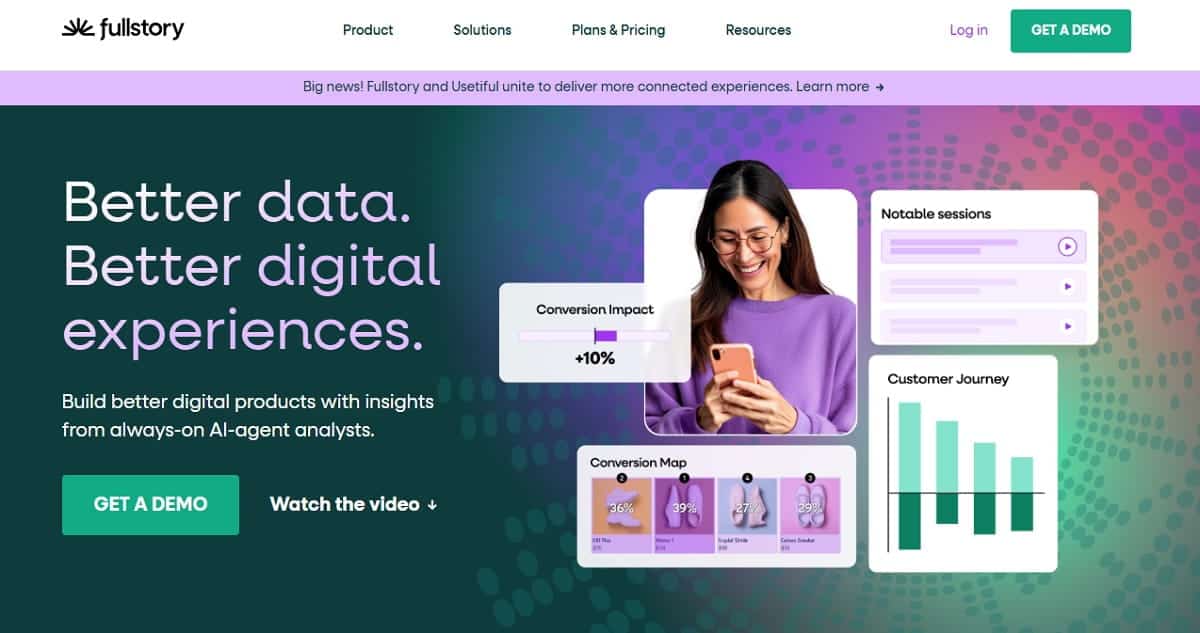
FullStory is a digital experience analytics platform that records and replays real user sessions, visualizes click/mouse/scroll behavior through heatmaps, and segments users by behavior and characteristics. It’s built for product, UX, engineering, and support teams that need to see exactly how visitors interact with a website or app, then use that context to fix bugs, improve conversion, and reduce churn.
Best FullStory Alternatives Comparison Table
| Tool | Best For | Key Features | Starting Price |
|---|---|---|---|
| Plerdy | Marketing, ecommerce, and CRO teams that want session replay plus conversion tools in one platform | Heatmaps, session replay, SEO audit, popups, A/B testing, ecommerce tracking | Free (2,000 pageviews/day); paid from $21/mo billed yearly |
| Hotjar (part of Contentsquare) | UX research teams that need recordings, surveys, and feedback | Heatmaps, session recordings, surveys, feedback | See Contentsquare’s unified plans |
| Microsoft Clarity | Any team on a $0 budget | Session recordings, heatmaps, AI summaries, no traffic cap | Free forever |
| Heap | Product teams that want autocapture plus session replay | Autocapture, session replay (add-on), Heap Illuminate | Free (10,000 sessions/mo); paid custom |
| LogRocket | Product and engineering teams debugging technical issues | Session replay, console logs, network requests, AI (Galileo) | From $176/mo (25K sessions) |
| Mouseflow | Teams needing form analytics and friction detection | Session replay, heatmaps, funnels, form analytics | Free tier; paid from $25/mo |
| OpenReplay | Teams that need self-hosted, privacy-first session replay | Session replay, DevTools, privacy controls, self-hosting | Free (self-hosted); cloud from $199/mo |
| Lucky Orange | Small and mid-size ecommerce/service sites | Recordings, heatmaps, funnels, live chat | From $32/mo |
| Quantum Metric | Enterprise teams needing unified digital analytics | Journey analytics, Felix AI, friction scoring | Custom (demo only) |
| Medallia DXA | Enterprise customer-experience programs | Session replay, Digital Experience Score, journey analytics | Custom (demo only) |
Prices above are pulled from each vendor’s public pricing page as of August 2026 — confirm current numbers on the vendor site before buying, since SaaS pricing changes often.
The 10 Best FullStory Alternatives And Competitors In 2026
1. Plerdy — All-In-One CRO, UX, And SEO Alternative To FullStory
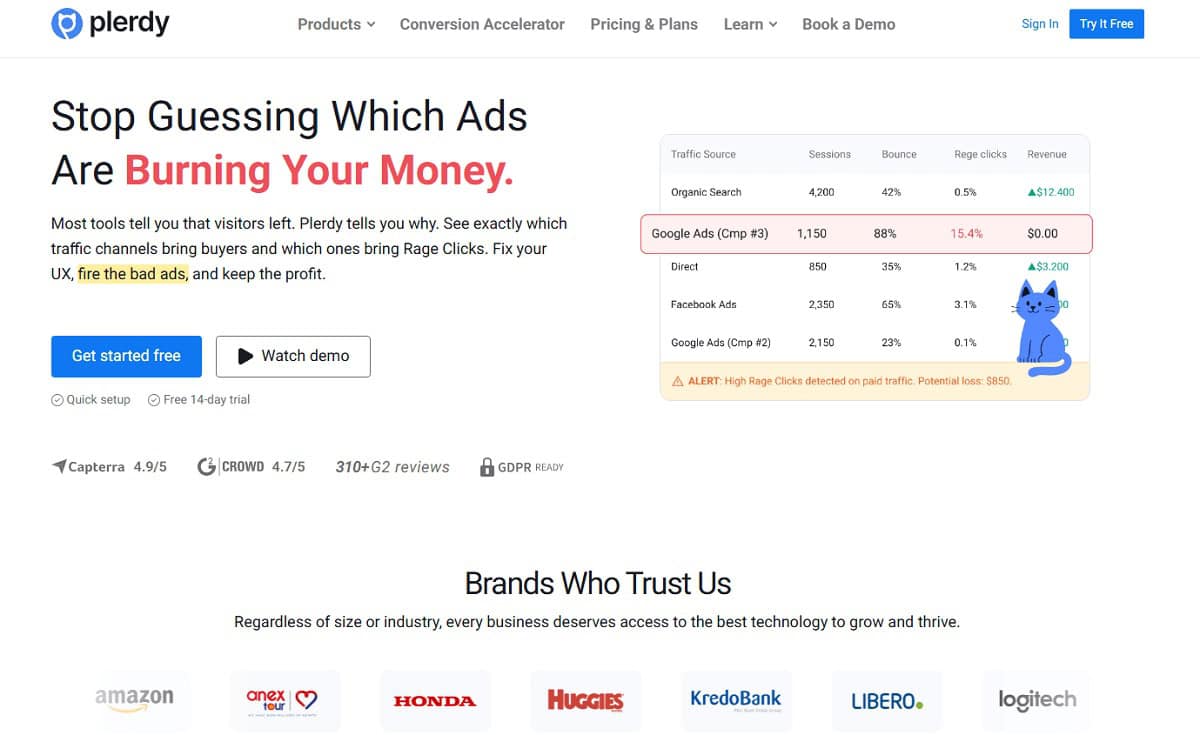
Plerdy is built for teams that want more than a session-replay tool: it combines heatmaps, video session replay, an SEO audit, popups, A/B testing, conversion tracking, and ecommerce tracking in a single dashboard, so marketing, UX, and growth teams don’t have to stitch together three separate analytics tool subscriptions.
Key features: heatmaps (click, move, scroll), session replay, SEO audit, popups and forms, A/B testing, conversion and ecommerce tracking, AI UX Assistant.
Best for: marketing, ecommerce, and website-growth teams that want to find UX problems and fix conversion leaks without building a heavy product-analytics stack.
Pros: one platform instead of three or four; public, transparent pricing; free plan is usable, not a crippled trial.
Cons: less purpose-built than FullStory for deep enterprise product analytics with large in-house data teams.
Pricing: Free plan (2,000 pageviews/day); paid plans from $21/month billed yearly, scaling through mid-tier and enterprise plans. See Plerdy pricing for current plan details.
2. Hotjar (Part Of Contentsquare) — UX Research And Behavior Analytics
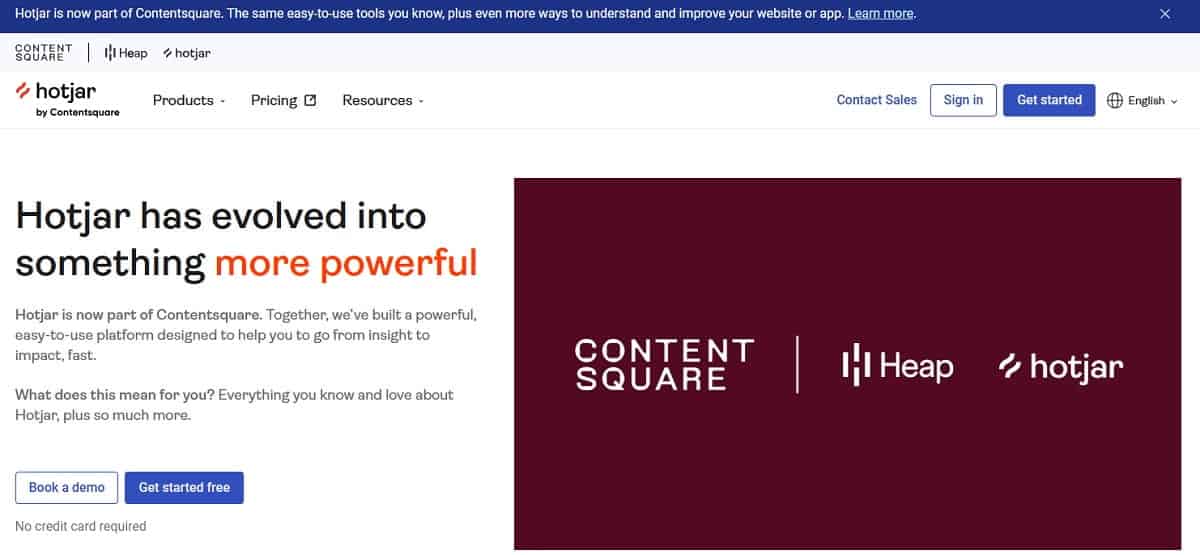
Hotjar is still one of the most recognizable names in behavior analytics, but its ownership status changed: Contentsquare acquired Hotjar in 2021, and as of July 2025 Hotjar Ltd. formally merged into the Contentsquare Group. Hotjar’s three products (Observe, Ask, Engage) are being reorganized into Contentsquare’s Experience Analytics, Voice of Customer, and Product Analytics lines, with the migration running through 2026 — so pricing and plan names you find today may differ from what existing Hotjar customers signed up for. See our Contentsquare vs Hotjar guide for what changed.
Key features: heatmaps, session recordings, surveys, feedback widgets, journey analysis.
Best for: marketing, UX, and research teams that want fast qualitative insight from heatmaps and recordings, plus direct user feedback.
Cons: the brand and pricing are actively being folded into Contentsquare, which adds transition friction for teams evaluating it today.
Pricing: now listed under Contentsquare’s unified plans — check Contentsquare’s Hotjar migration FAQ for current tiers before buying.
3. Microsoft Clarity — Best Free FullStory Alternative
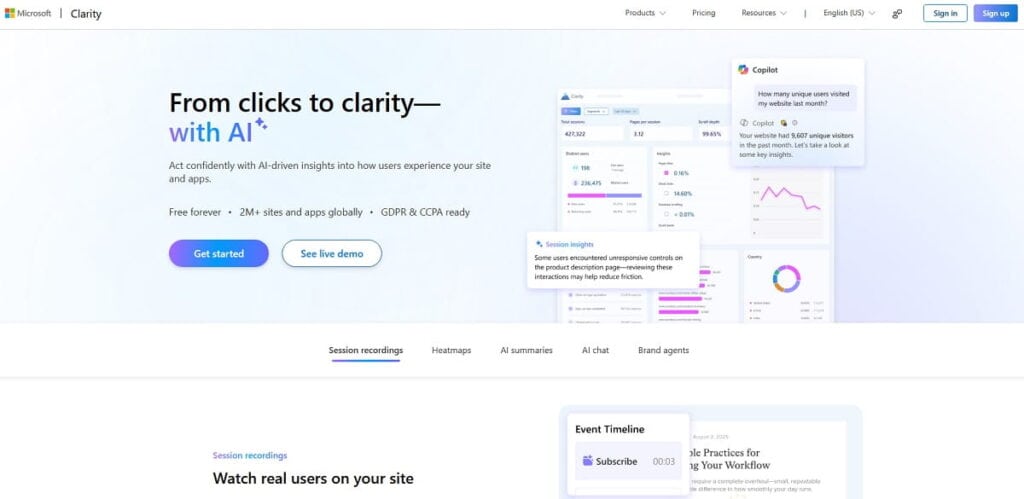
Microsoft Clarity is completely free, with no traffic limits, and remains one of the simplest ways to add session recordings and heatmaps to a site without a procurement conversation.
Key features: session recordings, heatmaps, AI-generated summaries, AI chat, mobile app analytics, integrations.
Best for: website owners, marketers, and small teams that need behavior data on a $0 budget.
Cons: no event tracking, funnels, A/B testing, or SEO tooling — it covers observation, not the CRO layer around it.
Pricing: Free forever, no traffic cap.
4. Heap — Product Analytics With Built-In Session Replay
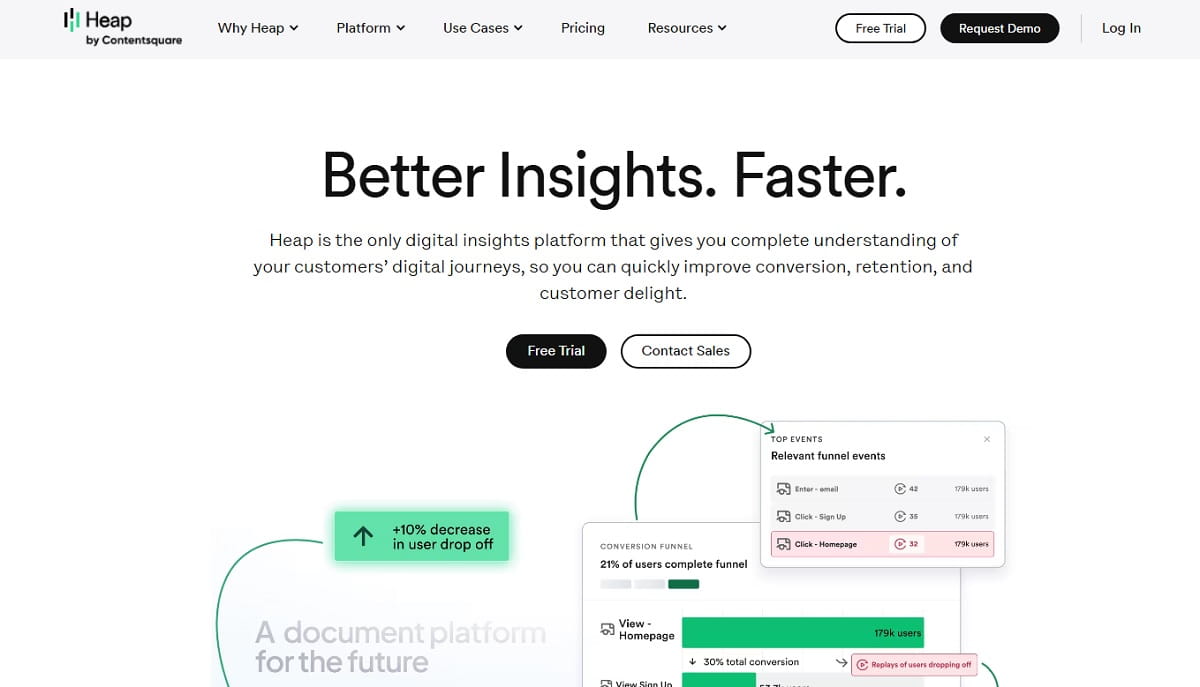
Heap takes a different approach than most FullStory alternatives: it autocaptures every user interaction from day one, so product teams can define and analyze events retroactively instead of pre-configuring tracking before they know what to measure. Session replay is available as an add-on rather than the core feature.
Key features: autocapture, retroactive event definition, session replay (add-on), Heap Illuminate (automated friction detection), Heap Connect (data warehouse export).
Best for: product teams that want quantitative, retroactive analytics with session replay layered on top, rather than a replay-first tool.
Cons: session replay is secondary to its analytics engine, and higher tiers (Pro, Premier) require custom, demo-based pricing.
Pricing: Free (10,000 sessions/month, 6-month retention); Growth, Pro, and Premier tiers scale from there — see Heap pricing.
5. LogRocket — Session Replay With Technical Debugging Context
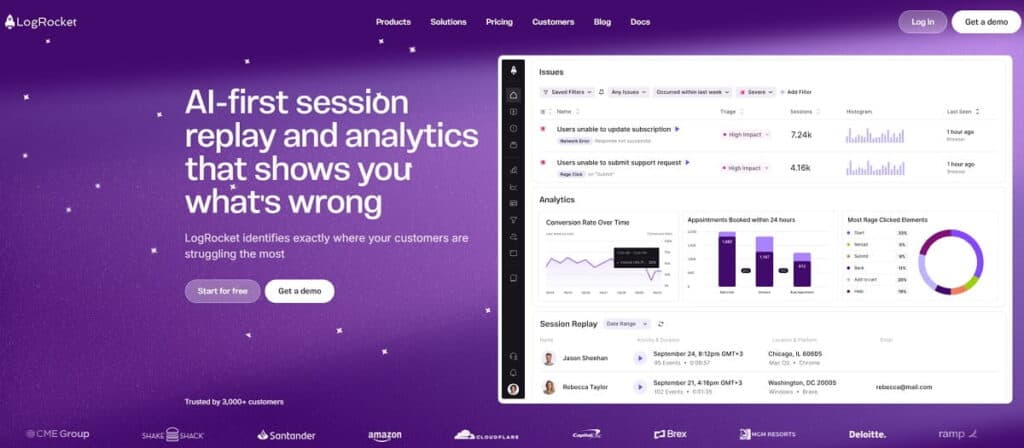
LogRocket goes beyond behavior observation into technical debugging: session replay is paired with console logs, network requests, Redux/state data, and performance metrics, plus AI features (Galileo) for summarizing sessions and surfacing issues automatically.
Key features: session replay, console/network capture, AI session summaries (Galileo), product analytics, conversion funnels.
Best for: product and engineering teams that need to reproduce and debug real user issues, not just watch what happened.
Cons: more technical setup than a marketing-focused tool, and pricing scales quickly with session volume.
Pricing: Core from $176/month (25,000 sessions/month); Pro and Enterprise tiers add AI features, unlimited seats, and self-hosted options. 14-day free trial, no credit card required.
6. Mouseflow — Best For Form Analytics And Friction Detection
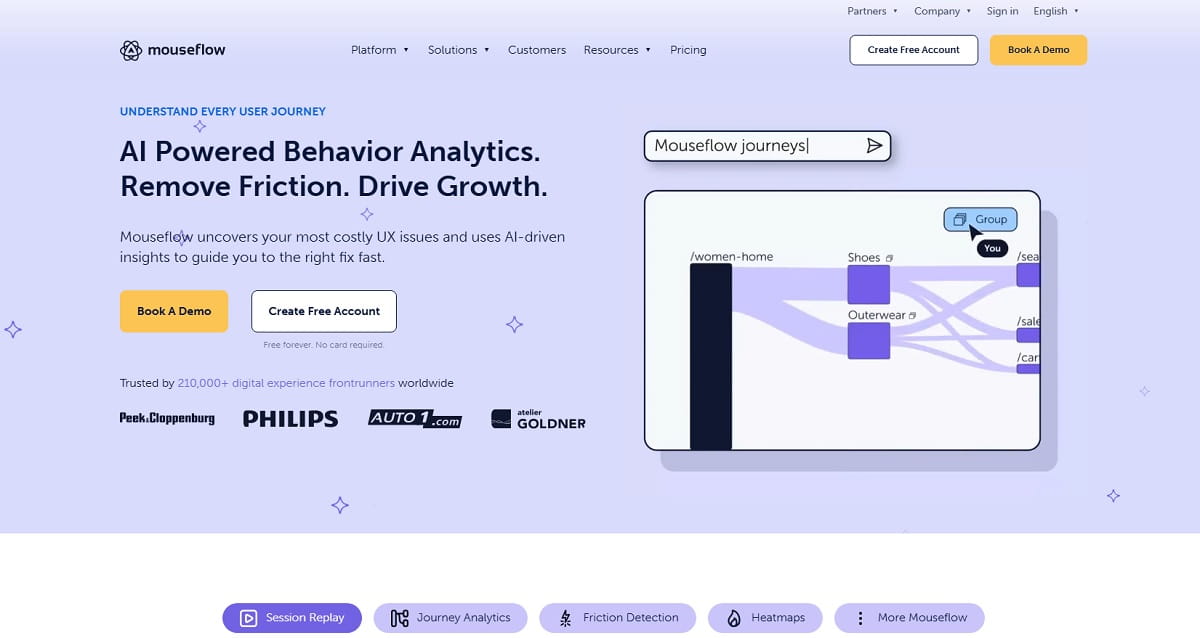
Mouseflow focuses on the parts of a page that quietly kill conversions: it combines session replay and heatmaps with dedicated form analytics (field-level drop-off, hesitation, re-entry) and friction/funnel detection.
Key features: session replay, heatmaps, funnels, form analytics, feedback surveys, friction detection.
Best for: teams whose conversion problems live in forms and checkout flows — lead-gen pages, signup flows, and ecommerce checkout.
Cons: less suited to teams that need broad product analytics or technical debugging depth.
Pricing: Free tier available; Essential from $25/month, scaling through Advanced and Premium tiers for higher session volume.
7. OpenReplay — Best Open-Source FullStory Alternative
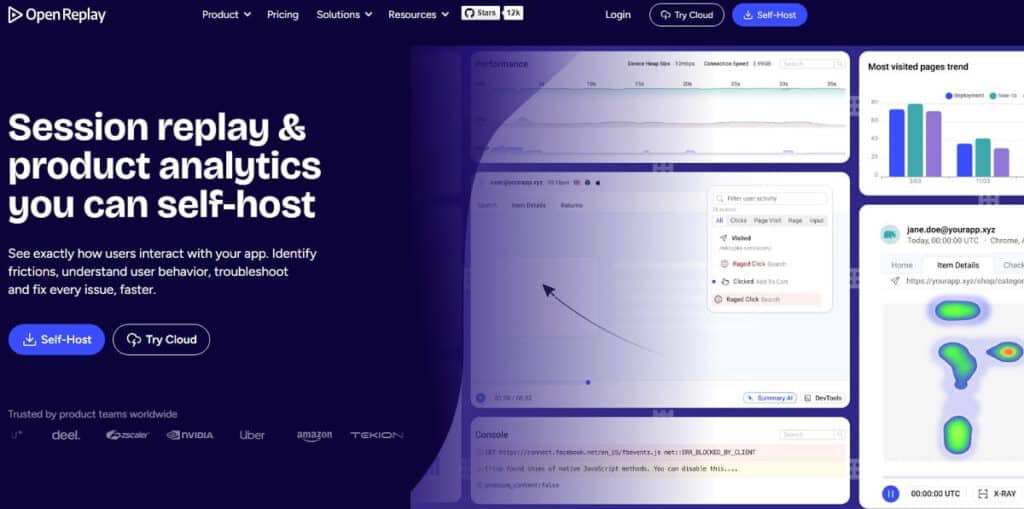
OpenReplay is the strongest open-source pick on this list, and it remains actively maintained in 2026 (its GitHub repositories show ongoing commits and releases). Self-hosting gives engineering teams full control over where session data lives, which matters for GDPR/data-sovereignty requirements that a SaaS-only tool can’t satisfy.
Key features: session replay, DevTools-style debugging, co-browsing, funnels, heatmaps, privacy controls, self-hosted deployment.
Best for: engineering-led teams that want session replay and debugging context without sending user data to a third-party server.
Cons: self-hosting requires real DevOps effort (community estimates run $6–$12/month in bare infrastructure plus setup time); not a plug-and-play choice for non-technical teams.
Pricing: Open-source edition is free, self-hosted, with core features up to roughly 50,000 sessions/month; managed Cloud (Dedicated) starts at $199/month if you don’t want to host it yourself.
8. Lucky Orange — Best For Small And Mid-Size Ecommerce Sites
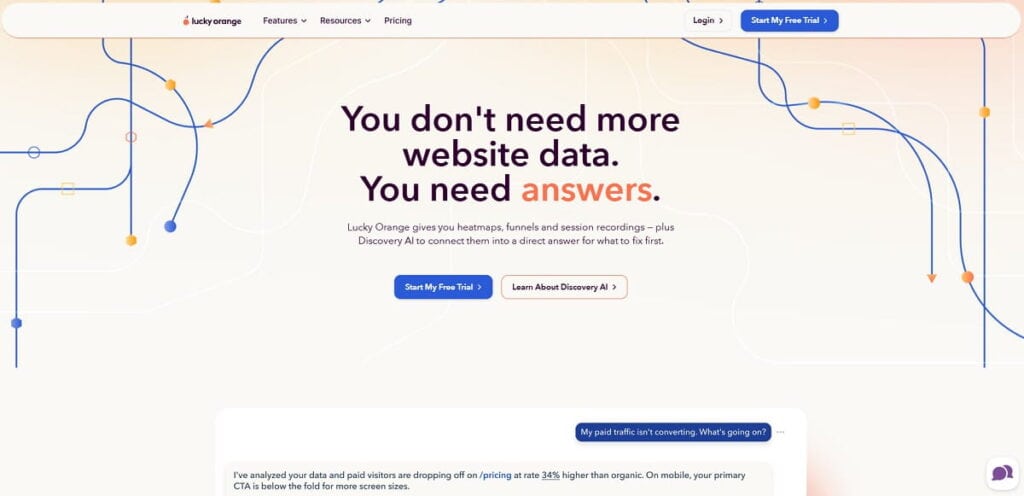
Lucky Orange packages session recordings, heatmaps, funnels, and live chat into one straightforward tool aimed at smaller teams that want conversion insight without an enterprise learning curve.
Key features: session recordings, dynamic heatmaps, conversion funnels, visitor profiles, surveys, live chat.
Best for: small and mid-size ecommerce and service websites that want quick, visual conversion insight.
Cons: shallower technical/debugging depth than LogRocket or OpenReplay, and less product-analytics depth than Heap.
Pricing: Build plan from $32/month, scaling to Grow, Expand, and Scale tiers; 7-day free trial, no credit card required.
9. Quantum Metric — Enterprise Digital Experience Analytics
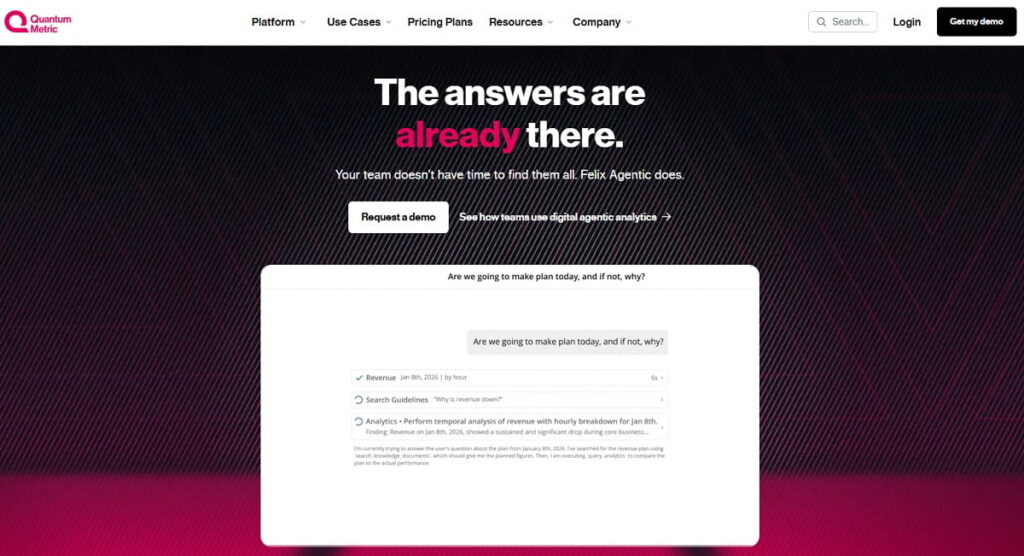
Quantum Metric is built for large organizations that need product, marketing, UX, and engineering teams working off one shared view of digital behavior, with AI (Felix Agentic) layered on top for automated friction and opportunity detection.
Key features: journey and experience analytics, Felix AI, friction/conversion scoring, technical and behavioral signal correlation.
Best for: large enterprises with the traffic volume and internal resources to act on deep digital-experience data.
Cons: overkill — and priced accordingly — for small sites or teams without a dedicated analytics function.
Pricing: Custom, demo-based pricing only; no published tiers.
10. Medallia Digital Experience Analytics (DXA) — Enterprise Customer Experience
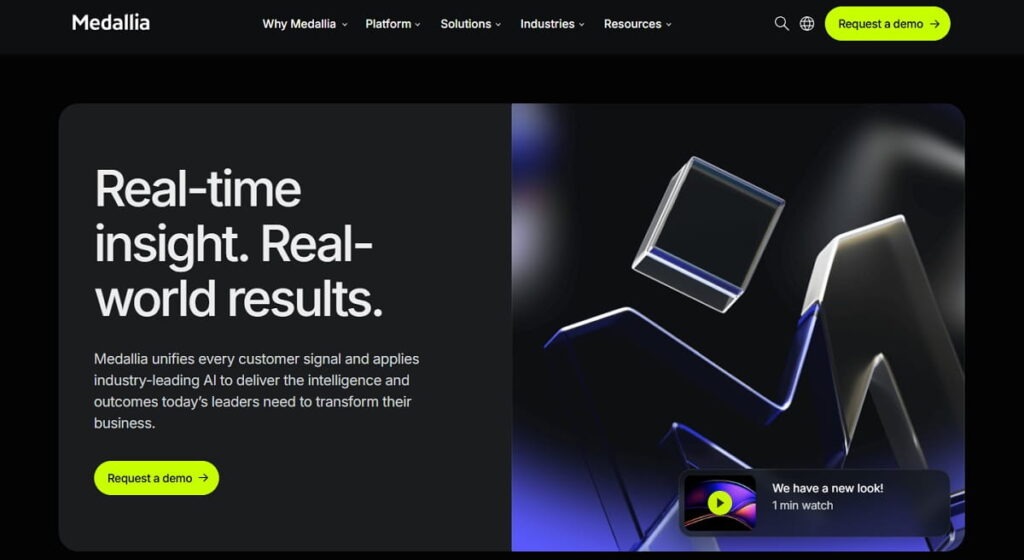
Medallia DXA pairs session replay and heatmaps with a proprietary Digital Experience Score that rates every visitor session on frustration, engagement, navigation, and technical performance — useful for enterprises that already run broader customer-experience programs through Medallia.
Key features: session replay, heatmaps, journey analytics, AI/ML-based Digital Experience Score.
Best for: enterprise CX teams that want digital behavior data folded into an existing customer-experience program.
Cons: built for large organizations — complex to roll out and not priced for small teams.
Pricing: Custom, demo-based pricing only.
A Note On Smartlook: Why It Is No Longer a Safe Choice
You’ll see Smartlook recommended in a lot of older “FullStory alternatives” roundups, so it’s worth being direct about its current status: Smartlook (now under Cisco) reached End of Sale on May 31, 2026. No new accounts can be created, the last day to renew or add to an existing subscription is August 31, 2026, and servers are scheduled to shut down entirely on August 31, 2027, after which all dashboard and historical data access is revoked. If you’re choosing a FullStory alternative today, Smartlook should not be on your shortlist — it may still be relevant if you’re an existing customer planning a migration, but not as a new pick. See Cisco’s official End-of-Sale announcement for the exact dates.
Which FullStory Alternative Should You Choose? (Decision Guide)
Match the tool to the job, not the other way around:
- Best FullStory alternative overall: Plerdy — if you want session replay and heatmaps plus the CRO tools (A/B testing, popups, SEO audit) to act on what you see.
- Best FullStory alternative for ecommerce: Plerdy or Lucky Orange — both pair replay/heatmaps with conversion-focused features built for storefronts and checkout flows.
- Best FullStory alternative for startups: Microsoft Clarity to start (free, no traffic limits), moving to Plerdy or Hotjar once you need CRO tools or deeper UX research.
- Best FullStory alternative for B2B SaaS: Plerdy for UX/CRO/SEO in one place, or LogRocket when engineering needs console logs and network data alongside replay.
- Cheapest alternative for session recordings: Microsoft Clarity, or Mouseflow’s free tier if you specifically need form-level analytics.
- Best for mobile app analytics: Heap or Contentsquare’s mobile tooling (formerly under the Hotjar/Contentsquare merger) if native iOS/Android depth matters.
- Best open-source / self-hosted: OpenReplay, when data sovereignty or GDPR compliance rules out sending sessions to a third-party SaaS.
- Best for enterprise digital experience analytics: Quantum Metric or Medallia DXA, for organizations with the traffic and internal resources to use deep, AI-scored journey data.
Do not pick a tool purely because it’s the most popular. Test it against your actual pages, funnels, and conversion goals for at least a couple of weeks before committing.
FullStory Pricing In 2026: Why Teams Compare Alternatives
FullStory’s free plan includes 30,000 sessions/month, 12 months of data retention, core session replay, basic analytics, debugging tools, and access for up to 10 users. Every paid tier above that — Business, Advanced, and Enterprise — requires requesting pricing and a demo; no dollar figures are published. That’s a reasonable model for a large product-analytics buyer with a procurement process, but it’s exactly why smaller SaaS teams, ecommerce sites, and marketing teams often compare FullStory alternatives before committing: they want a tool with public pricing, a faster setup, and — in Plerdy’s case — a broader CRO feature set out of the box.
FAQ About FullStory Alternatives
What Is The Best FullStory Alternative In 2026?
It depends on the job: Plerdy for teams that want session replay plus CRO tools (A/B testing, popups, SEO audit) in one dashboard; Microsoft Clarity if the budget is $0; OpenReplay if the requirement is self-hosted, open-source session replay.
What Is The Best FullStory Alternative For Ecommerce?
Plerdy and Lucky Orange are built with ecommerce conversion in mind — both combine session replay/heatmaps with funnel and conversion tracking, rather than analytics alone.
What Is The Best FullStory Alternative For Startups?
Microsoft Clarity is the easiest starting point since it’s free with no traffic cap. Once a startup needs CRO features like popups or A/B testing on top of replay and heatmaps, Plerdy is the natural next step.
Which FullStory Alternative Is Best For B2B SaaS?
Plerdy, when the team needs UX, CRO, SEO, heatmaps, session replay, and conversion tools together; LogRocket, when engineering needs console logs, network requests, and technical debugging context alongside replay.
What Is The Cheapest Alternative To FullStory For Session Recordings?
Microsoft Clarity is free with no session cap. Mouseflow’s free tier is a good option if form-level analytics matter more than raw session volume.
What Is The Best Free FullStory Alternative?
Microsoft Clarity — session recordings, heatmaps, AI summaries, and AI chat, with no traffic limits and no paid tier required.
What Is The Best Open-Source FullStory Alternative?
OpenReplay — self-hosted session replay, DevTools-style debugging, privacy controls, and full control over where session data is stored.
Is Hotjar Still A FullStory Competitor?
Yes, functionally — but Hotjar is no longer a fully independent product. Contentsquare acquired Hotjar in 2021, and as of July 2025 Hotjar Ltd. merged into the Contentsquare Group, with its features being reorganized under Contentsquare’s Experience Analytics, Voice of Customer, and Product Analytics lines through 2026.
Is Smartlook Still A Good FullStory Alternative In 2026?
No. Smartlook reached End of Sale on May 31, 2026, meaning no new accounts can be created; the last day to renew existing subscriptions is August 31, 2026, ahead of a full shutdown on August 31, 2027. It shouldn’t be on a shortlist for anyone choosing a new tool today.
Conclusion: Which FullStory Alternative Is Worth Testing First?
If you only test one FullStory alternative, make it the one that matches what you’re actually trying to fix. For most marketing, ecommerce, and growth teams, that’s Plerdy — heatmaps and session replay plus the CRO tools (A/B testing, popups, SEO audit, ecommerce tracking) to act on what you find, all under one transparent, public pricing page. If budget is the only constraint, start with Microsoft Clarity’s free plan. If your team needs deep technical debugging context, LogRocket is the stronger fit. And if you’ve been considering Smartlook, treat that as a sign to look elsewhere — it’s past End of Sale.
Whatever you pick, don’t choose on brand recognition alone: run it against your real pages, funnels, forms, and conversion goals before deciding.