
12 Best OptiMonk Alternatives In 2026 For Popups, CRO And Email Capture

Andrew Chornyy - 001

CEO Plerdy — expert in SEO&CRO with over 15 years of experience.

See where your website loses sales

Create a free Plerdy account to find revenue leaks in minutes. See where visitors click, scroll, drop off, and what stops them from buying — with heatmaps, session recordings, SEO checks, and UX insights.

OptiMonk built its reputation on one thing: getting a personalized popup in front of the right shopper without a developer. It still does that well. But pageview ceilings, domain caps and a feature set that stops at the popup itself push a lot of teams to look elsewhere — especially agencies juggling client sites and ecommerce brands that want to know why a campaign underperforms, not just that it did.

This guide compares 12 verified OptiMonk alternatives, with pricing checked directly against each vendor’s own pricing page in September 2026. First on the list is Plerdy, because it solves the gap most popup tools leave open: it ships a pop-up form builder alongside heatmaps, session recordings and A/B testing, so the diagnosis and the fix live in one tool. Every other pick below is a real popup platform that can take over OptiMonk’s core job — not an adjacent product padded in to make the list longer.

OptiMonk Alternatives At A Glance

#ToolEntry PriceFree PlanBest For
1Plerdy$32/moYes, foreverPopups plus heatmaps and session replay in one tool
2OptinMonster$7/mo (annual intro)NoWordPress and content publishers
3Poptin$25/moYes, 1,000 visitorsAgencies needing unlimited domains
4ClaspoContact for ProYes, all featuresTesting every feature before paying
5Popupsmart$39/moYes, 5K pageviewsAI-assisted popup creation
6Sleeknote€49/moNo, 14-day trialEcommerce with unlimited campaigns
7Privy$24/mo (popups only)No, 15-day trialShopify stores wanting popups plus email and SMS
8Getsitecontrol$19/moYes, 10K viewsCheapest path to unlimited widget views
9Justuno$59/moNoAI product recommendations and done-for-you service
10Wisepops$499/moNo, 14-day trialEnterprise teams that want a strategist
11Hello Bar$29/mo (annual)Yes, 5K viewsSimple bars and popups with A/B on every plan
12ConvertFlow$29/moYes, previews onlyFull funnels: landing pages, quizzes and popups

Prices reflect each vendor’s published plans as of September 2026 and change often — check the vendor page before you commit.

Why Teams Look For OptiMonk Alternatives

Best OptiMonk Alternatives - 001

OptiMonk is not a bad product, and most people leaving it are not leaving over quality. They leave over structural limits that only bite once a site grows. Reading OptiMonk’s own pricing page makes the pattern obvious.

The pageview ladder gets steep. The free plan covers 10,000 monthly pageviews on a single domain. Essential is $19/mo. Growth jumps to $69/mo, and Premium to $179/mo. For a store doing several hundred thousand pageviews a month, the popup layer alone starts to cost more than the analytics stack underneath it.

Domain caps punish agencies. Free allows one domain, Essential two, Growth four, Premium ten. An agency running twelve client sites is pushed to the Master tier or to buying separate accounts. By contrast, Poptin’s $119/mo Agency plan and Sleeknote’s plans both allow unlimited domains, and Getsitecontrol sells per site at $19–$29.

The tool tells you what happened, not why. OptiMonk reports impressions and conversions per campaign. It does not show you the scroll depth at which visitors abandoned the page the popup fired on, or the recording of the session where someone dismissed it three times. That is the gap Plerdy’s conversion funnel and event tracking close.

There is a learning curve. Segment-level personalization and Smart Product Pages are powerful, but they assume someone on the team owns the setup. Small teams often want a builder they can learn in an afternoon — which is where Poptin, Hello Bar and Popupsmart win.

How We Picked These OptiMonk Alternatives

Most listicles on this query recycle each other’s entries. We applied four filters instead, and several widely recommended tools did not survive them.

  1. It must replace the core job. The tool has to build onsite popups or embedded forms, target them by behavior (exit intent, scroll, time, cart value), and push captured leads into an ESP or ecommerce platform. Survey tools, review widgets and pure email platforms were excluded.
  2. Pricing was read from the vendor, not from a competitor’s blog. Every figure below came from the vendor’s own pricing page in September 2026. This matters: several published OptiMonk lists still quote Wisepops at €99/mo, but Wisepops now starts at $499/mo and positions itself as a managed enterprise service.
  3. Status was verified. We confirmed each product is still sold and maintained, and we checked ownership. Privy, for example, acquired Sendlane in January 2026 after acquiring Emotive in 2025 — relevant if you are betting a roadmap on it.
  4. No padding. We did not add tools to reach a round number. Each of the 12 has a distinct “best for” that no other entry on the list covers as well.

One honest caveat: there is no reliable public benchmark for “average conversion lift” when switching popup tools. Any list quoting a universal percentage is inventing it. The only number that matters is your own — run the old and new tool side by side on the same traffic for two weeks using Plerdy’s A/B testing tool and check the result with an A/B significance calculator before you migrate everything.

12 Best OptiMonk Alternatives In 2026

1. Plerdy — Popups Backed By Behavior Data

Plerdy Pop-Up Form Builder With Heatmaps As An OptiMonk Alternative

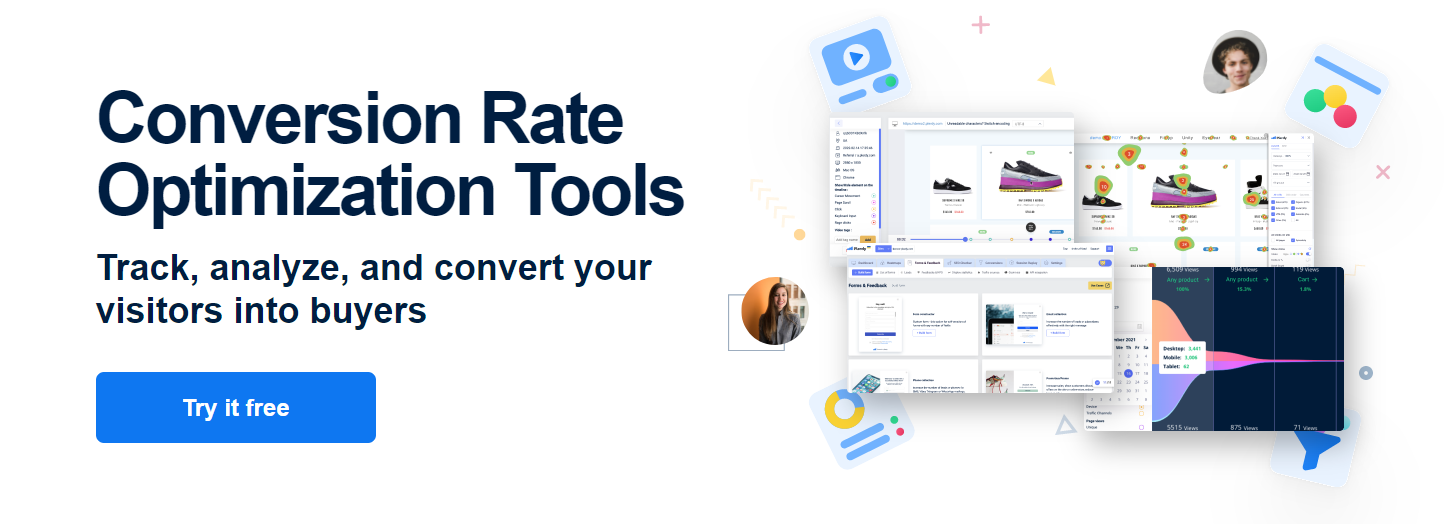
Plerdy is a conversion rate optimization platform where the popup builder is one module inside a larger toolkit. You build a smart pop-up form, then use the heatmap and session recording tools on the same page to see why it converted or did not. With OptiMonk you would need a second vendor for that half.

Key Features

  • Pop-up and smart form builder with exit intent, scroll, time and click triggers
  • Click, scroll and mouse-movement heatmaps on desktop and mobile
  • Session recordings with filters by conversion, device and traffic source
  • A/B testing with unlimited experiments on every plan, including free
  • Conversion funnels and event goal tracking
  • Ecommerce sales performance reporting tied to on-page behavior
  • Built-in SEO checker and site error monitoring

Use Cases

  • Diagnosing a popup that gets impressions but no signups, by replaying the sessions where it fired
  • Finding the scroll depth where readers drop off, then triggering the form just before it
  • Running a popup A/B test and an on-page layout test from the same dashboard
  • Consolidating a popup tool and an analytics tool into one subscription

Pros

  • The only tool here that pairs the popup with heatmaps and session replay natively
  • Genuinely usable free tier: 100 pop-ups, 100 daily heatmaps, 500 sessions, unlimited A/B tests
  • 35% discount on annual billing
  • Works on any stack — Shopify, WooCommerce, WordPress, custom builds

Cons

  • Not a pure popup specialist: fewer prebuilt popup templates than OptinMonster or Popupsmart
  • No native email sending, so you still connect an ESP for campaigns
  • The breadth of tools means a longer first-week orientation than a single-purpose builder

Pricing: Free forever. Startup $32/mo, Scale $64/mo, Thrive $108/mo, Enterprise tiers at $149, $248 and $390/mo. Annual billing cuts 35%. See Plerdy pricing.

Best For: Teams that are tired of guessing why a popup underperforms and want the diagnosis in the same tool as the fix.

2. OptinMonster — The WordPress And Publisher Standard

OptinMonster Campaign Builder For WordPress Lead Capture

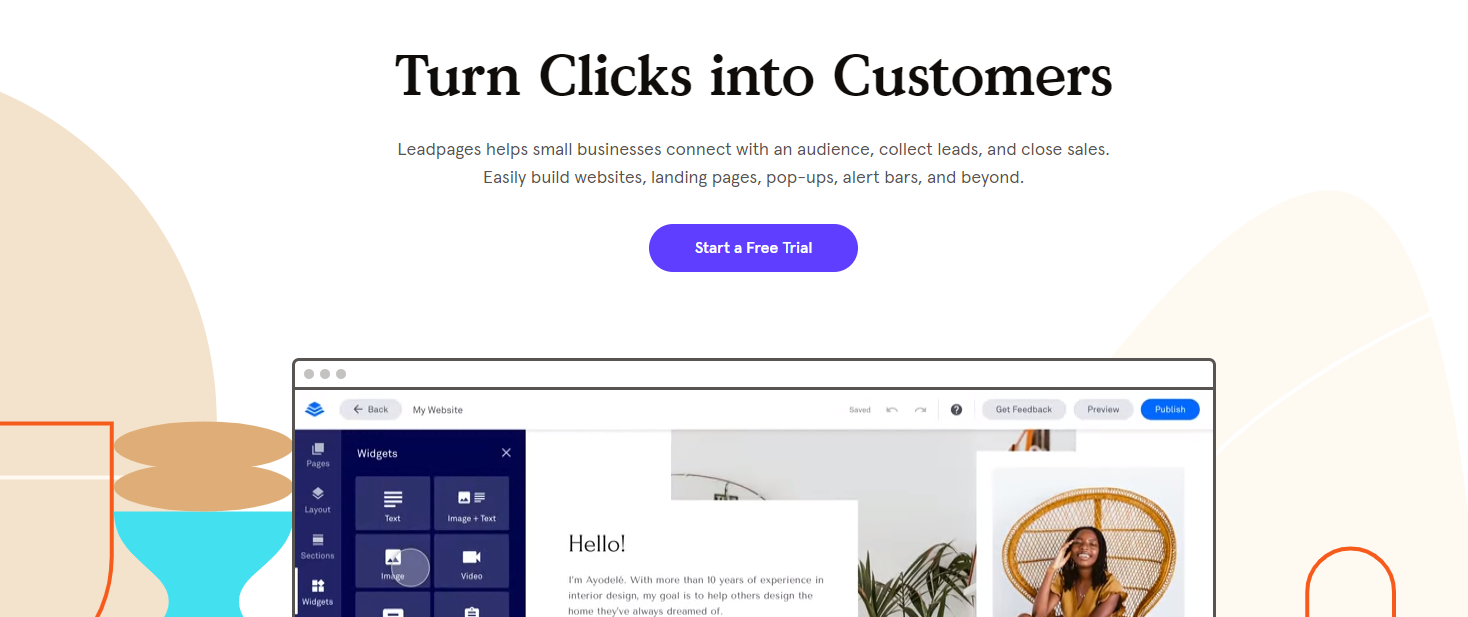
OptinMonster is the most established name in this category and remains the default for WordPress sites and content publishers. Its campaign types — lightbox, floating bar, slide-in, inline, gamified wheel — cover almost everything OptiMonk offers, and its WordPress plugin integration is deeper than anything else on this list.

Key Features

  • Exit Intent technology with adjustable sensitivity
  • Page-level targeting, geolocation and OnSite Retargeting
  • Content locking for gated articles and lead magnets
  • A/B testing and campaign scheduling
  • Deep WordPress, WooCommerce and Shopify plugin integrations

Use Cases

  • Growing a newsletter list on a high-traffic blog
  • Gating a downloadable resource behind an email form
  • Showing different offers to returning versus first-time readers

Pros

  • Enormous template library and the most mature WordPress workflow
  • Very low entry price during the introductory year
  • Strong documentation and a large community of tutorials

Cons

  • Impression caps are tight: 2,500/mo on Basic, 10,000 on Plus
  • Exit Intent is gated to the Pro tier, which is the feature most people come for
  • Introductory pricing renews at full list price after year one — Basic goes from $84 to $210/year

Pricing: Annual introductory rates of $7/mo Basic (1 site), $19/mo Plus (2 sites), $29/mo Pro (3 sites), $49/mo Growth (5 sites). See OptinMonster pricing. If OptinMonster is your actual starting point rather than OptiMonk, compare our dedicated OptinMonster alternatives guide.

Best For: WordPress publishers and bloggers who want the deepest CMS integration available.

3. Poptin — Unlimited Domains Without An Enterprise Contract

Poptin Popup Builder Dashboard With Unlimited Domains Plan

Poptin is the pick when the constraint is the number of websites rather than the number of features. Its Agency plan carries unlimited domains at $119/mo, which is where OptiMonk pushes you toward custom pricing.

Key Features

  • Drag-and-drop popup and inline form builder
  • Exit intent, scroll, time-delay and click triggers
  • Autoresponder emails built in, plus 40+ native integrations
  • A/B testing and behavior-based targeting
  • Poptin Forms for embedded and standalone forms

Use Cases

  • An agency running lead capture across a dozen client sites from one login
  • A small store validating popups on a free plan before spending anything
  • Adding a simple autoresponder without buying a separate ESP

Pros

  • Free plan with a real allowance: 1,000 visitors/mo, unlimited popups, unbranded
  • Unlimited domains at $119/mo, well below equivalent enterprise tiers elsewhere
  • Simple enough that a non-technical marketer ships a campaign the same day

Cons

  • Reporting is basic next to Justuno or Wisepops
  • Visitor caps are lower per dollar than Getsitecontrol at high traffic
  • Template designs feel dated compared to Claspo or Sleeknote

Pricing: Free (1,000 visitors, 1 domain). Basic $25/mo (10K visitors), Pro $59/mo (50K, 4 domains), Agency $119/mo (150K, unlimited domains), Enterprise custom. See Poptin pricing.

Best For: Agencies and freelancers who need many domains on one affordable plan.

4. Claspo — Every Feature On The Free Plan

Claspo Popup Template Library On The Free Plan

Claspo takes an unusual position: all plans, free included, unlock every platform feature. You pay for pageviews and for removing the badge, not for capabilities. That makes it the cheapest honest way to evaluate a full-featured popup platform.

Key Features

  • 1,000+ responsive templates including gamification widgets
  • Unlimited widgets and unlimited team members on every plan
  • Multi-language AI translation for campaigns
  • Webhooks plus direct integrations across major ESPs
  • Dedicated mobile customization controls

Use Cases

  • Trialling advanced targeting without a credit card or a feature-gated demo
  • Running localized popups across several language versions of a store
  • Onboarding a whole marketing team without per-seat costs

Pros

  • No feature gating at any tier, which is rare in this category
  • Unlimited team members even on free — most competitors charge per seat
  • Strong mobile editing, an area where many popup builders are weak

Cons

  • The free plan carries a “Powered by Claspo” badge and covers one website
  • Paid tier pricing is not published; you start a 14-day Pro trial or contact sales
  • Smaller brand and community than OptinMonster or Privy

Pricing: Free with all features, tiered pageviews and a badge. Paid Pro tiers via 14-day trial, 20% off annual. Enterprise and Agency plans add white-label domains. See Claspo pricing.

Best For: Teams that want to test the full feature set properly before committing budget.

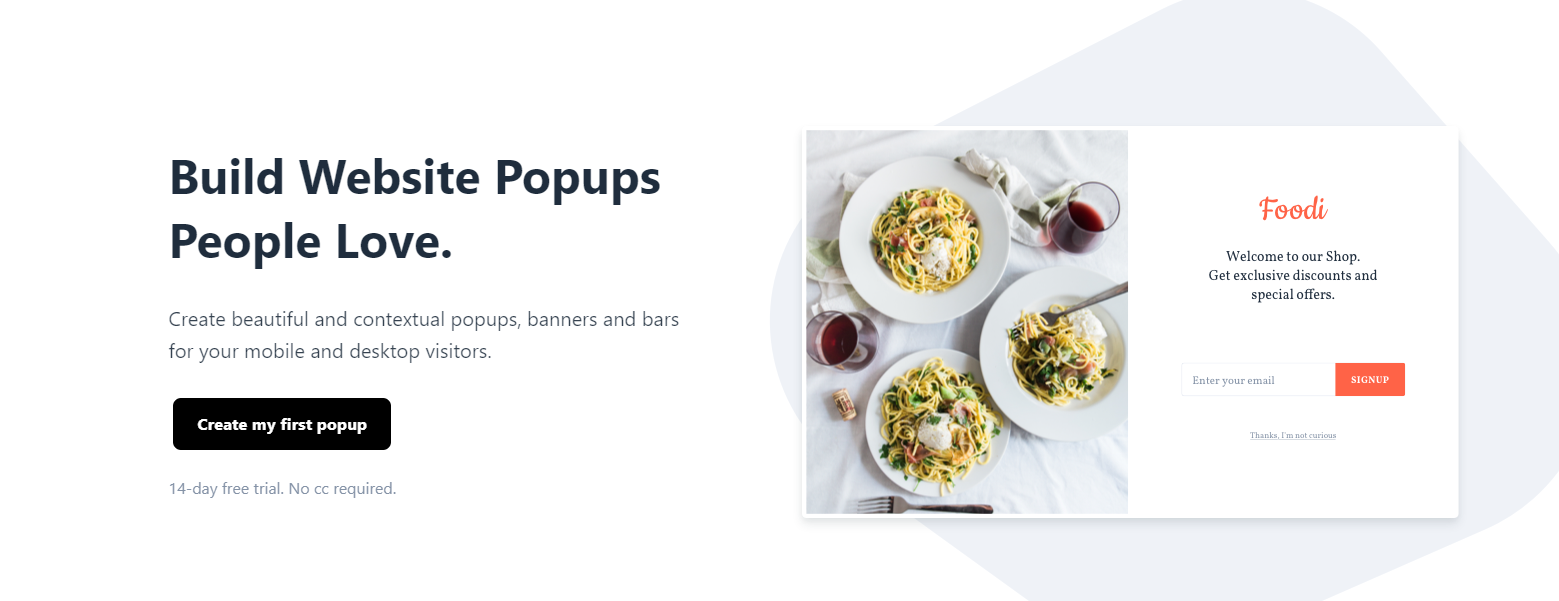
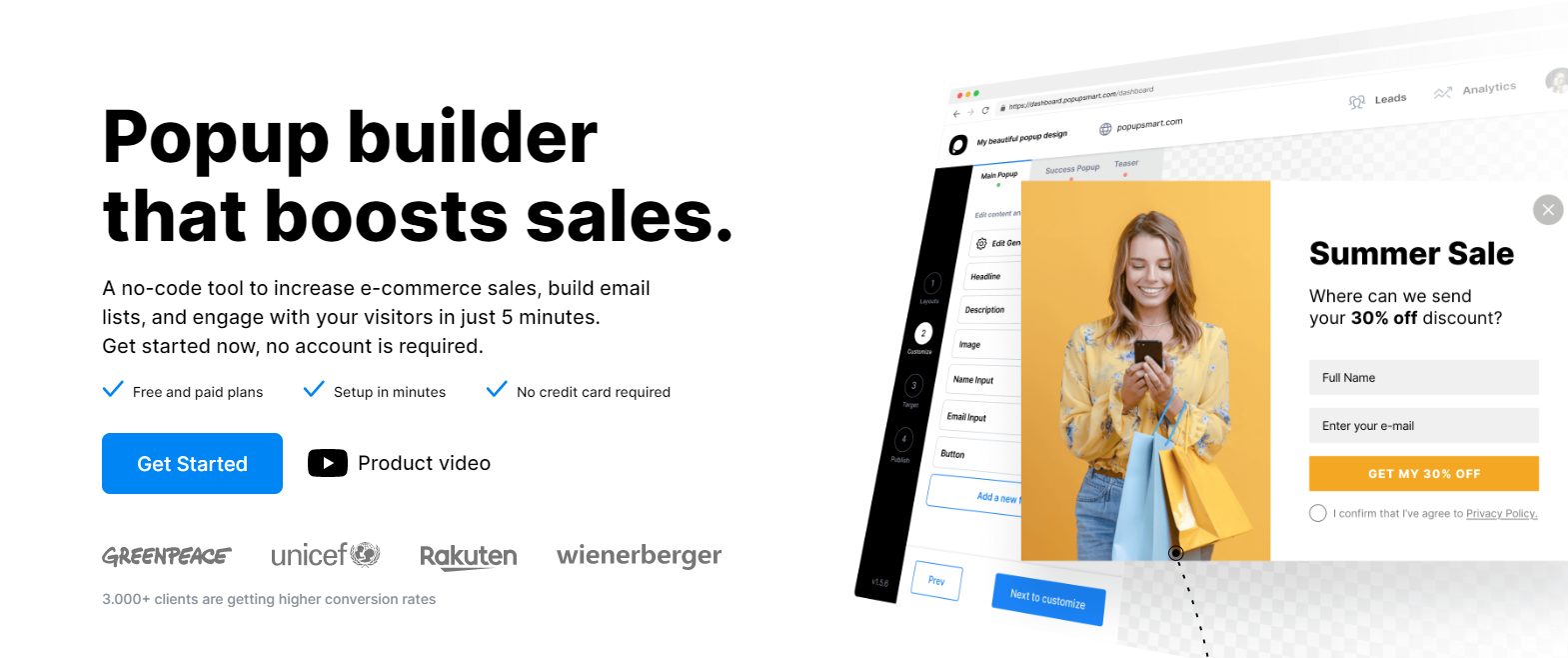
5. Popupsmart — AI-Assisted Campaign Building

Popupsmart Smart Mode AI Popup Generator Interface

Popupsmart leans on its Smart Mode AI to generate a working campaign from a short prompt, which shortens the blank-canvas problem that slows most popup projects down.

Key Features

  • Smart Mode AI popup generation
  • 500+ conversion-focused templates
  • Light, sidebar, fullscreen, floating and teaser popup types
  • Time, exit-intent, scroll and geolocation targeting
  • Custom CSS and font control for brand matching

Use Cases

  • Launching a seasonal campaign quickly without a designer
  • Running popups across three to seven brand sites on one plan
  • Adding GDPR- and adblock-safe popups to a compliance-sensitive site

Pros

  • AI generation is a genuine time-saver for teams shipping many campaigns
  • Site allowances are generous: 5 sites on the $69 Advanced plan
  • 7- to 15-day money-back guarantee on paid plans

Cons

  • A/B split testing is gated to Advanced ($69/mo) and above
  • Free plan allows only one live popup and 5,000 pageviews
  • Email quotas are modest — 1,000/mo on Basic

Pricing: Free (5K pageviews, 1 site, 1 live popup). Basic $39/mo, Advanced $69/mo, Pro $99/mo, Expert $159/mo; 20% off annual. See Popupsmart pricing.

Best For: Marketing teams shipping a high volume of campaigns who want AI to handle the first draft.

6. Sleeknote — Ecommerce Popups Without Domain Limits

Sleeknote Ecommerce Popup Campaign Editor

Sleeknote is a Danish ecommerce specialist whose pricing model is the direct answer to OptiMonk’s domain caps: unlimited campaigns, unlimited domains and multiple users on every tier, priced purely on visitors.

Key Features

  • Ecommerce-focused templates and side-message formats
  • Unlimited campaigns, domains and users on all plans
  • Optional gamification tier (spin-to-win and similar)
  • Visitor-based rather than pageview-based billing
  • Campaigns stay live if you exceed your tier

Use Cases

  • A multi-brand retailer running campaigns across several storefronts
  • Replacing a per-domain popup contract with one visitor-based plan
  • Testing gamified offers during a seasonal promotion

Pros

  • Unlimited domains at every price point, including the €49 entry tier
  • Visitors, not pageviews — a multi-page browsing session counts once, which is materially cheaper for content-heavy stores
  • Campaigns are never disabled at overage; you auto-upgrade at 100% over

Cons

  • Priced in EUR, which adds currency friction for US teams
  • No free plan, only a 14-day trial
  • Gamification costs extra on top of the Core tier

Pricing: Core from €49/mo (0–25K visitors, annual) up to €369/mo (300–500K); Core + Gamification from €68/mo. 20% off annual, 14-day trial. See Sleeknote pricing.

Best For: Ecommerce brands and multi-store retailers that hit domain limits elsewhere.

7. Privy — Popups Bundled With Email And SMS

Privy Popup Email And SMS Dashboard For Shopify Stores

Privy is the option when you would rather buy the popup and the email program from the same vendor. It bills itself as Shopify’s most-reviewed email and SMS app, and it sells a popups-only plan if you do not need the messaging side.

Key Features

  • Popups, banners, flyouts and embedded forms
  • Email campaigns with unlimited sends on contact-based plans
  • SMS with credit-based pricing and volume discounts
  • Cart abandonment and win-back automations
  • Native Shopify, BigCommerce, Wix and WooCommerce integrations

Use Cases

  • A Shopify store consolidating popup, email and SMS into one bill
  • Running an abandoned-cart flow triggered by an exit popup
  • Replacing a popup tool and an ESP at the same time

Pros

  • Popups-only plan starts at $24/mo for 10,000 pageviews — competitive as a pure popup tool
  • Removes an integration hop between capture and send
  • Actively investing: Privy acquired Sendlane in January 2026 and Emotive in 2025

Cons

  • Email pricing scales hard with contacts — 50,001–55,000 contacts is $570/mo
  • Popup design controls are lighter than Sleeknote’s or Claspo’s
  • No permanent free plan, only a 15-day trial

Pricing: Popups and displays from $24/mo (10K pageviews) to $1,500/mo (3.5M). Email from $30/mo (0–1,500 contacts). SMS add-on from $15/mo. See Privy pricing.

Best For: Shopify merchants who want capture and messaging under one roof.

8. Getsitecontrol — The Cheapest Route To Unlimited Views

Getsitecontrol Widget Builder With Unlimited Views Plan

Getsitecontrol is the value pick. Pro Max removes the widget-view ceiling entirely for $29/mo, a threshold no other tool here comes close to matching.

Key Features

  • Popup, bar, slide-in, survey and chat widgets
  • Built-in email marketing with automations and broadcasts
  • Unlimited contacts on every plan, including free
  • Per-1,000 email pricing rather than contact-tier pricing
  • Multi-site management

Use Cases

  • A high-traffic site that keeps blowing through pageview caps
  • Combining a popup and an onsite survey without a second subscription
  • Keeping a large contact list without list-size penalties

Pros

  • Unlimited widget views at $29/mo — the standout number on this list
  • Unlimited contacts at every tier, including free
  • Email billed per send ($1.40–$2.00 per 1,000) instead of per contact

Cons

  • Design flexibility is more limited than Sleeknote or Claspo
  • Pricing is per site, so multi-site setups add up
  • Fewer ecommerce-specific templates than the Shopify-first tools

Pricing: Free (10K widget views). Pro $19/mo (100K views), Pro Max $29/mo (unlimited views). Email $1.40–$2.00 per 1,000 sends. Up to 25% off annual. See Getsitecontrol pricing. We also maintain a Getsitecontrol alternatives comparison.

Best For: High-traffic sites where pageview ceilings are the binding constraint.

9. Justuno — AI Recommendations And A Done-For-You Option

Justuno AI Product Recommendation Overlay For DTC Brands

Justuno is an onsite conversion platform that goes beyond overlays into visitor identification and AI product recommendations. Its Done-For-You tier hands campaign management to Justuno’s own team.

Key Features

  • AI-driven product recommendations
  • Visitor identification (Spotlight) for anonymous traffic
  • Advanced segmentation and audience rules
  • A/B testing, exit offers and automated workflows
  • Cross-domain reporting and custom analytics dashboards

Use Cases

  • A DTC brand wanting personalized product offers inside its popups
  • A lean team outsourcing campaign strategy and build to the vendor
  • Coordinating email and SMS capture with verification

Pros

  • Deepest personalization and recommendation engine at this price point
  • Done-For-You tier includes a dedicated manager and a private Slack channel
  • White-glove onboarding on every plan

Cons

  • Expensive per visitor: $59/mo covers only 10,000 monthly visitors
  • Lite is capped at 5 live workflows
  • No free plan

Pricing: Lite $59/mo (10K visitors, 5 workflows, 14-day trial). Done-For-You $299/mo (20K visitors, 30-day trial). 10% off annual. See Justuno pricing.

Best For: DTC brands that want AI recommendations or a managed service rather than a DIY builder.

10. Wisepops — Enterprise Managed Personalization

Wisepops Enterprise Onsite Campaign And Revenue Attribution View

Wisepops has repositioned sharply upmarket and now describes itself as an AI traffic activation platform. Note this carefully, because many published OptiMonk lists still quote its old €99/mo tier: high-touch plans now start at $499/mo and include a dedicated strategist.

Key Features

  • Six activation channels: popups, embeds, onsite feed, bars, quizzes and web push
  • Revenue attribution tracking per campaign
  • Advanced A/B testing and behavioral targeting
  • SSO/SAML, multi-site management and SOC 2 certification
  • Assigned strategist with monthly reviews

Use Cases

  • An enterprise retailer needing SOC 2 and SSO for procurement sign-off
  • Attributing revenue to individual onsite campaigns for a board report
  • Running an onsite content feed alongside popups

Pros

  • Genuine enterprise controls that most tools on this list do not offer
  • Revenue attribution is stronger than the category norm
  • Part-platform, part-agency model suits teams without in-house CRO

Cons

  • $499/mo entry point rules it out for small and mid-sized sites
  • Pricing is not self-serve; you go through a demo
  • Overkill if you only need popups

Pricing: High-touch plans from $499/mo, scaling with pageviews; two months free on annual; 14-day trial. Lower-priced self-service Shopify plans exist. See Wisepops pricing.

Best For: Enterprise teams with procurement requirements and budget for a managed service.

11. Hello Bar — Simple Bars And Popups, A/B On Every Plan

Hello Bar Top Bar And Modal Popup Editor

Hello Bar is the simplicity pick. It does bars, modals and sliders well, and unlike OptinMonster it does not gate A/B testing behind a mid-tier plan.

Key Features

  • Top bars, modals, sliders, page takeovers and alerts
  • A/B testing included on every paid plan
  • Unlimited popups and unlimited subscribers
  • Targeting rules by page, device and traffic source
  • Branding removal on paid tiers

Use Cases

  • Announcing a promotion with a sitewide bar in under ten minutes
  • Testing two headlines on a signup bar without upgrading
  • A content site that needs capture but not a full CRO suite

Pros

  • A/B testing on the cheapest paid plan, unlike most competitors
  • Unlimited subscribers at every tier
  • Free plan covers 5,000 views for genuine evaluation

Cons

  • Feature depth is shallow next to Justuno or Wisepops
  • Premium CRM integrations (HubSpot, Salesforce) are Elite-only
  • Limited ecommerce-specific triggers such as cart value

Pricing: Free (5,000 views). Growth $29/mo annual ($39 monthly, 50K views), Premium $49/$69 (150K), Elite $99/$129 (500K).

Best For: Small teams and content sites that want speed and testing without complexity.

12. ConvertFlow — When Popups Are Only Part Of The Funnel

ConvertFlow Funnel Builder With Popups Quizzes And Landing Pages

ConvertFlow treats the popup as one step in a funnel that can also include landing pages, quizzes, surveys and sticky bars — all personalized against the same visitor profile.

Key Features

  • Landing pages, popups, quizzes, forms, surveys and sticky bars in one builder
  • Full-funnel personalization logic and conditional branching
  • AI-powered A/B split testing
  • Identity resolution and CRM/SMS integrations
  • Funnel analytics across steps

Use Cases

  • A quiz that segments visitors, then shows a matched offer in a popup
  • Replacing a landing page builder and a popup tool with one subscription
  • Personalizing an entire funnel by CRM segment

Pros

  • Broadest campaign-type coverage on this list
  • Conditional logic is genuinely powerful for segmentation
  • Free tier lets you build five campaigns to evaluate the builder

Cons

  • Free plan is preview-only — you cannot publish live without upgrading
  • “Powered by” branding stays until the $99 Prime tier
  • Steeper learning curve than a dedicated popup builder

Pricing: Free (5 campaigns, previews only). Personal $29/mo, Prime $99/mo, Pro $299/mo, Plus $999/mo; annual saves roughly 15%. See ConvertFlow pricing.

Best For: Teams building multi-step funnels, not just popups.

Situational Picks Worth Knowing

These four do not belong in a general ranking, but each is the right answer in a narrow case.

ToolWhen It Is The Right CallPricingThe Catch
Klaviyo Signup FormsYou already pay for KlaviyoIncluded at every tier, free plan $0Klaviyo branding on free plan forms; only worth it if Klaviyo is already your ESP
BDOW! (formerly Sumo)You want the old Sumo workflow, still maintainedFree; Starter $19/mo annual, Pro $39/mo annualSingle site on most tiers; smaller feature set than modern rivals
PicreelBudget entry with exit intentFree 5K pageviews; $9.99/mo Essentials, $39.99/mo BusinessExit intent trigger is gated to the $39.99 Business plan
Elementor Popup BuilderYour site is already built in ElementorElementor Pro from $49/yearPopup Builder is not in the $49 Essential plan — it requires Advanced Solo or higher

Best OptiMonk Alternatives For Shopify

Best OptiMonk Alternatives For Shopify Stores Compared

Shopify stores have requirements a generic popup tool does not always meet: cart-value triggers, product-level targeting, and a native app rather than a script pasted into “theme.liquid”. These four handle Shopify best.

ToolShopify StrengthEntry Price
PrivyNative Shopify app; popup, email and SMS in one bill; abandoned-cart flows$24/mo popups only
JustunoAI product recommendations pulled from the Shopify catalog$59/mo
SleeknoteUnlimited storefronts on one visitor-based plan€49/mo
PlerdyPopups plus ecommerce sales performance tracking and session replay of the checkout$32/mo

How to choose. If email and SMS are part of the same project, Privy removes a vendor. If you run more than one storefront, Sleeknote’s unlimited-domain model is the cheapest structure. If the problem is that your Shopify popups convert inconsistently and you cannot tell why, Plerdy is the one that shows you the session recording of the shopper who dismissed it and the heatmap of the product page they were on.

A practical note: whichever you pick, add the popup script through the Shopify app rather than a manual theme edit. Theme edits survive until the next theme update, then silently disappear — a common cause of “our popups stopped converting” reports.

Best OptiMonk Alternatives For WordPress

Best OptiMonk Alternatives For WordPress Stores Compared

WordPress sites want a plugin, not a script tag, plus compatibility with page builders and caching plugins.

  • OptinMonster — the deepest WordPress integration available, with page-level targeting that reads WordPress categories and tags. The trade-off is the impression cap and Exit Intent sitting on the Pro tier.
  • Elementor Popup Builder — the obvious answer if the site is already Elementor, but confirm your tier: Popup Builder is excluded from the $49/year Essential plan.
  • Getsitecontrol — a lightweight plugin, unlimited widget views at $29/mo, and it will not fight your caching plugin.
  • Plerdy — installs as a plugin or a script, and adds heatmaps and session recordings that WordPress-native popup plugins do not offer at all.

OptiMonk Vs OptinMonster: Which One Should You Pick?

The names are almost identical and the products are not. This confusion drives a lot of searches, so here is the direct comparison.

—–OptiMonkOptinMonster
Primary audienceEcommerce, personalization-ledWordPress, publishers, content sites
Entry price$19/mo Essential$7/mo Basic (introductory, renews higher)
Metered byPageviews (10K free, 100K–250K on Growth)Campaign impressions (2,500 on Basic)
Exit intentAll plansPro tier and above
Domains/sites1 free, 2 Essential, 4 Growth, 10 Premium1 Basic, 2 Plus, 3 Pro, 5 Growth
Product recommendationsYes, Smart Product PagesNo
Free planYes, 10K pageviewsNo

The short answer. Choose OptiMonk if you run an ecommerce store and want product-level personalization inside the popup. Choose OptinMonster if you run a WordPress content site and want the deepest CMS integration plus the largest template library. OptiMonk’s free plan is the more generous starting point; OptinMonster’s headline price is lower but the impression caps are far tighter and renewal pricing is roughly 2.5× the introductory rate.

If OptinMonster is the tool you are actually trying to leave, we cover that separately in OptinMonster alternatives.

OptiMonk Vs Other Personalization Platforms

OptiMonk also gets compared against full personalization suites and ESPs. These sit in different price brackets and solve different problems.

ComparisonThe Real DifferenceWho Should Pick Which
Nosto vs OptiMonkNosto is a full commerce personalization suite — product recommendations, merchandising, content personalization — sold at enterprise pricing. OptiMonk is an onsite messaging layer.Nosto if personalization spans the whole catalog experience; OptiMonk if it is popups and onsite offers
Dynamic Yield vs OptiMonkDynamic Yield (Mastercard-owned) is an enterprise experimentation and personalization platform with server-side capability. OptiMonk is client-side and self-serve.Dynamic Yield for enterprise experimentation programs; OptiMonk for marketer-owned campaigns
Privy vs OptiMonkPrivy bundles popups with email and SMS sending. OptiMonk captures the lead and hands it to your ESP.Privy to consolidate vendors; OptiMonk if your ESP is already chosen and working
Sleeknote vs OptiMonkBoth are ecommerce popup specialists. The split is the billing model: Sleeknote bills visitors with unlimited domains, OptiMonk bills pageviews with domain caps.Sleeknote for multi-store or content-heavy sites; OptiMonk for single-store with product personalization

Google Optimize Vs OptiMonk: Are They Still Comparable?

No — and this is worth stating plainly, because the comparison is still widely searched.

Google Optimize and Optimize 360 were shut down on 30 September 2023. Google confirmed the sunset in its Analytics Help documentation and has not shipped a replacement. It chose instead to invest in third-party A/B testing integrations for Google Analytics 4.

Even while it existed, the two were never true substitutes. Google Optimize was an A/B testing and page-experimentation tool: it changed elements of a page and measured the effect. OptiMonk is an onsite messaging tool: it adds an overlay, a form or a personalized offer on top of the page. Teams commonly ran both.

What to use instead depends on which half you need:

  • For A/B testing and experimentationPlerdy’s A/B testing tool covers page-variant testing with unlimited experiments on every plan, including free. VWO and Optimizely serve the enterprise end. Our Google Optimize alternatives guide compares these in detail.
  • For onsite popups and personalized offers — any of the 12 tools above.
  • For both in one subscription — Plerdy, ConvertFlow and Wisepops each combine testing with onsite campaigns.

If you were running Optimize experiments feeding OptiMonk campaigns, the replacement is not one tool but a decision about whether you want testing and messaging from the same vendor.

OptiMonk Pros And Cons

Before switching, it is worth being clear about what you would give up.

OptiMonk Pros

  • Generous free plan at 10,000 monthly pageviews with all features unlocked
  • Smart Product Pages and personalized product recommendations built in
  • Exit intent available on every tier, including free
  • Strong template library aimed specifically at ecommerce
  • Clear, published, self-serve pricing — increasingly rare in this category

OptiMonk Cons

  • Domain caps (1/2/4/10) force agencies toward custom pricing early
  • Pageview-based billing is expensive for content-heavy stores where one visitor views many pages
  • No heatmaps or session replay, so campaign diagnosis needs a second tool
  • Personalization features carry a real learning curve for small teams
  • The $69 to $179 jump between Growth and Premium is steep for mid-sized sites

How To Migrate From OptiMonk Without Losing Conversions

The risk in switching is not the build — it is turning off a working campaign before the replacement is proven.

  1. Record the baseline first. Export at least 30 days of OptiMonk campaign data: impressions, conversion rate and revenue per campaign. Without this you cannot tell whether the new tool is better or just different.
  2. Run both in parallel on split traffic. Keep OptiMonk on 50% of visitors and the new tool on the other 50% for two weeks. Two popup tools firing on the same visitor at once produces a bad experience and unusable data, so split, do not stack.
  3. Rebuild your top three campaigns only. Most accounts have one or two campaigns producing the majority of signups. Port those, verify them, and only then migrate the long tail.
  4. Check the significance before you decide. Two weeks of traffic often is not enough to separate a real difference from noise. Run the numbers through an A/B testing significance calculator rather than eyeballing the percentages.
  5. Watch the sessions, not just the totals. If the new tool underperforms, session recordings usually show why within twenty replays — a mistimed trigger, a mobile layout break, a close button nobody can find.
  6. Confirm the ESP handoff before switching off the old tool. Send test submissions through the new integration and verify they land with the right tags and list assignment.

Conclusion

There is no single best OptiMonk alternative, because teams leave OptiMonk for three different reasons and each points somewhere different.

  • Leaving over domain limits? Poptin at $119/mo or Sleeknote from €49/mo both give you unlimited domains.
  • Leaving over cost at scale? Getsitecontrol removes the view ceiling entirely at $29/mo.
  • Leaving because you cannot tell why campaigns underperform? Plerdy is the only tool on this list that puts the popup builder, heatmaps, session recordings and A/B testing in one subscription — and its free plan is enough to test the premise before you pay.

Whichever you choose, verify the pricing on the vendor’s own page before you commit. Wisepops moving from roughly €99/mo to $499/mo shows how quickly this category shifts, and how much of the published advice about it is out of date.

FAQ About OptiMonk Alternatives

What Are Some Alternatives To OptiMonk?

The strongest alternatives in 2026 are Plerdy, OptinMonster, Poptin, Claspo, Popupsmart, Sleeknote, Privy, Getsitecontrol, Justuno, Wisepops, Hello Bar and ConvertFlow. All twelve build onsite popups with behavioral targeting and push leads to an ESP. They differ mainly in billing model — pageviews, visitors or contacts — and in how many domains each plan allows.

What Is The Best OptiMonk Alternative For CRO?

Plerdy, because conversion rate optimization needs more than a popup builder. It combines pop-up forms with heatmaps, session recordings, conversion funnels and A/B testing, so you can see the behavior that caused a drop-off and fix it in the same tool. Justuno is the stronger pick if your CRO priority is specifically AI product recommendations.

What Is The Best Free OptiMonk Alternative?

Claspo gives you every platform feature on its free plan with a badge, which is the most complete free offering. Plerdy’s free tier is the most varied — 100 pop-ups, 100 daily heatmaps, 500 session recordings and unlimited A/B tests. Poptin’s free plan covers 1,000 visitors unbranded, and Getsitecontrol’s covers 10,000 widget views.

Is Google Optimize An OptiMonk Alternative?

No. Google Optimize was discontinued on 30 September 2023 and Google has released no replacement. It was also a different type of product — an A/B testing tool for page variants, not an onsite popup builder. For testing, use Plerdy, VWO or Optimizely; for popups, use any tool on this list.

Which OptiMonk Alternative Is Best For Shopify?

Privy is the strongest Shopify pick because it is a native app that combines popups with email and SMS, starting at $24/mo for popups only. Justuno is better if you want AI product recommendations drawn from your catalog, Sleeknote if you run multiple storefronts, and Plerdy if you need to see the session recordings and heatmaps behind your checkout drop-off.

Which OptiMonk Alternative Is Best For WordPress?

OptinMonster has the deepest WordPress integration, though Exit Intent requires its Pro tier at $29/mo annual. Getsitecontrol is the cheaper option at $19–$29/mo with unlimited views. If your site runs on Elementor, its built-in Popup Builder works well — but check your plan, because it is excluded from the $49/year Essential tier.

Which OptiMonk Alternative Is Cheapest At High Traffic?

Getsitecontrol’s Pro Max plan at $29/mo removes the widget-view limit entirely, which no other tool here matches. Sleeknote is next best for content-heavy sites because it bills by visitor rather than pageview, so a shopper viewing ten pages counts once instead of ten times.

Do Any OptiMonk Alternatives Include Email Sending?

Yes. Privy, Getsitecontrol, Poptin and Klaviyo all send email from the same account that captures the lead. Privy and Klaviyo add SMS. The rest — including Plerdy, OptinMonster and Sleeknote — capture the lead and pass it to your existing ESP, which is usually preferable if your email program is already established.

How Much Does OptiMonk Actually Cost?

OptiMonk publishes a free plan at 10,000 monthly pageviews on one domain, Essential at $19/mo, Growth at $69/mo for 100,000–250,000 pageviews and four domains, Premium at $179/mo for 500,000–1,000,000 pageviews and ten domains, and a custom Master tier. Annual billing takes 25% off. All paid plans include the full feature set; you are paying for pageviews and domains.

Will Switching Popup Tools Increase My Conversion Rate?

There is no reliable public benchmark for this, and any article quoting a fixed percentage lift is inventing it. Conversion outcomes depend on your offer, timing and audience far more than on the vendor. The only trustworthy answer comes from running both tools on split traffic for two weeks and testing the result for statistical significance before committing.